📈 SA Had a Week of Good News — and the Rand Lost 31 Cents Anyway
Published 22 June 2026
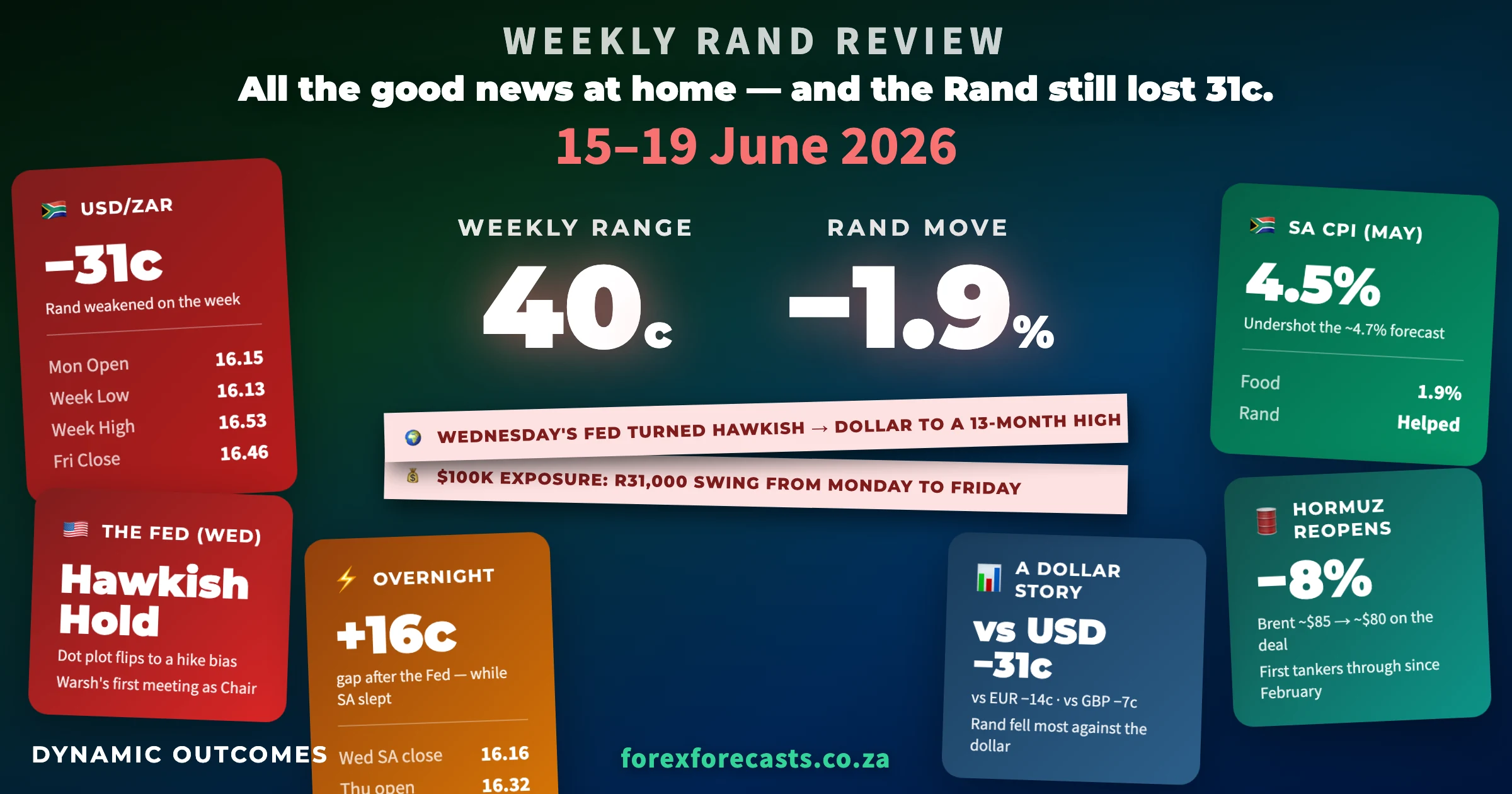
Some weeks the Rand's story is written at home. This was not one of them.
South Africa had as good a week as it could ask for – a signed Iran deal, the Strait of Hormuz reopening, cheaper oil, an inflation number cooler than feared.
And the Rand lost thirty-one cents anyway.
Because none of it was about us. A new Fed chair drew a hawkish line in Washington, the dollar took off, and the Rand got out of its way.
Here's how it played out.
Key Moments (15–19 June 2026)
A few of the major headlines and events over the past five days:
🌍 A New Fed Chair Drew the Line. Kevin Warsh chaired his first meeting – and what the new man signalled caught the whole market off guard.
🛢 The Strait of Hormuz Reopened. A signed US-Iran deal sent the first tankers through in months – and oil tumbling with them.
🇿🇦 SA Inflation Came In Cooler Than Feared. Wednesday's number undershot the forecast – a quiet bit of home-grown good news, hours before Washington had its say.
🇺🇸 The Dollar Hit a 13-Month High. One shift in tone out of Washington outweighed every piece of good news South Africa produced.
🏦 A Central-Bank Super-Week. The Bank of Japan hiked to a thirty-one-year high and three more held the line – the developed world's rate-cutting era is, for now, on pause.
Monday: A Firm but Heavy Open 📈
Monday picked up where the prior week left off, with the Rand still trading from a position of strength.
The unit opened at R16.15/$ and spent the morning holding its ground, helped along by a weekend headline that the United States and Iran had finally agreed a framework to end their war – the kind of news that, in a normal week, drains the risk premium out of an emerging-market currency.
But the dollar was already firm, sitting near the top of its recent range as traders squared up ahead of Wednesday's Fed decision. The Rand drifted with it, easing to R16.19/$ by the close.
Four cents weaker on the session, and barely a ripple – but the undertow was there from the first hour (the market had one eye on Tehran and the other, the more important one, on the Federal Reserve).
Tuesday: Youth Day, and the High-Water Mark 📉
Tuesday was a public holiday at home – Youth Day, the JSE dark, local desks closed – so the Rand's fate was handed entirely to offshore trading.
And offshore, it shone. With the Iran deal still feeding optimism and the dollar treading water before the Fed, the Rand pushed to R16.13/$ around midday, its strongest level of the entire week.
For a few hours the Rand had the run of things, pressing down into the low sixteens while the dollar bided its time before Wednesday's Fed. It was as good as the week would get.
Overnight, the Bank of Japan had lifted its own rate by a quarter-point to 1.00% – a thirty-one-year high – a reminder that the global tide was turning toward tighter money, not looser.
And the Rand? It closed the holiday session at R16.19/$, a couple of cents firmer, having quietly marked the best number it would see all week before anyone in Johannesburg was back at a desk.
That high-water mark would matter – because from here, every move ran the other way.
Wednesday: The Calm Before the Fed 📉
Wednesday split neatly in two: a quiet, constructive South African morning, and a Washington evening that rewrote everything.
At 10:00 SAST, Stats SA reported that consumer prices rose 4.5% in the year to May, up from 4.0% in April but comfortably below the 4.7%-plus the market had braced for. Food inflation fell to 1.9%, near multi-year lows, and the overshoot that did show up was almost entirely a fuel story.
For a market bracing for worse, a cool number is a quiet relief. The Rand held its ground through the local session, closing the SA day firm at R16.16/$ – still camped near its weekly best.
Then the South African desks went home, and at 20:00 SAST the Federal Reserve spoke.
The decision itself was no surprise – rates held, unanimously, for a fourth straight meeting...
...the shock was in the projections. The Fed's own dot plot – the chart of where policymakers expect rates to go – flipped to signal a rate hike for the first time since 2022, with most officials now pencilling in higher rates, not lower, by year-end.
And presiding over it for the first time was the new chair, Kevin Warsh, who used his opening press conference to plant a flag: the commitment to deliver price stability, he said, was "strong, unanimous and unambiguous."
The market heard a hawk. The dollar surged, Treasury yields jumped, and the Rand – which had closed its local day at R16.16 – was trading above R16.40 within a couple of hours, while South Africa slept.
The good number at home never stood a chance against the change of tone abroad.
In Other News 🌍
The Week the Strait Reopened 🌍
The single biggest event of the week was not a price at all – it was a signature. After nearly four months of the Strait of Hormuz being effectively shut, the United States and Iran put their names to a fourteen-point agreement, and Washington lifted its naval blockade of the world's most important oil chokepoint.
The effect was immediate. The first Saudi supertankers transited the Strait since February, two Iranian vessels carrying 3.8 million barrels slipped out behind them, and Brent crude – which had opened the week near $85 a barrel – slid toward $80, a fall of more than 8% as the war premium drained away.
For an oil-importing economy like South Africa, that is unambiguously good news – precisely the kind of relief that usually lifts the Rand. The catch is that the deal is fragile.
Fresh fighting between Israel and Hezbollah in Lebanon nearly derailed the talks mid-week, and Trump publicly chided the Israeli prime minister to be "more responsible." Until the peace holds, the Rand's path still runs through the Gulf – but this week, for once, the Gulf was the good part.
A Central-Bank Super-Week 🏦
If the Fed set the tone, it had plenty of company. This was one of the busiest central-bank weeks of the year, and almost all of it pointed the same way.
The Bank of Japan kicked things off on Tuesday with that hike to a thirty-one-year high. By Thursday the Bank of England had held at 3.75% – though two of its members wanted a hike – while the Swiss National Bank held at zero and Norway's Norges Bank stood pat too (when two of a central bank's own members are voting against it, that is an institution arguing with itself).
The message running underneath all of it was consistent: the era of cutting is, for now, on pause across the developed world. A dollar earning more carry, in a world where everyone else is holding or hiking, is a hard thing for a high-yield currency to fight – and the Rand spent the back half of the week proving it.
South Africa's Quiet Good News 🇿🇦
Beneath the noise, the home front actually delivered. Wednesday's inflation undershoot was the headline, but there was a second gift on the way: from 1 July, the temporary fuel-levy relief expires – and yet, with oil falling and the Rand's earlier strength still in the tank, motorists are forecast to pay roughly R2.65 a litre less for petrol, not more.
Cheaper fuel feeds straight into next month's inflation read, and a softer inflation path is exactly what the Reserve Bank wants to see before its next decision in late July.
It was a genuinely decent week for the South African story. It simply ran into a bigger one.
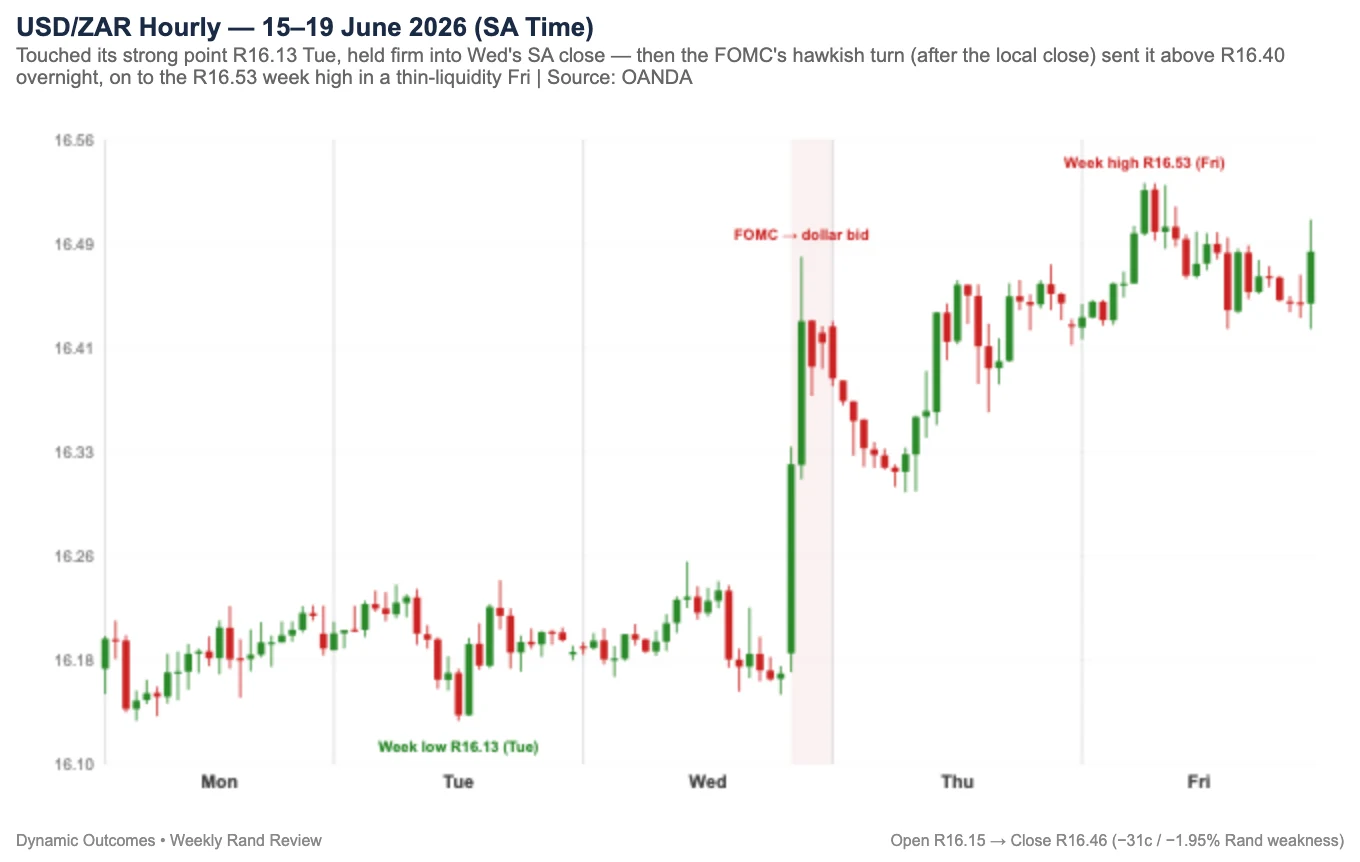
USD/ZAR hourly, 15–19 June 2026 (SA time) · the Rand's high-water mark at R16.13 on Tuesday, the break higher after Wednesday's Fed decision, and the drift to R16.53 into a thin Friday (OANDA)
To get back to the Rand...
...because for all the good news sitting at home, the week came down to what the dollar did once the Fed had spoken.
Thursday: The Dollar's Verdict 📈
Thursday was where the damage was counted.
The Rand opened at R16.32/$ – already sixteen cents weaker than where it had closed the local day on Wednesday...
...the entire gap had opened overnight, while the Fed's message sank in and the South African desks were dark. There was no single shock to react to on the day; there was simply a dollar that had found a new gear and an emerging-market currency on the wrong side of it.
The greenback pushed to its highest level in thirteen months as the rate-differential story reasserted itself, and the run of central-bank holds across Europe did nothing to stand in its way. The Rand leaked steadily through the session, with no domestic data to lean on and a global mood that had turned cautious.
And the Rand? It closed at R16.44/$, twelve cents weaker on the day – the worst single session of the week, and confirmation that Wednesday's quiet local optimism had been completely overrun.
Friday: Thin Air, Higher Still 📉
Friday was always going to be quiet – the United States was closed for the Juneteenth holiday, bonds and equities both shut, liquidity thin on the ground.
In that thin air the Rand drifted to its weakest point of the entire week, touching R16.53/$ in early trade before steadying. With no US session to drive direction, the move had the feel of momentum running its course rather than fresh selling.
By the close it had clawed back a few cents to finish the week at R16.46/$ – off the lows, but a long way from where it had started the week up at R16.13.
It was a quiet end that changed nothing about the verdict. The Rand had gone into the week strong and come out of it thirty-one cents weaker, with almost the whole of the move stamped in the hours after Wednesday's Fed decision (four days of the week were a sideshow; one Wednesday evening in Washington was the whole story).
Volatility & Risk Analysis
Thirty-one cents of Rand weakness in five trading days – and, unusually, almost none of it during South African business hours...
...the bulk of it opened up overnight, in the dark hours after Wednesday's close, when the Fed spoke to a market that South Africa could only read about the next morning.
Open to Close Move: the week opened Monday at R16.15/$ and closed Friday at R16.46/$ – 31 cents of Rand weakening (1.95%).
Risk per $1 Million Exposure: R310,000
Average Daily Range: 16 cents, the quietest week of 2026 by this measure. The week was calm at both ends and violent only in its Wednesday-night middle.
Risk per $1 Million Exposure: R160,000
Maximum Single-Day Move: Wednesday's 33-cent range (R16.15 up to R16.48). Almost all of it came after the local close, as the Fed decision detonated overnight.
Risk per $1 Million Exposure: R330,000
Weekly Range: 40 cents (R16.13 low to R16.53 high) – a 2.5% swing top to bottom.
Risk per $1 Million Exposure: R400,000
To put that in practical terms: an importer who bought $100,000 at Monday's R16.15 open rather than Friday's R16.46 close saved roughly R31,000 – this week the early buyer was the winner, the exact mirror of last week. For an exporter, the maths ran the other way: dollars sold into Friday's weakness fetched about R31,000 more per $100,000 than the same dollars on Monday.
The edge, as ever, sat in the timing – and this week the timing was set in a single evening that most of the local market slept through.
The Week Ahead
After a week decided abroad, the days ahead hand the Rand a lighter calendar at home and a heavier one in the United States.
At home, the data thins out after this week's inflation read. The focus shifts to the 1 July fuel-price announcement – a petrol cut now looks likely – and to whether the cooler May inflation number begins to shift the tone ahead of the Reserve Bank's next decision in late July. With the repo rate already at 7.00%, a softer inflation path is the case for patience.
On the US side, markets reopen after the Juneteenth break, building toward the Fed's preferred inflation gauge – the May core PCE reading. After a dot plot that just turned hawkish, every tenth of a point in that number will be read for whether a 2026 hike is genuinely back on the table.
Globally, the durability of the Iran deal is the swing factor. A peace that holds keeps oil soft and gives the Rand room to breathe; any breakdown in Lebanon puts the war premium straight back into crude. Watch the oil price as closely as any data release.
Until next week – to your success~
James Paynter
This week was a reminder that the Rand's direction is set far from home – and that the only real protection against a dollar move you didn't see coming is knowing where the currency is structurally headed before the week begins. That is what 21 years and over 8,750 scored Rand forecasts at 72.3% average accuracy are built on – not a promise the Fed will never surprise, but a disciplined read of where the Rand is going and the lines that tell you the moment it changes.
See the latest USD/ZAR forecasts at Strategic Rand.
Want the full Rand cycle picture?
Register Free for Rand ForecastsHow much extra have you been paying in fees and spreads? FX savings calculator