US Inflation Came In Hotter Than Expected...
...and the Rand Felt Every Cent of It.
Published 18 May 2026
Heading into this week, the Short-Term Update had a clear directional call: the Rand was expected to strengthen further, with a target zone of R16.22–R15.93 in sight. Last week had already brought the Rand to a low of R16.22 – right at the top of that zone – before a mild bounce back to R16.35.
This week, it gave it all back.
A hotter-than-expected US inflation print on Tuesday changed everything. CPI came in at 3.8% year-on-year – well above the 3.7% forecast. PPI on Thursday was even worse.
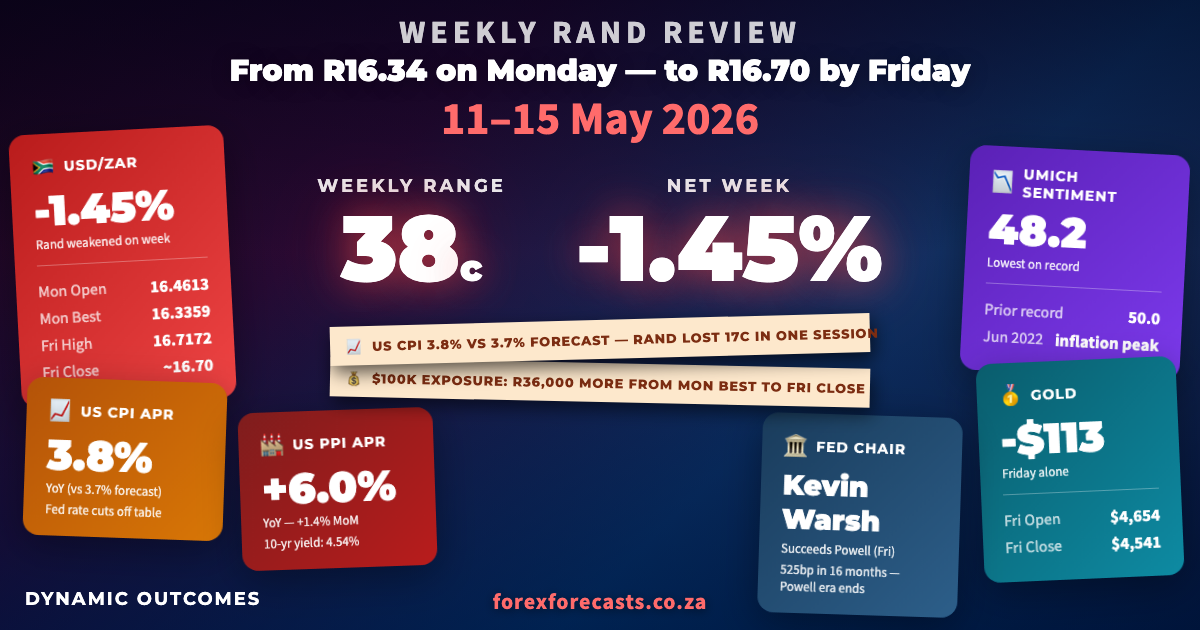
By Friday close, the Rand was sitting at R16.70/$. Thirty-eight cents weaker than Monday morning's best level.
Key Moments – May 11–15, 2026
- US CPI came in at 3.8% YoY on Tuesday – above the 3.7% forecast. Fed rate cut expectations for 2026 collapsed overnight.
- PPI on Thursday landed at +1.4% MoM, +6.0% YoY – amplifying the inflation shock. Treasury yields surged, the 10-year hitting 4.54%.
- UMich Consumer Sentiment hit 48.2 Friday morning – the lowest reading on record, surpassing the June 2022 inflation-peak low of 50.0.
- Jerome Powell's tenure as Fed Chair ended Friday. Kevin Warsh steps in, his first week at the helm already under scrutiny.
- The USDZAR moved from a Monday low of R16.34 to a Friday high of R16.72 – a 38-cent reversal over five trading sessions.
- Gold fell over $113 on Friday alone, from $4,665 at the open to $4,541 at the close – a sharp reversal after a resilient week.
Monday: The Week Starts on the Front Foot 📈
The Rand kicked off the week with genuine momentum.
With the Short-Term Update still pointing lower – target R16.22–R15.93, next leg imminent – Monday looked like it was going to cooperate.
The backdrop was still constructive. Washington and Beijing had agreed to a temporary tariff pause the prior week – dropping the headline rate from 145% down to 30% – and that risk-on mood hadn't fully faded. Global equities were holding up. The Dollar wasn't surging. SA's external picture wasn't deteriorating. For one session, the bears had nothing to feed on.
The Rand opened at R16.46/$ and drifted lower through the morning session, testing R16.34/$ at its best. That's not a number that makes headlines.
But it is the level that, by Friday afternoon, would look like a distant memory.
It gave the bulls something to work with. R16.34 would prove to be the strongest level of the entire week. For an importer who locked in at that level versus someone who waited until Friday – the cost difference was R36,000 per R100,000 of USD exposure.
Monday closed at R16.37/$. The week was still to come.
Tuesday: The Number That Changed Everything 📉
The week turned on a single data point.
US CPI for April was released on Tuesday morning. Markets had positioned for a reading of 3.7% year-on-year – roughly in line with the prior month's trajectory and consistent with the "slow progress" narrative the Fed had been managing.
Instead, CPI came in at 3.8%.
One decimal point. That's all it was.
But here's what that decimal point meant: the Federal Reserve had been nudging markets toward the possibility of rate cuts in the second half of 2026. A hotter-than-expected inflation read doesn't just push that timeline out – it pulls the rug from under the entire rate-cut narrative. And when US rate cuts get pushed out, the Dollar strengthens...
...because global capital doesn't leave USD-denominated assets if the yield stays attractive.
The DXY – the Dollar index – surged. Treasury yields followed. The 10-year US bond yield pushed toward 4.54%. The 30-year was testing above 5%.
The Rand opened Tuesday at R16.43/$ and closed at R16.51/$ – an 8-cent move driven by a single US data release 14,000 kilometres away.
This is exactly why watching the US economic calendar matters as much as anything happening in Pretoria or Johannesburg.
Tuesday's CPI had moved the Rand 8 cents in a session. Thursday's PPI would confirm whether that was the direction – or an overreaction.
Wednesday: A Bounce – But Read It Carefully 📊
Wednesday offered a brief respite.
The Fed released the minutes from its most recent meeting, and while the tone remained unmistakably hawkish – the "higher for longer" framework firmly intact – markets had already absorbed the worst of the shock. The initial CPI reaction had done its damage. Wednesday felt like the market catching its breath.
The Rand opened at R16.51/$ and drifted lower through the session, closing at R16.43/$ – recovering around 9 cents off Tuesday's close. A meaningful move in the right direction. R16.43 is still weaker than Monday's best level – but the market showed it wasn't going to move in one direction without at least pausing for air.
Wednesday's pattern was telling, though...
...the bounce was technical, not fundamental. The underlying forces – US inflation above forecast, rising yields, a hawkish Fed – hadn't changed. What changed was the speed of the move, not the direction. Wednesday's recovery was rented, not owned.
That distinction matters.
Thursday: The Second Punch 💥
Thursday confirmed what Wednesday's bounce was: a false floor.
PPI data hit the wire. April's Producer Price Index came in at +1.4% month-on-month. Year-on-year: +6.0%.
PPI matters because it leads CPI. If producers are paying more for inputs, those costs eventually work their way through to consumers – and Tuesday's CPI reading had already shown us where consumers were sitting. Thursday's PPI told the market there's more where that came from.
It wasn't just one hot print. It was two consecutive data points, pointing the same way.
Treasury yields resumed their climb. The 30-year pushed back above 5%. The 10-year was sitting at 4.54% by end of day. Bond markets were sending a clear and consistent message: inflation isn't beaten, and the Fed isn't going anywhere in a hurry.
The Rand drifted weaker again, closing at R16.49/$. Not dramatic on its own – but R16.43 on Wednesday, R16.49 on Thursday. Each close incrementally higher (weaker) than the last, pressure building beneath the surface.
The South African political backdrop added a layer of noise. The Constitutional Court's May 8 ruling on the Ramaphosa impeachment proceedings was generating headlines domestically – and when the Dollar is surging on inflation data, domestic political uncertainty is the last thing the Rand needs.
Petrol was sitting at R26.63/litre. Load shedding was still absent, 360-plus days and counting. The domestic picture was better than the market was giving it credit for.
But against a surging Dollar and rising yields? Better-than-expected domestic data can only do so much.
Friday: Powell's Last Day – and the Final Move 🔴
Friday delivered the week's biggest move.
It was Jerome Powell's final day as Federal Reserve Chairman. His tenure – 525 basis points of rate hikes in 16 months, the fastest tightening cycle in four decades – ended with bond markets still unsettled, inflation above target, and a successor about to inherit a complex hand.
Kevin Warsh takes over. His first public communications as Chair will be studied very carefully.
Then came the University of Michigan Consumer Sentiment Index – a read on how ordinary Americans are feeling about the economy.
The reading: 48.2. The lowest on record – below the 50.0 low hit in June 2022, at the peak of that inflation cycle.
Not a soft print. Not a miss by a few tenths. A record. That's the kind of number that signals something deeper than ordinary uncertainty – it reflects tariff anxiety, inflation fatigue, and rising mortgage and credit costs all converging at once.
The Rand opened Friday at R16.49/$...
...and then it moved.
By late morning, it had pushed to a high of R16.72/$. That's the weakest level of the week – and well above where Monday had started. The Dollar strength, the yield pressure, the weak sentiment read – everything compounded on the same day.
It pulled back slightly into the close, settling around R16.70/$. But the damage was done.
From Monday's best of R16.34/$ to Friday's high of R16.72/$ – that's a 38-cent swing in five trading days.
To translate that:
An importer buying $100,000 worth of product, paying at R16.34 on Monday morning versus R16.70 on Friday afternoon: that's R36,000 more in cost. Same product. Same quantity. One week apart.
On $1 million of USD exposure: R360,000.
This is not abstract. This is the real cost of timing, or the absence of it.
Volatility & Risk Analysis
Open to Close Move: R16.46 Monday morning to R16.70 Friday close – 24 cents (1.5%).
Risk per $1 Million Exposure: R240,000
Average Daily Range: roughly 16.7 cents for the week.
Risk per $1 Million Exposure: R167,000
Maximum Single-Day Move: Friday, when the Rand pushed from R16.49/$ at the open to R16.72/$ at the high – 23 cents.
Risk per $1 Million Exposure: R230,000
Weekly Range: 38.1 cents (R16.34 Monday low → R16.72 Friday high) – a 2.3% swing top to bottom.
Risk per $1 Million Exposure: R381,000
For importers, Monday's session offered the week's best level. R16.34 at Monday's low was the most favourable rate of the entire week. Friday's high of R16.72 was the worst. The gap between those two moments: R36,000 per $100,000 of exposure. Those working with a framework that flagged Monday as the window had a meaningful structural advantage.
In Other News 🌍
Gold
Gold had a rough Friday – and it deserves its own paragraph.
Gold had been holding up remarkably well through most of the week's inflation and yield noise. The precious metal has been one of the standout assets of 2026, driven by central bank buying, US debt sustainability concerns, and a broad consensus that the Dollar-dominant world order is slowly being repriced.
Friday changed the mood.
As the Dollar surged and yields climbed, gold felt the squeeze. From an open of $4,654, it traded to a high of $4,665... and then collapsed to a low of $4,511, closing at $4,541. That's a fall of over $113 from open to close – in a single session.
For South Africa, gold's direction matters. The JSE mining index feels every major gold move, and that sentiment feeds into the broader currency picture. Worth watching next week whether the $4,511 level holds as support – or whether Friday's move accelerates.
Bitcoin
Bitcoin came into the week at elevated levels and held up better than most expected through the risk-off Friday session.
Sitting around $80,832 as the week wrapped, Bitcoin was down modestly on the week but far from the kind of collapse that previous Dollar-surge episodes had triggered. Whether that's a sign of a maturing narrative – Bitcoin as a macro hedge – or simply a quiet week in crypto markets is a debate for another day.
Interesting, isn't it?
Bitcoin held its ground while gold dropped $113 in a single session. Markets are never boring for long.
The Week Ahead
Two things to watch closely next week.
The SARB MPC meets May 28, with markets currently pricing a possible 25 basis point rate hike. That would take the repo rate from 6.75% to 7.00%. A rate hike in the middle of Rand weakness is a double-edged sword – higher rates can support the currency, but they also cool an already sluggish economy. The SARB will be navigating a narrow path.
Kevin Warsh's first public communications as Chair will set the tone. Any shift from the "higher for longer" framework – or any hint of a different read on Tuesday's CPI and Thursday's PPI – will move markets. Few Fed appointments in recent memory have stepped into a week this loaded with expectation.
The data this week made it clear: the inflation battle isn't over in the US, and the Rand remains exposed to every twist in that story.
That's exactly what the forecasts are designed to navigate. I'll be back with the next Short-Term Update before Wednesday.
Until then – to your success~
James Paynter
Want the full Rand cycle picture?
Register Free for Rand Forecasts