Peace Talks Collapsed...
...Then Hope Returned – and the Rand Had Its Second-Best Week of 2026
Published 20 April 2026
It looked like the worst possible start to the week...
...and ended as the Rand's second-best performance of 2026.
The Iran peace talks that markets had been banking on fell apart over the weekend, and by Sunday night Trump had ordered a full US naval blockade of Iranian ports. Monday morning opened with Rand selling, oil surging, and safe-haven demand flooding back into the Dollar – the kind of start that usually sets the tone for the rest of the week.
And then something shifted.
By Wednesday the ceasefire was back on the table, by Thursday Trump was calling the war "very close to over" – and although the market spent one more day testing Iran's resolve before it believed him, Friday was when the real move arrived. The Rand gained another 33 cents against the Dollar in the space of an afternoon, wiping out Monday's losses and then some.
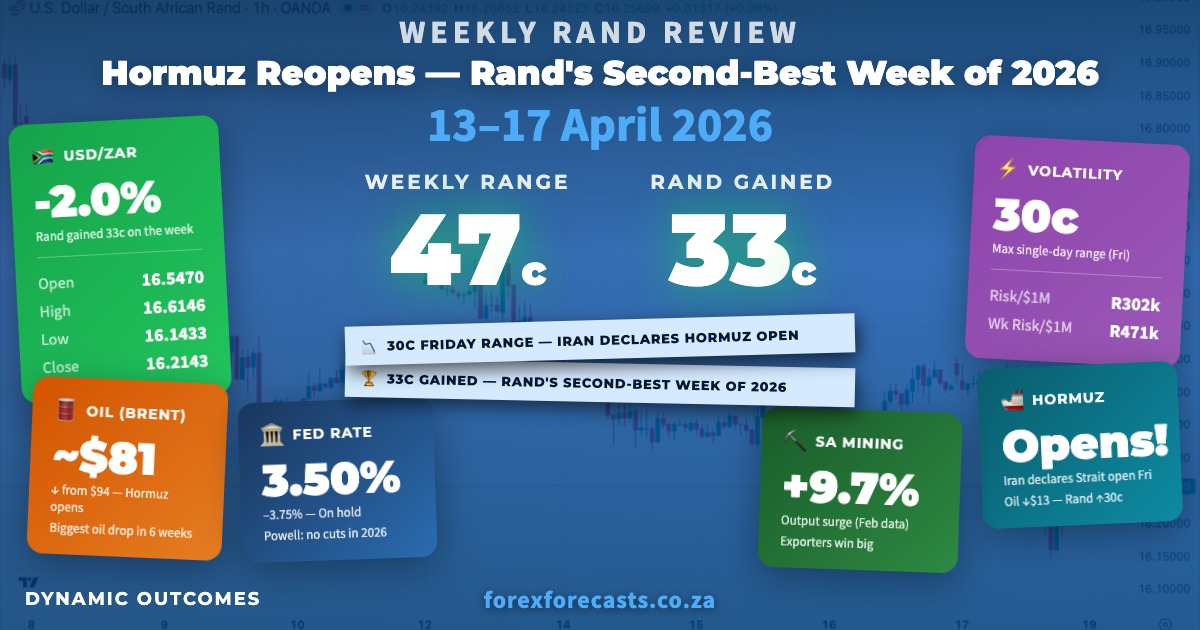
The result: a second consecutive week of Rand strength – R16.5470/$ on Monday's open, closing Friday at R16.2143/$.
(Oh – and Julius Malema was sentenced to five years in prison on Thursday, which in any other week would have been the lead story. Just another week in South Africa.)
Here's what happened...
Key Moments (13 – 17 April 2026)
🚨 Iran Peace Talks Collapse – Blockade Announced: Weekend talks in Islamabad produced no agreement, and Trump ordered a US naval blockade of Iranian ports from 13 April. Oil supply fears spiked.
🛢️ Araghchi Declares Hormuz Open – Rand's Best Single Session of 2026: Iranian FM Araghchi declared the Strait "completely open" Friday, Brent fell from ~$94 to ~$81, and the Rand surged 30 cents in under four hours (iran re-closed the Strait on Saturday after Trump confirmed the US blockade remained in effect – the ceasefire remains unresolved going into this week).
⚖️ Malema Sentenced to 5 Years: EFF leader Julius Malema handed a five-year prison sentence Thursday for unlawful firearm possession – the biggest SA political story of the year so far (he immediately applied for leave to appeal, which was granted; he's out on bail and retains his parliamentary seat while the appeal runs, but the sentence itself stands for now).
🇿🇦 SA Domestic: Mining output up 9.7% year-on-year (the strongest monthly print in over a year, with PGMs leading), and SA also locked out of the G20 Finance Ministers' meeting in Washington.
🇺🇸 US Data: PPI +4.0% YoY (fastest since 2023) alongside Retail Sales +0.4% MoM – the Fed holds, Powell confirms no cuts in 2026, and the S&P 500 hit fresh all-time highs on two consecutive days on Iran optimism.
Monday: Bearish Open, 11c Recovery 📈
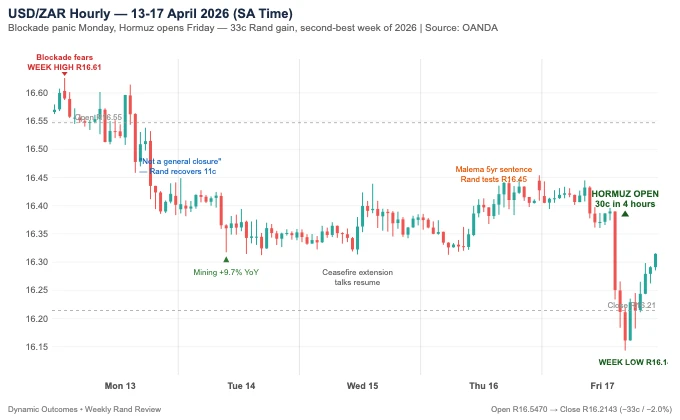
Monday opened at R16.5470/$...
...and immediately the week looked ominous, with the Islamabad peace talks having collapsed over the weekend and Trump announcing a US naval blockade of Iranian ports effective Monday morning.
Oil surged, the Dollar caught haven bids, and emerging market currencies – the Rand included – took the brunt of the initial selling.
The pair pushed up toward R16.60 in early trading, testing intraday resistance (the session high of R16.6146 was struck in the London open – the week's weakest Rand level). But the selling pressure was contained, and with the Rand having entered the week from a position of strength, support held around the R16.54–R16.56 zone through most of the London session.
Then the afternoon brought a different story. Equities recovered as traders started digesting a detail about the blockade that most of the headline coverage had missed: the US was allowing all ships through the Strait – except Iranian ones. This wasn't a general closure of global oil supply; it was a targeted financial squeeze on one country.
That distinction matters, and by mid-afternoon the market had started to price it in. The Rand stabilised, drifting back to close the day at R16.4351/$.
An 11.2-cent gain on the day, despite the seemingly bearish open (the daily range of 23.1 cents tells the full story of how much ground was covered and recovered).
Tuesday: Mining Data Lifts the Rand 📉
Tuesday opened at R16.4070/$...
...and the domestic picture improved, with Stats SA releasing South Africa's February mining production figures: up 9.7% year-on-year, comfortably ahead of expectations.
The story behind the number is a China one. China has been aggressively stockpiling platinum group metals – a function of both energy transition demand and a hedge against supply disruptions from the ongoing Middle East conflict – and South African miners have been shipping into that demand. February's output simply reflects it.
For the Rand, strong mining data is supportive in two ways: it reflects healthy export revenues in hard currency, and it signals that the SA economy's structural base is holding even as global conditions tighten.
Elsewhere, China released its March trade data: exports missed estimates (+2.5% YoY versus an 8.6% forecast), but imports surged +27.8% – the fastest pace since 2021. That import surge matters for SA, because it signals Chinese domestic demand is absorbing more globally – including South African commodities.
The Rand tested R16.3124 during the session before pulling back to close at R16.3516/$ – a 5.5-cent gain on the day.
Wednesday: Ceasefire Talks Restart ⚖️
Wednesday opened at R16.3481/$...
...and gave back a small slice of Tuesday's gains, but the key story wasn't what happened in the market – it was what was being discussed in diplomatic back-channels.
Reports emerged that the US and Iran were weighing a two-week extension to the ceasefire, which was due to expire April 22. The framework: allow more time for technical talks on the most contentious sticking points – the status of the Strait of Hormuz and the nuclear programme.
Markets are forward-pricing machines, and the mere possibility of extension was enough to keep oil in check (Brent holding around $94/barrel mid-week) and risk appetite stable. The S&P 500 hit a fresh all-time high for the second consecutive day.
US data added context but not direction. Retail sales for March came in at +0.4% month-on-month – the sixth consecutive monthly gain, driven partly by higher-than-average tax refunds – while US PPI for March printed at +0.5% MoM, +4.0% YoY, the fastest 12-month wholesale inflation pace since 2023.
These numbers cement the Fed's "wait-and-see" stance. No cuts coming – and Powell confirmed as much at Harvard earlier in the week, reiterating that the Fed will stay the course on 2% inflation regardless of tariff pressure or geopolitical noise.
The Rand drifted slightly to close Wednesday at R16.3688/$ – a 2.1-cent softening on the day. A consolidation after three days of gains, but the bigger picture was still intact.
In Other News 🌍
And in other news...
SA Blocked at the G20 Table 🌍
This one barely moved the Rand – but it made headlines across the world.
South Africa's Finance Minister Enoch Godongwana and SARB Governor Lesetja Kganyago were denied accreditation for the G20 Finance Ministers' meeting in Washington (17-19 April). The US refused to recognise their credentials, effectively locking Africa's only G20 founding member out of the forum for the remainder of 2026.
SA's International Relations directorate called it "a formal breach of G20 regulations." Germany's BNC meeting with SA (held Monday) produced a statement of support, and France said it would raise the issue formally.
But the ANC-led government has no-one to blame for this but itself. Years of deliberate (and increasing) alignment with communist and authoritarian regimes, while simultaneously expecting no consequences from historical Western allies was always a fantasy.
The G20 snub is what that fantasy looks like when reality finally catches up.
Finance Minister Godongwana's response? He told reporters he'd be taking a holiday instead.
SA rejoins when the UK takes over the G20 presidency in November – assuming nothing further deteriorates between now and then.
And the Rand? It barely flinched – because the market priced all of this in long ago. The exclusion didn't reveal new information; it just made visible what the capital flows had already decided.
Powell at Harvard: The Fed Isn't Moving 🏦
Federal Reserve Chair Jerome Powell spent Monday speaking to Harvard undergraduates – and the message was the same one he's been delivering since January.
The Fed remains committed to 2% inflation – tariffs treated as "transitory" until proven otherwise, and the Iran war filed under "elevated uncertainty" rather than a rate-cut trigger. Rate cuts? Not this year – futures now price the first cut in October at the earliest.
And the Rand? A higher-for-longer Fed means the dollar stays relatively firm as the baseline, so any strength from here has to be earned by SA-specific factors. And this week – between the mining data, the gold tailwind, and the Iran ceasefire hopes – those factors delivered.
Trump's Checkmate: Why the Iran Blockade Is a Trap Iran Can't Escape 🎯
Step back from the daily price moves for a moment – because once you see the strategic picture, the Rand's week makes complete sense.
The US naval blockade is not a general closure of global oil supply. It targets Iran alone. Non-Iranian ships transit the Strait freely; only Iranian-flagged vessels and Iranian-origin cargo are stopped. That detail – which the initial panic headlines largely missed – is why the Rand recovered Monday afternoon once traders understood what they were actually dealing with.
But here's the deeper logic most commentators haven't caught up to yet.
If Iran agrees to US terms – no nuclear programme, open inspections, reduced regional proxies – the blockade ends, oil flows again, Trump claims the foreign policy win of his presidency, markets cheer, and the Rand strengthens.
If Iran refuses, the weeks accumulate – and the global energy supply chain adapts, with US producers filling the gap. Around 100 tankers have already been repositioned off the American coastline, ready to replace Iranian supply on short notice. Every week Iran holds out is another week the world learns to function without Iranian oil – permanently.
The longer Iran waits, the less leverage they have when they finally do come to the table.
Friday's Rand move suggests the market is beginning to price in exactly this dynamic – not "will Iran deal?" but "both outcomes are manageable now." That realisation, when it crystallises, drives the risk premium out of oil and the safe-haven premium out of the Dollar simultaneously.
It is starting to look like a classic Trump 4D chess move...
...stumping those who thought he didn't have a plan.
To get back to the Rand...
Thursday: Markets Doubt, Rand Softens 📈
Thursday opened at R16.3263/$...
...and the session shifted tone, as the market began asking a question it had been avoiding: could Iran actually hold out?
For three days, markets had treated the blockade as a short-term squeeze – something Tehran would resolve at the table within weeks. Thursday was the day that assumption wobbled. Reports circulated of Iran hardening its public position and moving additional naval assets in the Gulf, and some analysts began questioning how long the blockade's enforcement would actually hold.
The result: Dollar safe-haven demand ticked back, and the Rand – which had spent Tuesday and Wednesday pushing multi-week lows on USDZAR – gave up ground as the "ceasefire imminent" trade partially unwound.
What the market hadn't yet priced in – the insight that would drive Friday's explosion – was the strategic endgame: both outcomes favour the US, and that realisation was still 24 hours away.
Thursday closed at R16.4234/$ – a 9.7-cent Rand weakening on the day.
For exporters (those selling Dollars), Thursday's drift back toward R16.43 provided the week's best execution window outside of Monday morning's brief test of R16.60.
Friday: Hormuz Opens, Rand Surges 📉
Friday opened at R16.4192/$...
...and was running quietly through the morning session – then 14:00 SA time arrived, and the Rand fell off a cliff.
In a single hour – 12:00 to 13:00 UTC – the pair dropped from R16.39 to R16.25, a 14-cent move in 60 minutes, and by 14:00 UTC the weekly low of R16.1433/$ had been struck.
What triggered it?
Iranian Foreign Minister Abbas Araghchi declared the Strait of Hormuz "completely open" to all commercial vessels, and the market took it at face value. Brent crude fell from ~$94 to ~$81 through the session – the biggest single-day drop in six weeks – and with it went every dollar of safe-haven premium that had been priced in since Monday's open.
(Trump later clarified the US blockade remained in effect, and Iran re-closed the Strait on Saturday. But on Friday afternoon, the market moved on Araghchi's words – not Trump's clarifications.)
The market was finally starting to process the strategic endgame – both outcomes of the Iran standoff are manageable – and it repriced in a matter of hours.
The Rand recovered some ground into the close, because when moves of this magnitude happen, profit-taking is inevitable. The pair stabilised around R16.20–R16.24 before closing the week at R16.2143/$.
A 20.5-cent gain on Friday alone, and a 30.2-cent intraday range – the most volatile single session of the week.
For context: that weekly close of R16.2143 is the Rand's strongest level since the ceasefire week of 8-10 April – two consecutive weeks of meaningful Rand strength.
Volatility and Risk Analysis
The week's price action told two very different stories, and the statistics reflect both.
The early part of the week was contained and grinding (Tuesday's 13.7-cent range, Wednesday's 12.5 cents). Then Friday broke all the rules: a 30.2-cent single-session range, the week's entire risk premium released in a matter of hours.
For businesses managing Dollar exposure, the practical lesson is the same one we keep coming back to – the next big move rarely announces itself politely.
Open to Close Move: The week opened at R16.5470/$ Monday morning and closed Friday afternoon at R16.2143/$ – a 33.3-cent (2.0%) Rand strengthening.
Risk per $1 Million Exposure: R333,000
Average Daily Range: ~18.7 cents (1.14%)
Risk per $1 Million Exposure: R187,000
Maximum Single-Day Move: ~30.2 cents (1.84%) on Friday 17 April
Risk per $1 Million Exposure: R302,000
Weekly Range: 47.1 cents (R16.1433 low to R16.6146 high) – 2.8% swing
Risk per $1 Million Exposure: R471,000
For importers (those buying Dollars), this week delivered genuine relief – the Rand at R16.21 is significantly better than Monday's R16.55 open. If your forex strategy allows you to act opportunistically on windows like this, this is exactly the kind of week it was designed for.
For exporters (those selling Dollars), a stronger Rand means lower conversion yields, and Friday's move to R16.14 on the week's low would have been the worst execution point. Thursday's drift back toward R16.43 was the best execution window of the week.
The Week Ahead (20-24 April 2026)
SA: No major economic data releases scheduled. Watch for any further developments on the G20 exclusion and any SARB commentary on the inflation impact of April's fuel price hikes. Kusile power station at full capacity – energy stability remains a supportive backdrop.
US: Housing Starts and Building Permits (Tuesday), Existing Home Sales (Wednesday), Initial Jobless Claims (Thursday). The big event – the FOMC meeting (April 28-29) – is the following week, but expect growing pre-meeting Fed speaker commentary. Markets are pricing no change.
Global: ECB commentary ahead of the April 29-30 meeting (no ECB meeting this week). The key watch: Iran ceasefire extension – the original two-week truce expires Tuesday 22 April.
The Big Watch: The Iran ceasefire extension. Both sides have given "in principle" signals of willingness to extend – but as this week showed, the difference between a deal and a breakdown can move the Rand 33 cents. Watch Sunday night and Monday morning for any announcement.
A confirmed extension would be Rand-positive: lower oil, weaker Dollar, better risk appetite. A breakdown would reverse the week's gains quickly. Neither outcome changes the underlying structural trajectory – but it will determine whether importers get another week of opportunity below R16.30.
The Rand has now spent two consecutive weeks strengthening, trading below R16.22 on a closing basis for the first time since February.
Whether it holds depends almost entirely on what happens in the Middle East over the next seven days.
Two weeks of Rand strength doesn't make a trend – but it does make a window.
Until next week – stay sharp, stay skeptical, and don't let the headlines do your thinking for you.
To your success~
James Paynter
"Headlines tell you what happened... ...cycles tell you what's coming.
The news explains the move after the fact – ...sentiment warned you before it happened."
Want the full Rand cycle picture?
Register Free for Rand Forecasts