Jobs Nearly Doubled the Estimate – ...and the Rand Strengthened Anyway.
Published 11 May 2026
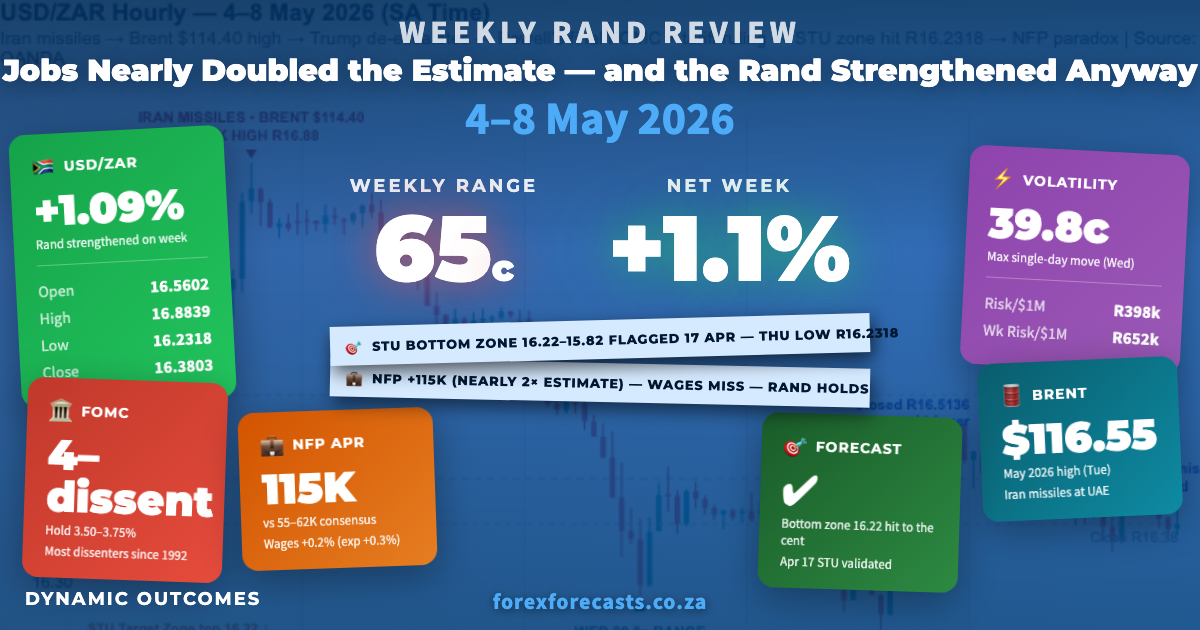
The week had everything.
Missiles at the UAE. A 2026 oil price high. A Federal Reserve chairman chairing his final meeting. A court striking down the 10% blanket tariff. And a jobs number that nearly doubled what the Street expected.
By Thursday, the Rand had touched R16.23 to the dollar – exactly the target zone we flagged back on 17 April. It opened the week at R16.53 and spent Monday retreating to R16.88.
What moved this market wasn't the data. It was the narrative – Iran, Hormuz, Powell's exit, and a court ruling that quietly rewrote the tariff arithmetic. If you've been watching with us through April, you'd have seen this set-up coming.
But first – the call we put out on 17 April.
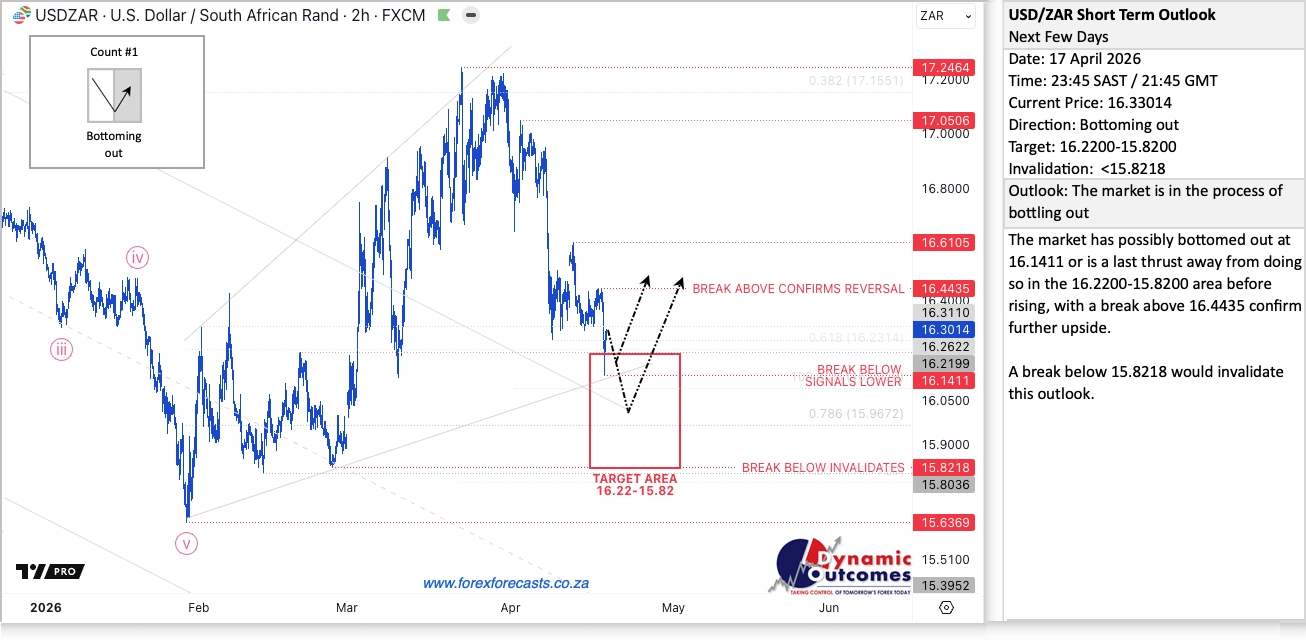
April's STU outlook flagged a potential bottom forming in the 16.22–15.82 zone, with a close above R16.4435 needed to confirm the reversal.
The April outlook flagged a potential bottom forming in the 16.22–15.82 zone, with a close above R16.4435 needed to confirm the reversal. Thursday's intraday low landed at R16.2318, with a close at R16.5136.
The market touched the top of that target zone – to the cent – and bounced. (Yes – to the cent. After twenty-one years of reading these cycles, it still surprises us when they land that precisely.)
Here's how the week played out.
Key Moments:
- Monday: Iran fires missiles at the UAE → Brent surges to $116.55/barrel (May 2026 high) → Rand weakens from R16.53 to R16.88, erasing last week's gains 📈
- Tuesday: Trump signals US escorts commercial ships through Hormuz → oil drops $7.88 from its peak → Rand recovers to R16.67 by the close 🔄
- Wednesday: FOMC sits; SA fuel prices rise; oil retreats further → Rand breaks R16.40, touching R16.28 intraday – biggest single-day range of the week 📉
- Thursday: Fed holds at 3.50%–3.75% in Powell's final meeting; court strikes down the 10% blanket tariff; Rand hits R16.23 low before closing R16.51 📈
- Friday: NFP lands at 115,000 – nearly double the 55,000–62,000 consensus – but softer wages keep the dollar contained; Rand holds around R16.38–16.41 📉
Monday 4 May: Iran Pulls the Trigger 📈
The week didn't ease in.
Before most Saffers had finished their first coffee, news broke that Iran had fired missiles at the UAE – the latest escalation in a conflict reshaping the global macro landscape since late February...
...the Strait of Hormuz, through which roughly 20% of the world's oil transits daily, was already partially disrupted. Monday's strikes pushed Brent crude to $116.55 a barrel – the May 2026 high, up 5.8% in a single session.
The textbook reaction followed: dollar firmed, risk assets sold off, and emerging market currencies that had been quietly recovering took a step back (saffers know this script – geopolitical shock, textbook risk-off, and the Rand first in line to feel it).
And the Rand? It gave back four days of gains in the space of a single session.
The Rand opened Monday at R16.53. By the session's high it had touched R16.88 – the weakest level in weeks.
Here's what the headlines missed, though: South Africa's manufacturing sector surprised on the same morning. The Absa PMI for April landed at 52.6, up sharply from 49.0 in March – the first expansionary reading since September 2025...
...and the S&P Global Manufacturing PMI confirmed the move, hitting a 44-month high at 51.6. New orders and business activity both surged.
Encouraging – but read the fine print carefully. Purchasing prices surged to 85.6 on the Absa measure, more than 30 points above where they started the year. These aren't businesses buoyed by genuine demand. They're stocking up before shelves get more expensive, front-loading orders ahead of anticipated fuel and tariff-driven price increases.
A PMI that signals expansion at the top line while screaming cost inflation underneath it is not a clean positive. It's a distorted one.
Monday closed at R16.7925.
Tuesday 5 May: Trump Changes the Script 🔄
The shift came from an unexpected direction.
By Tuesday morning, the Trump administration signalled that the US military would escort commercial vessels through the Strait of Hormuz – a direct move to stabilise oil supply regardless of Iran's next decision. Markets didn't need to hear the full plan...
...the signal alone was enough to pull Brent from $116.55 down to $106.52 across Tuesday's session. That's a $10+ drop from peak in under 24 hours.
Oil retreating does what central banks currently cannot: it eases inflation fears, lifts risk appetite, and softens the dollar in a single move.
And the Rand? It recovered 20 cents in a single session, closing at R16.6712.
Tuesday's ADP private payroll figure came in at 109,000 – ahead of the 84,000 forecast and the best reading since January 2025 (following March's weak 61,000). The employment picture that emerged was one ADP's own chief economist described as "low-hire, low-fire" – employers aren't aggressively cutting, but they're not filling roles with any urgency either. The US trade balance for March showed the deficit widening to $60.3 billion, though markets largely moved on.
Tuesday opened at R16.80 and closed at R16.67.
Intraday range: 23.1 cents.
The direction of travel was now clearly away from Monday's peak.
Wednesday 6 May: The Rand's Best Day of the Week 📉
Wednesday is where the week's real move happened.
The session opened at R16.6630 – already well off Monday's R16.88 peak – and by mid-session the Rand had pushed to R16.2800...
...a 39.8-cent intraday range in a single trading day. That is R398,000 of value per million dollars of USD exposure, moving in one direction, inside six hours.
What drove it? A combination of factors all pointing the same way simultaneously. Oil continued its retreat – Brent was approaching $100 by mid-week. The FOMC's two-day meeting had begun, and markets had already started positioning for a hold, which meant no new reasons to be long dollars. The dollar softened broadly. Emerging market currencies, battered on Monday, staged a coordinated recovery.
And the Rand? It moved further in a single Wednesday session than on any other day this week – and further than most of April's individual sessions combined.
Back home, South Africa's fuel prices rose on Wednesday – petrol and diesel both up, the hike that had been flagged for weeks finally landing. With March CPI already at 3.1% year-on-year, and FNB economists forecasting April's reading could approach 3.8% (those figures release later in May), the SARB's 28 May MPC meeting is shaping up to be more complicated than the current 6.75% repo rate suggests.
The Rand didn't care about domestic fuel costs on Wednesday – and frankly, we didn't expect it to. Global sentiment was in charge.
The close: R16.3900.
And in other news...
Gold's V-Shape: The Week's Other Surprising Recovery 🥇
Gold opened the week on the back foot.
Despite missiles flying at the UAE, gold fell more than 1% to $4,580 on Monday – its lowest since late March. The same dollar strength that hit the Rand hit gold: when the greenback surges on geopolitical shock, even safe-haven assets can get caught in the crossfire.
What happened next was the mirror image of the Rand's story...
...as Tuesday's de-escalation signal sent oil retreating, risk appetite returned, inflation fears eased, and the dollar softened. Gold reversed sharply. By Friday it had climbed back to $4,724 – up 2% on the week and heading for its highest close since late April.
The same narrative that drove the Rand's recovery drove gold's. Oil retreating does what central banks cannot: it eases inflation fears in a single move. For gold – priced in dollars and sensitive to real yields – a softer dollar and lower energy-driven inflation expectations is exactly the right combination.
Bitcoin Stalls at $82K ₿
Bitcoin touched $82,320 on Wednesday – the week's high – before giving back roughly $3,000 by Friday's close at $79,340.
The weekly candle told the story: a strong opening, a push toward $82K that failed to hold, and a close that looked more like a rejection than a breakout. Bitcoin remains caught between the same competing forces as every other risk asset this week – geopolitical uncertainty pulling one way, dollar softening pulling the other.
Thursday 7 May: The Fed Changes Hands 📈
Thursday was the week's defining session – and possibly one of the more consequential days for the dollar this year.
Jerome Powell walked into his final FOMC press conference as Federal Reserve Chairman. His term expires on 15 May. Kevin Warsh – a noted hawk during his earlier tenure at the Fed – is widely expected to succeed him, adding a new layer of policy uncertainty to an already fragile rate outlook.
The decision itself: rates held at 3.50%–3.75%. Exactly what the market expected. But the details were far from routine.
Four committee members dissented – the most since 1992...
...the statement upgraded its inflation language from "somewhat elevated" to simply "elevated," and cited the Middle East conflict as contributing to "a high level of uncertainty about the economic outlook." Powell's press conference offered no rate cut signals. The bond market, which had already priced out all 2026 cuts, had its instinct confirmed.
Neither dovish nor hawkish – a Fed that, for now, has nowhere to move.
Then, while Powell was still at the podium, news broke that the US Court of International Trade had struck down the 10% blanket universal tariff. The ruling followed the Supreme Court's February decision that the International Emergency Economic Powers Act cannot be used to impose tariffs. Roughly $166 billion in refunds now appear to be legally required.
The legal architecture of the Trump trade war was beginning to crack.
And the Rand? Another headwind for the dollar – and another tailwind for the Rand.
The Rand hit its weekly low of R16.2318 during Thursday's session – precisely at the top edge of the target zone we flagged in the April forecast. Then it bounced.
Thursday's close: R16.5136. That is above the R16.4435 level the April forecast identified as the break point for a potential reversal. Twenty-one years of reading these cycles has taught us that key levels tend to mean something. Whether Thursday confirmed the reversal or simply marked a pause in a larger move lower – for USDZAR – is what next week's price action will clarify.
Friday 8 May: The Jobs Paradox 📉
April's non-farm payrolls came in at 115,000 against a consensus that had pencilled in 55,000 to 62,000. Nearly double the Street's estimate.
Under any normal circumstances, that kind of beat sends the dollar surging and emerging market currencies running for cover.
The Rand opened Friday at R16.52 and drifted lower through the session, trading around R16.38–16.41 as of late afternoon.
But what is the reality? Average hourly earnings rose just 0.2% in April – against a 0.3% expectation. Wage growth is decelerating. The Fed's inflation problem is being driven by oil and energy, not by labour cost pressure. A strong jobs headline without wage acceleration doesn't change the calculus for a Fed that is already paralysed between its inflation and employment mandates.
The University of Michigan's May consumer sentiment reading confirmed the picture from a different angle: 48.2, a record low, driven by gas prices near their highest in years and tariff uncertainty that has yet to resolve. The American consumer is voting with their survey responses even as the payroll number holds up.
Strong hiring, falling wages, record-low consumer confidence, and a Fed that cannot cut. Sound familiar? You've just described the dollar's ceiling – and the setup that's been building since March.
That is not a bullish-dollar environment.
Volatility & Risk Analysis
Here's what the week cost in Rand terms – for anyone who didn't have a framework in place.
Average Daily Range: 32 cents, Monday through Thursday.
Risk per $1 Million Exposure: R320,000
Maximum Single-Day Move: Wednesday at 39.8 cents.
Risk per $1 Million Exposure: R398,000
Weekly Range: 65.2 cents – from R16.88 on Monday to R16.23 on Thursday.
Risk per $1 Million Exposure: R652,000
Day by day: Monday 4 May 36.8c (R368,000) · Tuesday 5 May 23.1c (R231,000) · Wednesday 6 May 39.8c (R398,000) · Thursday 7 May 28.2c (R282,000).
For importers, Monday's session offered the week's worst moment to cover – R16.88 was the highest cost of the week for buying dollars. For exporters, Thursday's R16.23 low offered the most favourable window for converting USD receipts. Those working with the levels we publish each week had a meaningful advantage.
The key risk going into next week: the Thursday bounce off R16.23 looks technically constructive, but it is entirely contingent on oil maintaining its retreat. If Iran talks collapse – or if new Hormuz disruptions emerge – expect R16.65–16.80 to come back into focus quickly.
Week Ahead
The calendar offers less in the way of scheduled data next week, but the event risk is anything but thin.
Tuesday 12 May – US CPI (April): After March's energy-driven 3.3% year-on-year reading, April's figure will tell us whether the oil-driven inflation acceleration is compounding or levelling off. This number will define whether "higher for longer" holds its grip on markets or starts to soften.
Wednesday 13 May – US Retail Sales (April): With consumer sentiment at record lows, any softness in spending will amplify recession concerns. Watch for a divergence between the strong payroll signal and the spending reality.
Thursday 14 May through Friday 15 May – Trump-Xi Summit, Beijing: The first US presidential visit to China in nearly a decade. A sixth round of US-China trade talks in Paris this week was described as "constructive." A breakthrough here – or even a credible ceasefire in trade tensions – would be a material positive for emerging market sentiment and the Rand. A breakdown would do the opposite.
Friday 15 May – Powell's last day as Fed Chairman: Kevin Warsh formally takes over. His first public signals on rates and balance sheet policy will be closely scrutinised.
Wednesday 28 May – SARB MPC decision: Not next week, but the context builds from here. With fuel prices up, April CPI tracking toward 3.8%, and global inflation risks elevated by the oil shock, the SARB faces a genuinely difficult call.
For the Rand, the levels to watch: resistance at R16.65–16.80 (Monday's territory), support at R16.23 (Thursday's low) and then R15.82 at the bottom of the April forecast target zone. What we're watching next week is whether the FOMC-and-tariff-driven Rand strength has legs – or whether a reversal of oil's retreat brings the R16.88 levels back into play faster than expected.
P.S. The April 17 STU flagged a potential bottom at R16.22–R15.82. Thursday's low came in at R16.2318 – to the cent. 8,756 Rand forecasts, 72.3% accuracy over 21 years. See the track record →
To your success~
James Paynter
Want the full Rand cycle picture?
Register Free for Rand ForecastsHow much extra have you been paying in fees and spreads? FX savings calculator