After Two Weeks Up...
...The Rand Gave 15 Cents Back as Iran's Hand Tightened
Published 27 April 2026
It was supposed to be three in a row...
...and right up until Tuesday morning, it nearly was.
Last week the Rand closed at R16.21/$ – its strongest level since February, on Friday's news that Iran had declared the Strait of Hormuz "completely open." (We wrote at the time that the market had moved on Araghchi's words, not Trump's clarifications, and that the ceasefire itself remained unresolved.)
This week answered the question.
The Strait never actually reopened. Iran seized two commercial vessels in Hormuz on Wednesday – MSC Francesca and Epaminondas – and Brent ran from $96 to $106 a barrel in five trading days (the biggest weekly move in energy since the war began).
And the Rand?
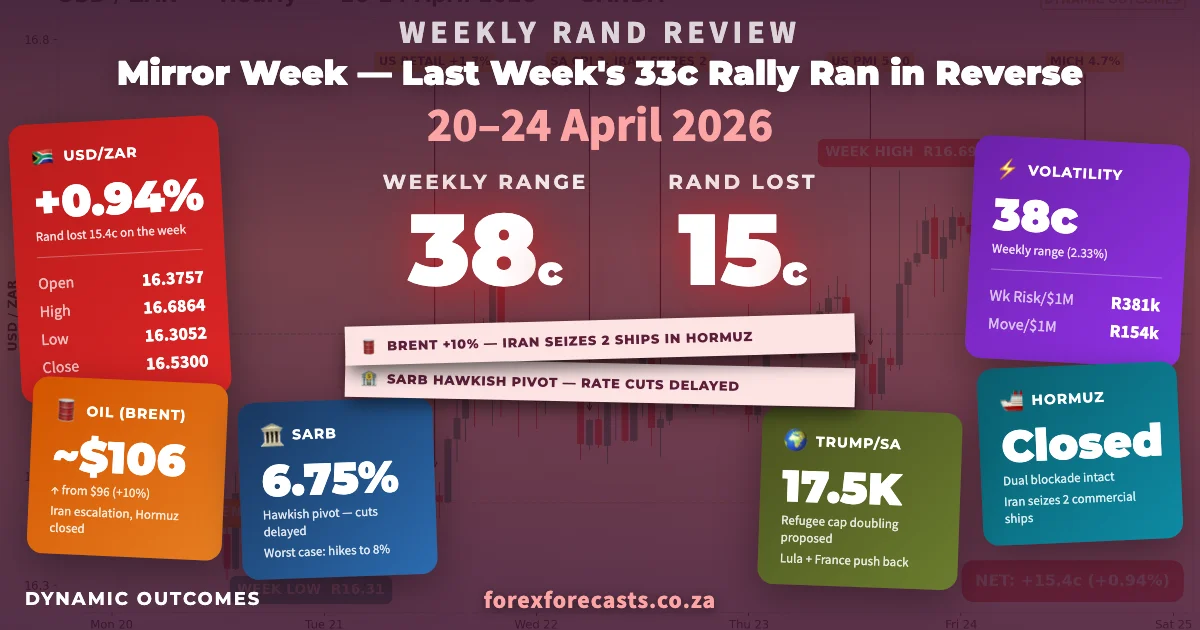
Gave back 15 of last week's 33 cents, opening Monday at R16.38/$ and closing Friday at R16.53/$.
The shorthand for the week: the mirror image of last week. Same Iran story, opposite outcome.
Here's how it played out...
Key Moments (20 – 24 April 2026)
🛢️ Brent +10% ($96 → $106) – Iran Seized Two Ships in Hormuz: Trump's Tuesday ceasefire extension was undercut Wednesday when Iran seized MSC Francesca and Epaminondas. Strait still effectively closed; oil priced in the disappointment.
🏦 SARB Monetary Policy Review – The Tone Just Hardened: Wednesday's MPR delayed the rate-cut path and outlined a worst-case scenario taking repo to 8%. A quiet pivot – but a meaningful one.
🇿🇦 SA Triple-Event Wednesday (CPI, Retail Sales, MPR): CPI undershot at 3.1% YoY vs 4.1% expected; Retail Sales missed at -1.0% MoM. Both pre-date April's fuel hike – which is why SARB's tone changed.
🇺🇸 US Retail Sales +1.7% MoM – Biggest Print Since Jan 2023: Tuesday's release drove DXY to 98.25 and triggered the week's 10-cent Rand selloff. The catch: +15.5% of the headline came from gasoline receipts, not volumes.
🌍 Trump/SA Back on the Front Pages: A rally the previous week, plus reports of a doubled refugee cap, brought the US/SA relationship back to the fore – amid some pushback from other countries.
Monday: Quiet Open, Rand's Strongest Point of the Week 📉
Monday opened at R16.38/$...
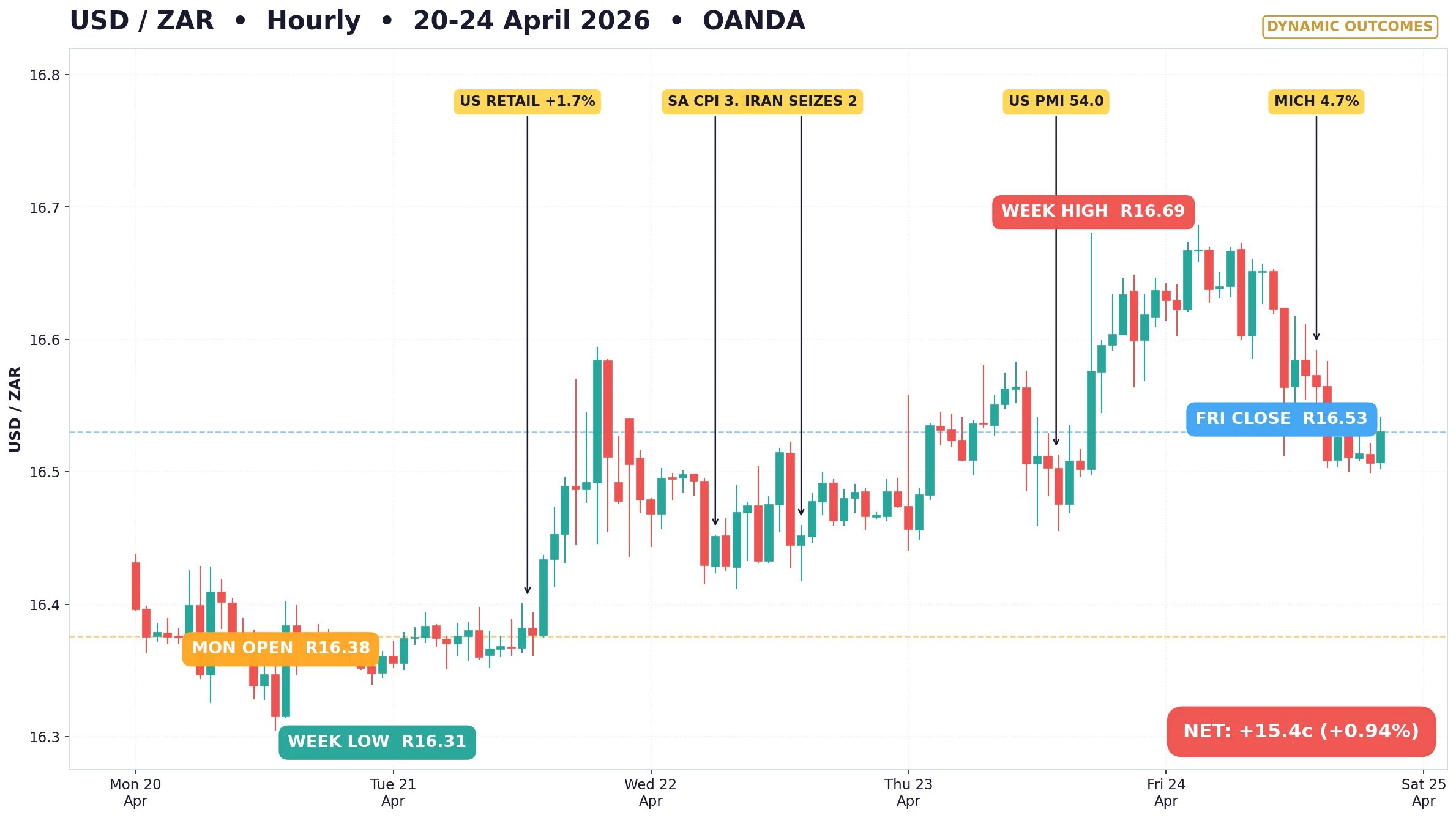
...and the session was a quiet one by recent standards. We drifted gently back toward R16.40 through the Asian session, and by 15:00 SAST the Rand had touched its strongest point of the entire week – R16.31. After that, every path was upward for USDZAR (and weaker for the Rand).
The Trump administration launched its tariff refund portal that morning – $166 billion in potential refunds for over-paid early-year tariffs (the rollout was glitchy, the market read it as incremental). Iran ship-seizure reports started circulating in the afternoon, and oil began climbing toward $100.
Monday closed at R16.37 – essentially unchanged. But the session low told you where the week was heading.
Tuesday: US Retail Sales Ends the Streak 📈
Tuesday opened at R16.38/$...
...and the 14:30 SAST data release effectively dictated the rest of the week. US Advance Retail Sales for March printed +1.7% month-on-month – the biggest monthly gain since January 2023, and comfortably ahead of consensus. DXY lifted to 98.25, and the Rand sold off 10.5 cents through the session, hitting R16.59 in the late New York afternoon.
(The catch – and the kind of detail Market Demystifier readers will appreciate – is that +15.5% of that retail-sales headline came from gasoline receipts – higher fuel prices, not higher volumes. The market reacted to the headline, but the composition tells a different story. SACCI Business Confidence for March also dropped to 131.3 from 134.6 the same day, adding a bit of SA-specific weight.)
Tuesday closed at R16.49/$ – the damage done in a single session.
Wednesday: SA Triple Event, Ships Attacked in the Strait ⚖️
Wednesday opened at R16.50/$...
...and within a six-hour window the South African calendar delivered three releases at once – CPI, Retail Sales, and the SARB's April Monetary Policy Review.
CPI was the surprise: 3.1% year-on-year against 4.1% expected – a full percentage point below consensus, and well below SARB's 4.5% midpoint (in any ordinary week that's a Rand-positive lead, the cue for the curve to price in earlier cuts – but this wasn't an ordinary week).
Retail Sales pulled the other way – -1.0% MoM versus +0.7% expected, with food & beverages down 5% YoY – consumer weakness landing in the same envelope as the CPI undershoot.
Then the SARB MPR landed.
Repo held at 6.75% (the market view), and the 3% inflation target isn't going anywhere – Kganyago's framing was "we have learned our lesson." But the worst-case scenario in the Review takes repo back up toward 8%, not falling. The rate-cut path markets had been pricing for mid-year just got pushed out (a Bank that's watching the same April fuel-price shock the rest of us are – and bracing for the CPI print a month from now to look very different from Wednesday's 3.1%).
Meanwhile, Iran seized those two commercial vessels in Hormuz, Brent pushed through $100, and gold quietly slipped – peaking around $4,830 Monday and closing Friday at ~$4,681, well off its January 2026 record at $5,595 (last week's Rand tailwind, gone).
And the Rand?
Close to flat at R16.49/$ – just 0.7 cents weaker on the day, and an oddly still session against a loud backdrop. The CPI undershoot was pulling one direction; Hormuz and the SARB tone shift were pulling the other. They cancelled out almost exactly.
And in other news...
SARB's Hawkish Pivot 🏦
The headline rate didn't move – but the posture did. The Bank isn't close to hiking, but it is close to stopping any further cuts (and when a central bank stops easing while its peers continue, the carry-trade math tilts back in favour of the currency). Spot barely acknowledged it, but the longer end of the SA yield curve did – and that's where the next six months get priced.
Trump Escalates on South Africa – and the ANC's Choices Come Home 🌍
The Trump-SA file got louder again this week.
His Turning Point USA rally in Phoenix on 17 April brought the South Africa criticism back to the front pages. And on Friday, reports surfaced that the Administration is considering doubling the Afrikaner refugee cap from 7,500 to 17,500 – about 4,500 already admitted this fiscal year. Refugee processing capacity is being built around conditions Washington has formally accepted as material – farm violence, the Expropriation Act, the rhetorical climate from senior SA politicians.
The international response followed predictable lines.
Brazil's Lula slammed Trump on Monday over the G20 exclusion (consistent with his BRICS alignment). France's ambassador argued for SA's readmission to the Finance Ministers' table on Tuesday (consistent with the broader EU position on most things SA-adjacent). Neither amounts to a meaningful Western rebuke.
The deeper story isn't Trump's rhetoric, or whether you agree with it.
It's that years of ANC alignment with Iran, Russia and China – while simultaneously expecting Washington to pretend nothing had changed – was always a thesis with a sell-by date. And we're now past it, with the bills being presented.
And the Rand? Didn't price any of this on the day – it rarely does on diplomatic items. But the structural cost is being paid in slower channels: the AGOA Section 301 review next week, refugee processing now, capital flows over months.
To get back to the Rand...
Thursday: Stagflation Signals, Weekly High Struck 📈
Thursday opened at R16.53/$...
...and the US session delivered a split decision. The S&P Global flash PMIs for April all beat – Manufacturing 54.0 (highest since May 2022), Services 51.3, Composite 52.0 – a clean growth print on the surface.
The catch (and there's always a catch this week) was the cost-inflation sub-index at a ten-month high – the same "panic buying ahead of tariff hikes" pattern that March delivered, and exactly the profile that turns a "strong" PMI into a stagflation signal.
The Rand weakened into the New York afternoon regardless. The week's high to that point – R16.68 – was struck at 19:00 SAST Thursday: oil at $105, stagflation-flavoured PMIs, and the SARB tone shift all pressing in at once (the absolute high of R16.69 came later, on Friday's early Asian push).
For exporters, Thursday afternoon at R16.66–R16.68 was the cleanest execution window of the week; for importers, the most expensive point.
Thursday closed at R16.50/$ – most of the spike clawed back into the close.
Friday: Rand Reclaims, Trump Doubles Down 📉
Friday opened at R16.67/$...
...and Asian action saw one more push to the week high (R16.69 at 05:00 SAST) before the tone shifted.
Then Michigan Sentiment landed at 16:00 SAST: 49.8 final (down from 53.3 preliminary). Near a record low, but the part that mattered was 1-year inflation expectations jumping from 3.8% to 4.7% – the biggest monthly jump since April 2025. The cleanest stagflation flag the US economy has printed in months.
The dollar paused – DXY stalled just under 99 – and the Rand, on the back foot since Tuesday, started recovering ground.
Friday's NY close arrived at R16.53 – having touched R16.50 at 21:00 SAST during the New York afternoon (the week's second-best Rand level after Monday's R16.31 low) – just over 13 cents of Rand strength versus Friday's open, and the best Rand afternoon since Wednesday's close.
(Worth noting: while the Rand was clawing back ground, the S&P 500 closed Friday at a fresh record 7,165 – a new all-time high, with the VIX dipping below 19. That's a market shrugging off the oil shock, the stagflation flag, and the geopolitical noise to print new highs – risk-on regime intact.)
Volatility and Risk Analysis
This week reversed two consecutive weeks of Rand strength – and the velocity of Tuesday's reversal is the number worth remembering.
Open → Close: R16.38 → R16.53 – 15.4-cent (0.94%) Rand weakening
Risk per $1 Million Exposure: R154,000
Max Single-Day Move: ~10.5 cents (0.64%) – Tuesday 21 April (US Retail Sales day)
Risk per $1 Million Exposure: R105,000
Weekly Range: 38.1 cents (R16.31 low → R16.69 high) – 2.33% swing
Risk per $1 Million Exposure: R381,000
Average Daily Range: ~18.6 cents (1.14%)
Risk per $1 Million Exposure: R186,000
For importers (those buying Dollars), this week put the cost back on the clock. Last week's R16.21 has moved to R16.53 – a fifteen-and-a-half-cent reversal on a $1 million exposure is R154,000 added to your conversion cost. Thursday afternoon at R16.66–R16.68 was the pain point; Friday's drift back toward R16.50 returned some of that opportunity (for importers with cycle-informed timing: the high-water mark of the week landed almost exactly where expected given the combination of oil shock and SARB tone shift – which is the value of having a map rather than a rearview mirror).
For exporters (those selling Dollars), Thursday afternoon was the week's best execution window – anyone who held back through Friday's early-Asian push captured the week's single best rate. With FOMC, Q1 GDP, and ECB all landing inside five days next week, more windows are coming.
The Week Ahead – 27 April – 1 May 2026
SA: Freedom Day public holiday Monday 27 April (markets closed). Quiet domestic calendar – no major Stats SA releases. Watch for any further hawkish hints from SARB.
US: A loaded week. FOMC Tuesday-Wednesday (94–99% hold priced). Q1 GDP Advance Thursday – the watch point, because Atlanta Fed's GDPNow is at 1.2% while consensus is 2.6% (a real divergence – if Atlanta is closer to the final, the market reaction will be sharp). PCE drops the same day.
Global: ECB and Bank of England both meeting (both holds expected). And the AGOA Section 301 hearings begin Tuesday in Washington – that's the one that frames SA's export outlook for the rest of 2026.
The Big Watch: isn't FOMC – it's GDP-versus-GDPNow on Thursday. Either a clean print confirms dollar strength, or a miss revives rate-cut pricing. Either way, Rand-mover. The second watch is AGOA. The third is Iran. Ceasefire technically extended, Strait technically still closed, Brent technically still at $106. Any one of those can change inside a single session.
The Rand spent two weeks getting stronger...
...and then spent a week being reminded why two weeks doesn't make a trend.
Last week closed at R16.21; this week closed at R16.53. Not a breakdown, not a reversal – just the kind of mean-reversion cycles produce when a short-term catalyst (Iran Friday) pushes a pair beyond where the underlying sentiment can hold it.
Two weeks up; one week back – that's cycles doing their work.
Until next week – stay sharp, stay skeptical, and don't let the headlines do your thinking for you.
To your success~
James Paynter
"The news explains the move after the fact – cycles explain the move before it happens.
One tells you what just cost you money. The other tells you what's about to."
Want the full Rand cycle picture?
Register Free for Rand Forecasts