📊 Everything Said the Rand Should Weaken — It Barely Moved
Published 29 June 2026
Some weeks the Rand writes a dramatic story. This was the quieter, more revealing kind.
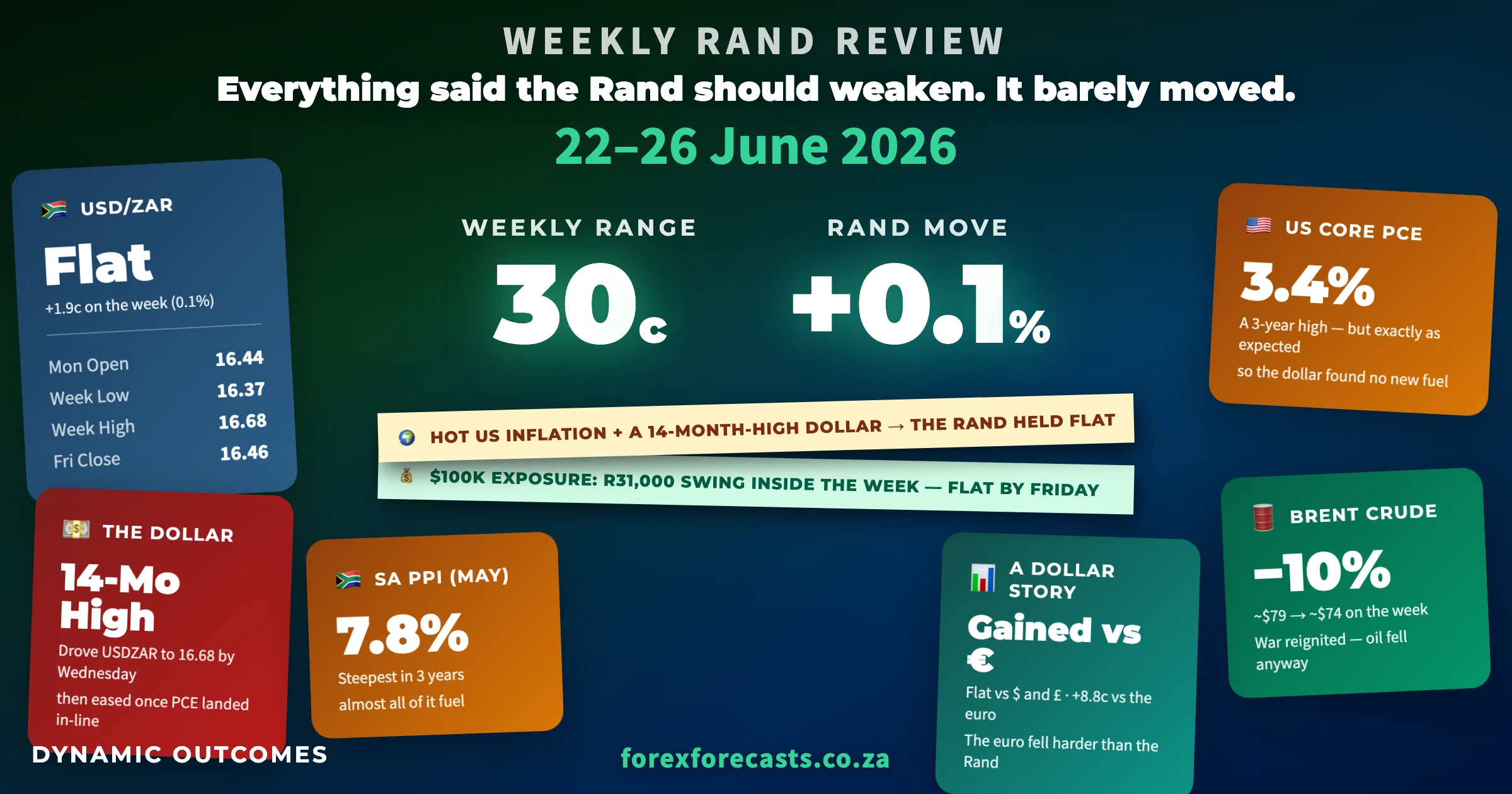
US inflation reached a three-year high. South African producer prices jumped to their hottest since 2023, and the dollar climbed to its strongest in over a year – each of them, on its own, a reason for the Rand to weaken.
It finished the week two cents from where it began.
Here's how it played out.
Key Moments (22–26 June 2026)
A few of the major headlines and events over the past five days:
🇺🇸 US Inflation Hit a Three-Year High. Thursday's reading was the hottest since 2023 – and the dollar's reaction was not the one the textbook predicts.
🇿🇦 SA Producer Prices Jumped to 7.8%. The steepest reading in three years – and yet the one force behind it may already be turning the other way.
🛢 The Gulf War Reignited. A peace roadmap signed Monday had collapsed into fresh US air strikes by Friday – yet oil did the opposite of what war usually does.
💰 The Dollar Reached a 14-Month High. It drove the Rand to its weakest by Wednesday – then, on the morning it should have pressed harder, the week quietly turned.
📊 The Quietest Week of 2026. The narrowest trading range the Rand has seen all year – and the round trip says more than a big move would.
Monday: A Firm, Watchful Open 📉
The Rand opened the week on the front foot, starting at R16.44/$ and easing to R16.37/$ by mid-morning – its strongest level of the entire week.
A weekend headline did the early lifting: the United States and Iran had agreed a sixty-day peace roadmap out of Switzerland, brokered with Qatar and Pakistan, and the oil price softened on the news. That should have been the template for the whole week – easing tension, cheaper crude, a firmer Rand (in a normal week, it would have been).
But the dollar was already coiled. Fresh off the prior week's hawkish turn from the new Fed chair, it was pushing toward its strongest level in more than a year, and the Rand's early advantage quietly drained away through the afternoon.
It closed at R16.40/$ – four cents firmer on the day, but with the dollar's shadow lengthening.
Tuesday: The Dollar Starts to Press 📈
Tuesday was when that shadow began to tell.
The Rand opened at R16.42/$ and spent the session on the back foot, with no domestic data to lean on and a greenback that would not stop climbing. The move was never violent – just a steady, all-day drift in one direction, the kind that does its damage quietly.
Gold and platinum prices were easing too, and for a currency whose export book leans so heavily on precious metals, that pulled away one of the Rand's usual props.
By the close it had given back almost thirteen cents to R16.54/$ – the softest session of the week, and the real test still a day away.
Wednesday: The High-Water Mark 📈
Wednesday took the drift and stretched it to its limit.
The Rand opened at R16.57/$ and pushed higher through the morning, touching R16.68/$ – its weakest point of the entire week and its softest level since late May.
There was no single shock behind it. The dollar simply kept grinding higher, sitting at a fourteen-month peak...
...as the market went on digesting the prior week's signal that US rates might rise rather than fall.
(When the world's reserve currency is paying you more to hold it, a high-yield currency has to work hard just to stand still.)
Yet even at its lowest, the Rand refused to break, clawing back through the afternoon to close at R16.55/$. That R16.68 high would prove to be the week's turning point – because from there, every move ran back in the Rand's favour.
In Other News 🌍
The Peace That Didn't Hold 🌍
The single biggest story of the week was one the Rand mostly ignored – and that, in itself, is the story.
The week opened with hope. The United States and Iran announced a sixty-day peace roadmap out of Switzerland, the framework meant to make permanent the fragile truce that had reopened the Strait of Hormuz a fortnight earlier. For an oil-importing economy like South Africa, a lasting Gulf peace is about as good as global news gets.
It did not last the week. By Thursday an Iranian drone had struck a tanker in the Strait, and by Friday American forces were back on Iranian soil, striking military targets and citing breaches of the deal. The roadmap was, for now, in pieces.
And yet – here is the part worth sitting with – the oil price fell anyway. Brent dropped from around eighty dollars on Monday to under seventy-four by Friday, roughly ten percent on the week...
...even as the bombs started again.
The market had decided the Strait would stay open regardless of the politics, and traded the barrels, not the headlines (for South Africa, watching its fuel bill, the barrels were the part that mattered).
South Africa's Quiet Ledger 🇿🇦
Beneath the dollar's noise, the home front kept doing its unglamorous work.
The one local data point of note arrived Thursday, and on paper it was ugly: producer price inflation jumped to 7.8% in the year to May, the steepest in three years and well ahead of what the market expected.
But scratch the surface and it was almost entirely a fuel story – diesel prices up by two-thirds over the year – and a backward-looking one, because the very oil collapse described above is now feeding the other way.
The proof lands on 1 July. Even with the last of the temporary fuel-levy relief expiring and the levies fully reinstated, motorists are still set for a net cut at the pump, because cheaper crude and a resilient Rand have more than offset the tax. Cheaper fuel is exactly what next month's inflation reading wants to see.
And the resilience is not an accident. The Rand has spent 2026 in the top third of emerging-market currencies, the grid has now gone more than four hundred days without load-shedding, and the Reserve Bank has been unambiguous about driving inflation back to its 3% goal. It is a quietly improving story the daily headlines rarely pause to notice.
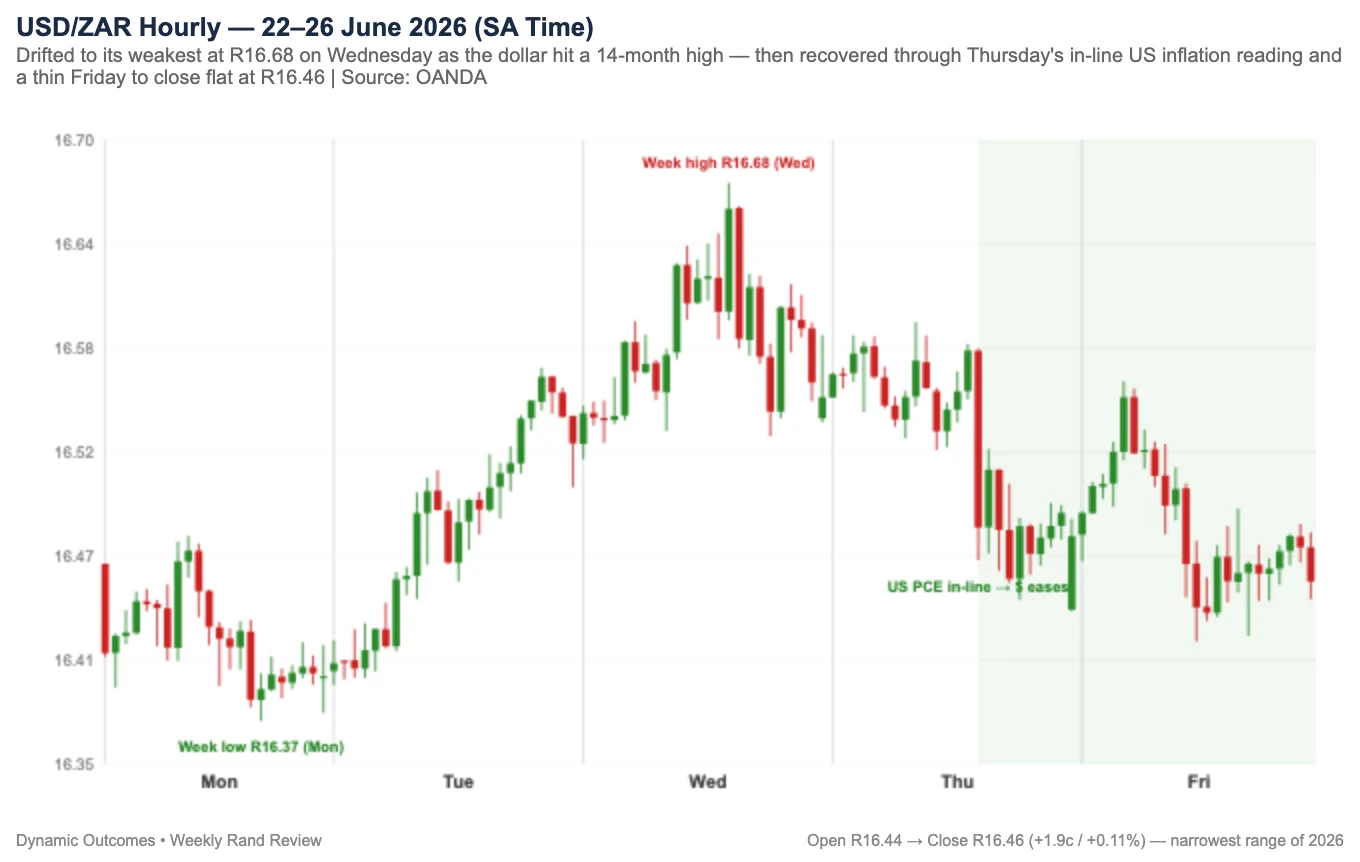
USD/ZAR hourly, 22–26 June 2026 (SA time) · the slow drift to R16.68 on Wednesday, and the two-day recovery after Thursday's data, back to R16.46 (OANDA)
To get back to the Rand...
...because the whole week turned on a single morning of data – and on what the market chose not to do with it.
Thursday: The Data That Should Have Stung 📉
Thursday was the test the week had been building toward, and it arrived all at once.
At 14:30 SAST a wall of US data landed together: the Federal Reserve's preferred inflation gauge, core PCE, came in at 3.4% for the year – its hottest in three years – alongside a first-quarter growth figure revised up to 2.1% and jobless claims at a four-week low.
On any reading, that is a hawkish set: hot inflation, firm growth, a tight labour market. Closer to home, the same hour brought that 7.8% producer-price figure – and the case for a weaker Rand had rarely looked more complete.
And the Rand? It strengthened.
The reason sits in one word: expected. The inflation figure, hot as it was, landed exactly where the market had pencilled it – and a number that merely confirms what everyone already feared gives the dollar nothing new to climb on.
With the hawkish trade already in the price and oil sliding, the greenback eased off its highs...
...and the Rand took the gap.
It opened at R16.55/$ and closed at R16.48/$, seven cents firmer on the day – the data that should have stung, and didn't.
Friday: Holding the Ground 📉
Friday's job was to keep Thursday's gains, and it did – quietly, into a market already turning toward month-end.
The Rand opened at R16.52/$ and firmed through a thin session, touching R16.42/$ before settling. There was little fresh to trade: a final reading on US consumer sentiment ticked up off its record low, the dollar drifted, and the Gulf headlines – for all their drama – moved nothing.
By the close it stood at R16.46/$, six cents firmer on the day and, remarkably, just two cents from where the whole week had started.
It was the narrowest trading week the Rand has had all year (four days of pressure, one morning of data that should have broken it, and a finish almost exactly back at the start – sometimes the most telling weeks are the ones that go nowhere).
Volatility & Risk Analysis
Two cents. That was the Rand's net journey over five full trading days – and yet, beneath that stillness, there was plenty of movement to be caught or missed.
Open to Close Move: the week opened Monday at R16.44/$ and closed Friday at R16.46/$ – barely 2 cents of Rand weakness (0.1%).
Risk per $1 Million Exposure: R19,000
Average Daily Range: just under 15 cents, the quietest week of 2026 by this measure too.
Risk per $1 Million Exposure: R149,000
Maximum Single-Day Move: Tuesday's 18-cent range.
Risk per $1 Million Exposure: R180,000
Weekly Range: just over 30 cents (R16.37 low to R16.68 high) – a 1.85% swing top to bottom – the narrowest range of the year.
Risk per $1 Million Exposure: R303,000
To put that in practical terms: with the week opening and closing in almost the same place, the early buyer and the late buyer of dollars finished within a whisker of each other. The cost this week sat inside the week, not across it.
An importer who bought into Wednesday's R16.68 spike rather than waiting for Friday paid roughly R21,700 more per $100,000 – while an exporter who sold into that same spike, rather than at Monday's open, banked about R23,600 more per $100,000.
The edge, as ever, sat in the timing – and this week the timing was a single Wednesday spike inside an otherwise flat week.
The Week Ahead
After a quiet week, the calendar turns heavy – and almost all of the weight sits in the United States.
SA: Trade & credit figures (month-end) · 1 July fuel announcement, expected to confirm the petrol cut · quiet until SARB's 23 July decision
US: June jobs report – Thursday 2 July (pulled forward for the holiday) · first labour read since the Fed turned hawkish
Global: the Gulf / Strait of Hormuz the swing factor for oil · NATO summit early next week
What to Watch
"Everything that should have moved the Rand this week happened... ...and almost none of it did. The market had already priced the bad news – and a currency only moves on what it didn't see coming."
Until next week – to your success~
James Paynter
This week proved an old point: what the market expects matters more than what the data says. The numbers were hot, the dollar was strong, the Gulf was at war – and the Rand barely moved, because none of it was a surprise. That kind of read is what 21 years and over 8,750 scored Rand forecasts at 72.3% average accuracy are built on – not a promise the data will never surprise, but a disciplined sense of where the Rand is structurally headed, and the lines that tell you the moment it changes.
See the latest USD/ZAR forecasts at Strategic Rand.
Want the full Rand cycle picture?
Register Free for Rand Forecasts