SARB Raised Rates. Oil Crashed. The Rand Picked Up 28 Cents.
Published 1 June 2026
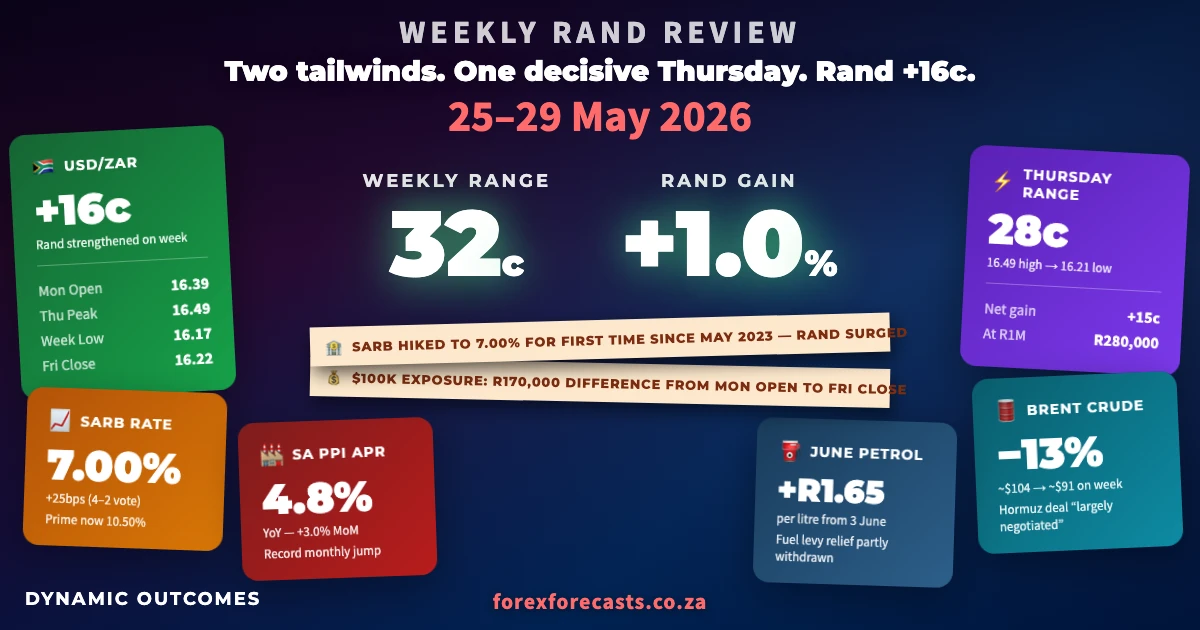
The SARB voted 4-2 to raise rates to 7.00% – the first hike since May 2023. On the same day, Brent fell 13% on Hormuz deal news. The Rand gained 28 cents intraday on Thursday alone – not because of what happened, but because sentiment was already positioned there.
The week started with silence.
Monday was Memorial Day in the United States – Wall Street closed, thin OTC volume, the Rand drifting gently stronger in the absence of any real catalyst – USDZAR sliding to around R16.29/$ with no US buyers around to hold the dollar up.
Nobody was watching. Thursday changed that.
Here's how it played out:
Key Moments (25–29 May 2026)
🏛️ SARB: First Rate Hike Since May 2023. The MPC made a decision few were positioned for – and the Rand's reaction was not the one the textbook predicts.
🛢️ Oil's Worst Month Since March 2020. The reason traces back to a single Strait – and it matters more to the Rand right now than most local data.
📊 SA PPI: Record Monthly Jump. It landed the same morning as the SARB decision – and together they wrote Thursday's 28-cent session.
🇺🇸 Warsh's First Full Week. His first FOMC meeting as Chair is June 16–17. Every word before then will be studied carefully.
⛽ June Petrol Hike Announced. From 3 June, pump prices rise ~R1.65/litre as the fuel levy relief is partially withdrawn – arriving the same week as the SARB's rate hike.
Monday 25 May: Wall Street Goes Dark 📉
Before Monday opened, here's where we stood – the call we put out the Friday before.
The Forecast: Direction: down further. Target zone: 16.22–15.82. Invalidation: above 16.77. The call was made on price structure alone – before any of what followed was known.
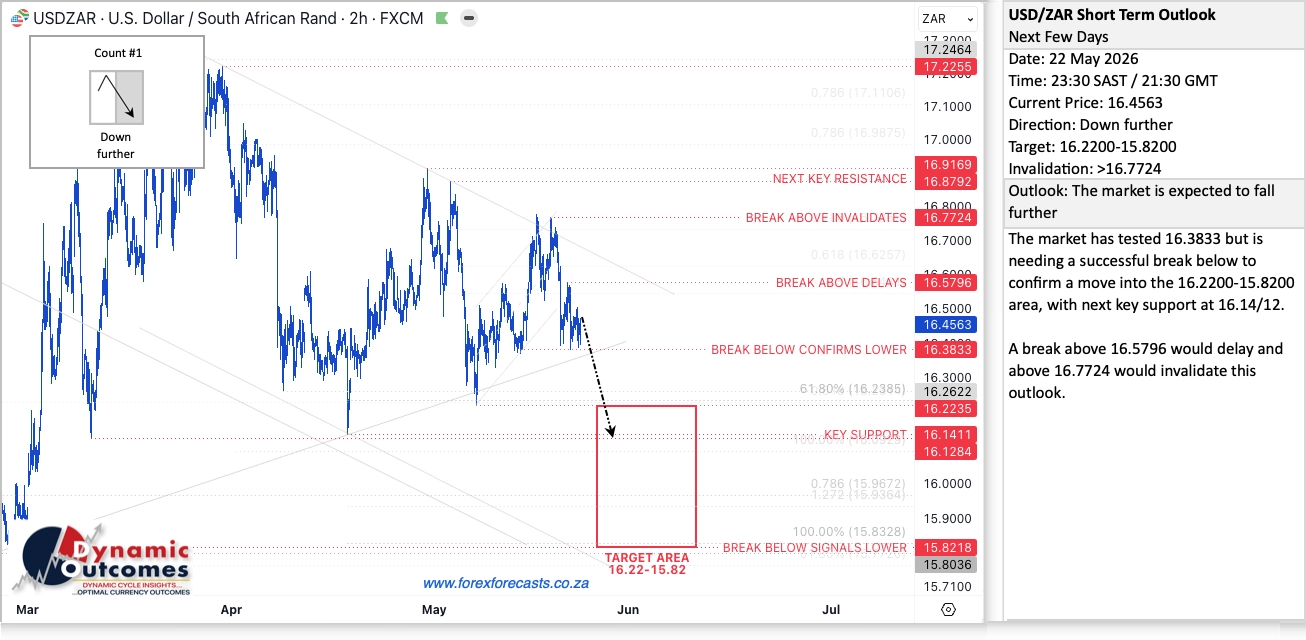
The week closed at R16.22/$ – the exact top of that target zone. Nobody knew a SARB rate hike was coming. Nobody knew oil would lose 13% in a week.
The United States was closed for Memorial Day.
The JSE was open – but thin. With no US buyers in the market, the dollar had no natural support during the overlap session, and the rand-dollar pair spent the day in the hands of the global OTC interbank network...
...which thins considerably when the primary counterparty time zone is at a Memorial Day barbecue.
The Rand opened the week at R16.39/$ and spent Monday drifting in that direction. Not because of any catalyst...
...but because the dollar found no support in a session with no one on the other side of the trade. By the close we were near R16.29/$. Ten cents of Rand strength before a single piece of data had been released.
I have seen thin-market Mondays like this before. They tell you less about the Rand's direction than about what happens when the market loses a counterparty for a day. The real session was coming on Thursday.
Four days remained.
Tuesday 26 May: The Market Waits 📈
Tuesday was the counter-move – and a quiet one.
The dollar found its footing as US markets reopened after the long weekend. The Rand gave back a portion of Monday's gains, drifting from R16.31/$ at the open to R16.38/$ at the close...
...a seven-cent reversal that, in context, barely registered. Markets weren't waiting for Tuesday's data. They were waiting for Thursday.
South Africa's producer price index for April was due. More importantly, the SARB's Monetary Policy Committee was meeting – with a decision to be announced Thursday morning. After April CPI came in at 4.0% (the highest since August 2024), the question of whether the SARB would hike had shifted from "unlikely" to "possible" to, by Tuesday, "genuinely uncertain."
A 4-2 vote is a committee that actually disagreed – not a rubber stamp...
...and the market was not sure which way it would land.
Wednesday 27 May: Quiet Consolidation 📉
Wednesday delivered almost nothing – which was itself a signal.
The Rand moved between R16.40/$ at the session high and R16.29/$ at the low – an 11-cent intraday range that said very little, because the pair closed almost exactly where it opened, at R16.37/$. The market was holding its position...
...and conserving ammunition for Thursday.
Oil continued to slide. Reports out of Washington suggested the Iran-US framework was closer than the market had priced – Brent was already below $100, well off its blockade-era highs above $120. Each $1 off the oil price reduces US inflation expectations by a fraction...
...reducing the pressure on the Federal Reserve to hold rates high – which reduces dollar rate support – which gives EM currencies like the Rand a little more air. The full transmission chain, running quietly in the background.
Wednesday was where it started registering...
...and Thursday was where it arrived.
In Other News...
Oil's Worst Month Since March 2020 🛢️
Brent crude has now fallen from a 2026 peak above $120 (during the Hormuz blockade) to approximately $91 by Friday – the largest monthly decline since the COVID crash of March 2020.
The proximate cause this week: the Iran-US framework agreement is described as "largely negotiated" – a 60-day memorandum that would guarantee unrestricted Hormuz shipping, allow Iran to export oil freely, and defer nuclear talks. If it holds, the war premium that has been embedded in oil prices since February disappears.
For the Rand, the mechanism is direct: lower oil reduces US inflation expectations, which prices out Federal Reserve rate hikes, which softens the dollar, which makes rand-denominated assets relatively more attractive. Every $10 off the oil price is, in a rough sense, a tailwind for the currency.
Worth watching whether the deal gets formally signed – and whether the Strait actually stays open. That single question is doing more for the Rand right now than any domestic data release. The Rand has ridden this story for three weeks. If it reverses, the move reverses with it.
US Equities Near Record Highs – Risk-On Persists 📊
The S&P 500 is tracking for a gain of roughly 5% in May – driven largely by the AI capital expenditure cycle. Dell reported this week with server revenue up 757% year-on-year.
For the Rand, this matters because global risk appetite and EM currency flows tend to move together. When US equities are at highs and the VIX is subdued, capital finds its way to higher-yielding markets. The Rand has been a modest beneficiary of that dynamic this week alongside the SARB and oil stories.
It does not change the fundamental picture – but it tells you the environment is not fighting the Rand right now.
Thursday 28 May: The SARB Moves – and the Rand Surges 📉
This is the day the week was decided.
It began with a data release that would have been the story on its own: South Africa's April producer price index came in at 4.8% year-on-year – well above the 2.9% expected. The monthly figure was worse: a 3.0% single-month jump, the largest in the history of the PPI series. Diesel up 39.4%. Petrol up 18.3%. The fuel pass-through from April's pump price hike was still working its way through every supply chain in the country.
Then, at midday SAST, the SARB delivered its verdict.
The Monetary Policy Committee voted 4-2 to raise the repo rate by 25 basis points – from 6.75% to 7.00%. It is the first rate hike since May 2023. Governor Kganyago's statement cited the oil-driven inflation shock, the El Niño food risk, and the persistence of above-target CPI. The prime lending rate is now 10.50%.
And the Rand?
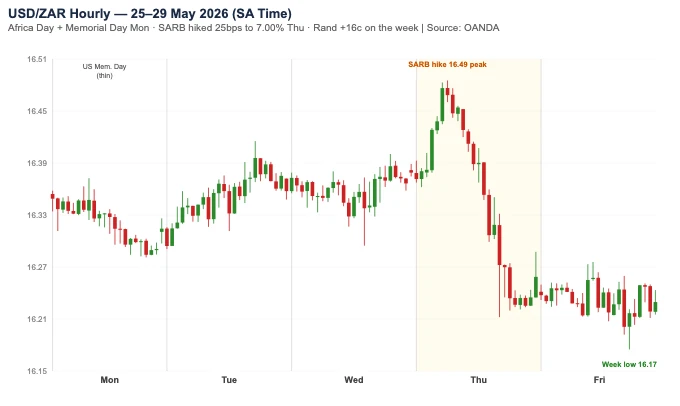
It surged – from R16.49/$ in the morning to R16.21/$ by the close, in a session that had started with the market leaning entirely the other way.
Here is the sequence. The Rand had been drifting weaker through Thursday morning – as traders positioned defensively ahead of the MPC decision...
...a hike was possible; a hold was also possible; the uncertainty pushed some players toward the dollar, and USDZAR had drifted up to R16.49/$ before the announcement.
Then the hike landed. PPI confirmed the worst of the inflation picture was driven by fuel, not demand – a commodity shock the SARB was right to act on, but one that markets expected to ease as oil fell. At the same time, Brent was extending its decline on Hormuz deal optimism – below $95 by midday, below $93 by the New York session open. The dollar softened against everything as the rate-support argument weakened.
That is a 28-cent intraday range – and a 15-cent net gain on the day from the open...
...in a session that began with the news that your borrowing costs had just gone up (and the market's verdict was: that is exactly the right call).
A rate hike in a fragile economy is supposed to worry a currency market. The Rand gained 28 cents intraday and closed 15 cents stronger.
The economist's version: the SARB did exactly what it said it would do, and the currency rewarded it...
...easy to say, after the fact.
Our version was different:
Look back at the forecast issued the Friday before – the one that called Rand strength on price structure alone...before anyone knew the SARB would hike...before oil had its worst month in three years.
What this told us is that sentiment was already positioned for this move. The SARB's decision didn't cause it...
...it simply provided the market with the trigger to take the Rand where it was already going to go anyway.
The week's direction had been decided.
Friday 29 May: The Extension 📉
Friday continued where Thursday left off.
The Rand opened at R16.23/$ and tested lower through the morning session, reaching R16.17/$ at the intraday low before settling into the close. The Hormuz deal continued to dominate global headlines – oil held near $91 – and the dollar found no catalyst to recover.
The week closed at R16.22/$. A rate hike the market had been genuinely uncertain about, delivered by a divided but decisive committee, into a week where the global oil story was already doing the Rand's heavy lifting...
...two tailwinds, one decisive Thursday, and a Rand that knew exactly what to do with both of them.
From Monday's open at R16.39/$ to Friday's close at R16.22/$...
...approximately 17 cents of Rand strength in five trading days.
Volatility and Risk Analysis
Close to seventeen cents of Rand strength in five trading days – and the move was anything but linear...
...ten of those cents came from a session when US buyers were absent, and the other seven came from a single Thursday.
Open to Close Move: Opened Monday at R16.39/$ – closed Friday at R16.22/$ – approximately 17 cents of Rand strengthening (~1.0%).
Average Daily Range: ~15.8 cents (~1.0%)
Risk per $1 Million Exposure: R158,000
Maximum Single-Day Move: ~28 cents (~1.7%) on Thursday
Risk per $1 Million Exposure: R280,000
Weekly Range: ~32 cents (R16.17 low to R16.49 high) – 2.0% swing
Risk per $1 Million Exposure: R320,000
For importers, buying USD near Friday's close (R16.22) rather than Monday's open (R16.39) saved approximately R17,000 per $100,000 of exposure – a meaningful difference from a single week's movement.
For exporters, Monday's open offered the best USD sale rate of the week – before the SARB and Hormuz combined to push the Rand stronger.
Thursday's 28-cent intraday swing is the risk figure worth internalising: that is how much the market moved in a single day on the SARB decision. If you needed to cover a USD obligation last Thursday and were caught on the wrong side of that range, the cost was real – regardless of what happened to the week's net movement.
The Week Ahead (1–5 June 2026)
SA: Petrol price adjustment – 3 June | Naamsa vehicle sales – 3 June
US: NFP (Employment Situation) – 5 June | Warsh first Fedspeak post-chair
Global: Hormuz deal formalisation watch | Brent trajectory around deal
What to Watch
Two things have now changed since last week, and both matter for the Rand's next move. The SARB is now at 7.00%. The higher domestic rate increases the carry trade attraction of the Rand – but it also increases borrowing costs across an already-fragile economy. The SARB revised its 2026 growth forecast down to 1.2%. Governor Kganyago signalled the committee sees 2 more hikes as possible in risk scenarios. Whether that assessment holds depends heavily on the June petrol price impact and whether global oil stays down.
The June petrol price hike lands on 3 June. Approximately R1.65/litre at the pump – the partial withdrawal of the fuel levy relief that had been cushioning prices. This will push June CPI higher. If global oil holds near $91, the fuel-price spike may be partly offset. If oil recovers, it will not be.
On the US side: Kevin Warsh chairs his first FOMC meeting on 16–17 June. The May jobs report (NFP, 5 June) and May CPI (approximately 10 June) are the two critical inputs. Markets are currently pricing no cuts in 2026. Watch Brent. If the Hormuz deal holds and the SARB's hawkish signal continues to attract carry flows, the Rand has room to strengthen further – but the June petrol hike and any Hormuz reversal are the two risks worth pricing.
Until next week – to your success~
James Paynter
P.S. The week that just passed is exactly the kind of move our forecasting methodology is designed to navigate – not predict the SARB's vote count, but read the structural position of the Rand well enough to know which direction the risk was weighted. Over 21 years and 8,756 Rand forecasts, our accuracy rate sits at 72.3%. That number was built in weeks like this one.
"A rate hike in a fragile economy is supposed to worry a currency market. The Rand gained 28 cents intraday and closed 15 cents stronger."
Want the full Rand cycle picture?
Register Free for Rand Forecasts