📉 Three Central Banks Held in Three Days...and the Rand Picked Up 19 Cents
Published 3 August 2026
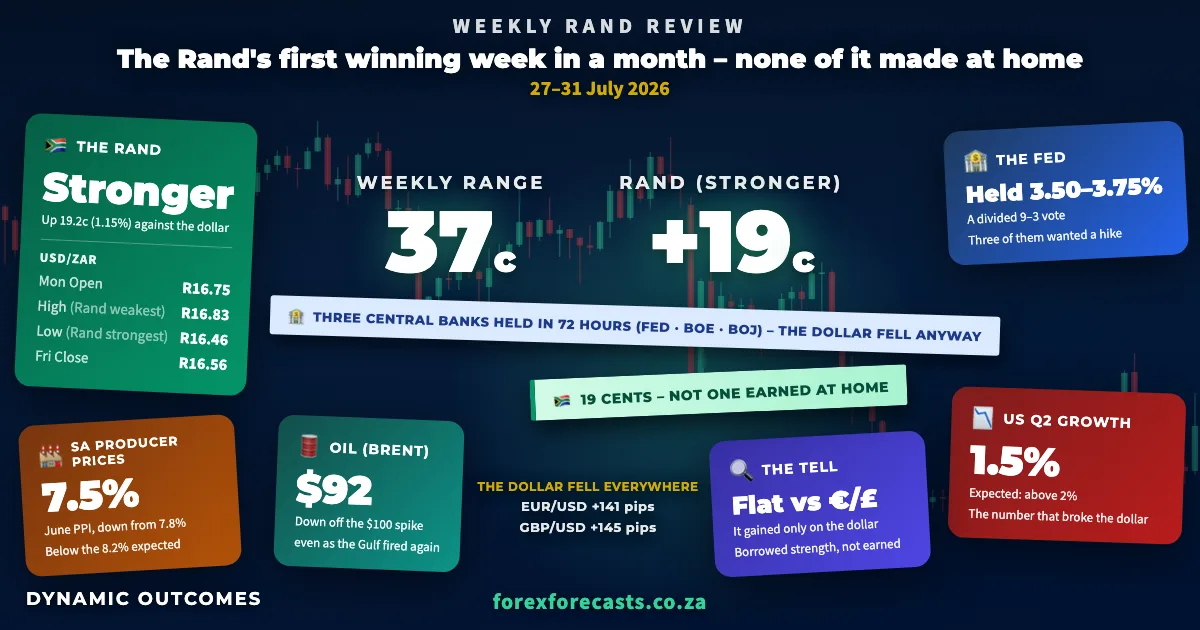
South Africa did not really have a week. Washington had one, and the Rand collected the proceeds.
There was no CPI here, no rate decision, nothing much at all for the market to trade. Yet by Thursday the Rand had won back most of what the Reserve Bank's shock cost it – on a dollar that had simply run out of reasons.
And the Rand? It picked up about nineteen cents, its first weekly gain in a month.
Here's how it played out.
But first – the call we put out on Friday night, before any of this happened. Direction, pivotal level, first target – all on the page. Worth saying plainly, because we said the opposite part plainly too. The two calls before this one were invalidated when the Reserve Bank held rates on 23 July against a market that had almost entirely priced a hike, and the Rand lost forty cents in an afternoon. The Review said so at the time – and this is the call that caught the turn back: issued 24 July at R16.81, direction down, R16.58 marked as the first target. The week's low was R16.46 and it closed at R16.56.
Key Moments (27–31 July 2026)
A few of the major headlines and events over the past five days:
🏦 Three Central Banks Held in Three Days. The Fed, the Bank of England and the Bank of Japan all sat still – none of them comfortably.
📊 The US Growth Number Missed Badly. The one reading the dollar could not afford to get wrong landed on Thursday afternoon.
🇿🇦 South Africa Released Almost Nothing. No CPI, no rate call, nothing the market bothered to trade – at the loudest possible moment.
⛽ August's Fuel Bill Goes Two Ways at Once. Both pumps were confirmed this week. Only one of them is good news.
🛢 The Gulf Started Shooting Again. A US base was hit on Tuesday, and Washington answered on Wednesday.
Monday: A Market Waiting for Washington 📉
The Rand opened the week at R16.75/$ with nothing on the local diary and everything on the US one.
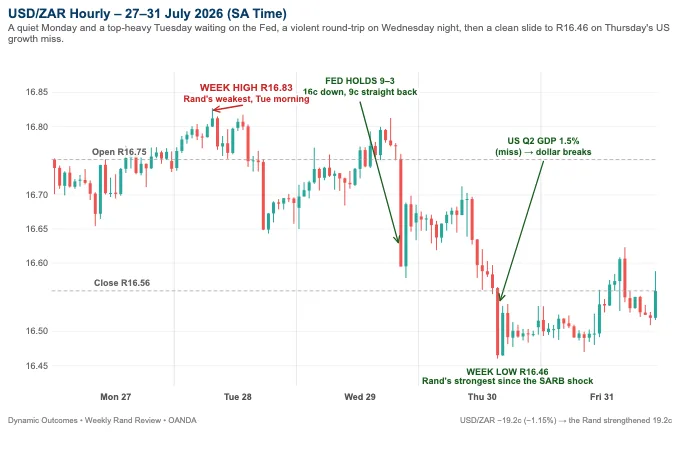
It firmed briefly just after eight, easing to R16.65 on thin early trade, and had given it all back by mid-morning. The main US number of the day – durable goods orders, up 0.3% against expectations nearer 1.6% – arrived in the afternoon and moved almost nothing. The Rand held around R16.74/$, a cent and a half stronger than it began.
Which was rather the point. With a two-day Federal Reserve meeting starting the next morning, nobody was going to take a position worth defending.
Tuesday: Confidence Cracks in the US 📉
Tuesday morning produced the weakest the Rand would trade all week, and then spent the rest of the day undoing it.
Early trade pushed it out to R16.83/$ just after seven, as the dollar firmed into the Fed meeting. By lunchtime the direction had turned, and at four in the afternoon the US consumer confidence reading landed at 90.8 – well short of the 92.4 the market wanted, and lower than the month before.
The dollar began to leak from there. The Rand ran through the mid-sixties in the space of an hour and pushed on to around R16.69/$, five cents firmer on the day, with the week's high already behind it – though nobody knew that at four o'clock. All anyone knew was that the dollar had stopped working.
Wednesday: The Fed Says Nothing, Loudly 📉
Wednesday was the day everyone had been waiting for, and it delivered a result almost nobody had planned around.
The Bank of England had already held earlier that day, at 3.75%, with three of its own nine wanting a hike. Then, at eight in the evening our time, the Federal Reserve held at 3.50–3.75% – also with three dissenting in favour of a rise.
On paper, that should have been dollar-positive. For a minute or two it was. Then Chairman Kevin Warsh stepped to the podium with a statement notably shorter than his predecessor's, offered no forward guidance at all, and waved the split away as a good family argument. The market had come for hawkishness and been handed a shrug.
The Rand took sixteen cents off the dollar in the eight o'clock hour and gave nine of them straight back in the nine o'clock hour, closing the day at R16.67/$ – almost exactly where it started. Violent, and it went nowhere – usually the sign a market has been surprised but hasn't worked out yet what the surprise is worth.
In Other News 🌍
The Gulf Fired Again 🛢
The pause everyone was hoping for did not last the week.
Washington's run of thirteen consecutive nights of strikes on Iran had stopped over the weekend before this week opened, and for about five days the Gulf was quiet. Then on Tuesday Iranian forces hit a US base in Jordan, and on Wednesday the United States hit back with a heavy wave of airstrikes.
So the shooting resumed, inside a single week, in the most sensitive oil corridor on earth – and the price of oil went down. Brent ended Friday at just over $92 a barrel, several dollars below the hundred-dollar level it had been testing when the strikes first stopped. A fuel-importing economy got a cheaper barrel in the same week a US base was hit and the retaliation went in. That is the tell. The market had already paid for that headline once, and it saw no reason to pay for it twice.
The Fuel Bill Splits in Two ⛽
The August fuel prices were confirmed this week, and they pull in opposite directions.
From Wednesday, petrol comes down – between fourteen and nineteen cents a litre, depending on grade. Diesel goes the other way, and hard: up somewhere between R1.42 and R1.60 a litre.
Petrol is what makes the headlines, because petrol is what most of us put in our own cars. Diesel is what moves the country – the trucks that carry the food, the tractors that grow it, and a fair share of the generators that still cover the gaps. So a one-and-a-half-Rand jump on the fuel that carries everything shows up on the shelves long before it shows up in the motoring pages, and it takes a month or two to get there – which is a peculiar thing to be importing in the same month the Reserve Bank chose to sit still on inflation. The Governor spent Friday reaffirming the Bank's 3% target. The trucks will have their own opinion.
Beijing Gets a Ceiling, Pretoria Gets a Bill 🇨🇳
One small item out of Washington on Monday deserves more attention here than it will get. China's Commerce Ministry said the United States has privately committed to capping any future replacement tariffs at 20%, ahead of a planned meeting between the two presidents.
Whether or not that number holds, the shape of it is instructive: Beijing has a ceiling and a date in the diary. South Africa, by contrast, has a 12.5% duty that took effect last Friday, a forced-labour finding attached to it, and a trade minister saying government will continue to engage. There is no conspiracy in this – China has the bigger stick and used it. But it is a fair question why a country that has spent a decade tilting its foreign policy toward Beijing, Moscow and Tehran keeps finding itself at the back of the queue – and the answer is not one Washington is obliged to supply.
To get back to the Rand... because Wednesday was only the set-up. The week actually happened on Thursday afternoon.
Thursday: The Growth Number Breaks It 📉
Thursday was the day the dollar stopped arguing.
It began well enough at home. At half-past nine the June producer price figures came in at 7.5% for the year, down from 7.8% and below the 8.2% expected, with prices actually falling on the month. At noon, a June budget surplus of just over R80 billion, well ahead of forecast. Two good local numbers in one morning, and almost nobody noticed either of them – a good local number on a big US day is a tree falling in an empty forest.
Because at half-past two our time, the US released the first estimate of its second-quarter growth: 1.5%, against expectations somewhere above 2%. Alongside it, inflation cooling to 3.7% and core to 3.3% – weak growth and softening inflation, landing less than twenty-four hours after a central bank that had just declined to sound hawkish about either.
This added fuel to the Rand's fire. It dropped straight through R16.50 and kept going, touching R16.46 in the middle of the afternoon – its strongest level since the Reserve Bank's shock a week earlier – before catching its breath around R16.52/$, better than fifteen cents up on the day, and validating the call we'd made the Friday before, in the process.
Friday: A Little Given Back 📈
Friday's job was to find out how much of Thursday the market actually believed.
The Bank of Japan completed the set overnight, holding at 1.00% with one dissenter – and on Bloomberg's reporting Tokyo had been in the market supporting the yen only hours beforehand.
The Rand touched R16.47 early, its best level of the day – hardly a surprise, not after four days that had already put the better part of twenty-four cents in the bank. It ran out of steam from there, giving ground well before any US number even landed, which is usually just month-end doing its housekeeping.
Then two things pushed the other way. US consumer sentiment jumped to 55.2 from 49.5 – a big move for a soft number – and a fistful of big technology results pushed the S&P 500 to a record close, just short of 7,490. Locally, June's trade surplus came in at R17.75 billion – a surplus, and a much larger one than May's, but well below the R32 billion the market had pencilled in.
The Rand ran out to R16.62 late in the SA afternoon before fighting back to end the week at R16.56/$, about four cents softer on the day and nineteen cents firmer than where Monday started. Giving back a fifth of a week's gain on a Friday is not a reversal – it is a market checking its own work.
Volatility and Risk Analysis
Nineteen cents, and not one of them earned at home. That is the week – and here is the arithmetic behind it.
Open to Close Move: the week opened Monday at R16.75/$ and closed Friday at R16.56/$ – 19.2 cents of Rand strength (1.15%).
Risk per $1 Million Exposure: R192,000
Average Daily Range: just under 19 cents (1.1%).
Risk per $1 Million Exposure: R188,000
Maximum Single-Day Move: 15.3 cents on Thursday (0.9%).
Risk per $1 Million Exposure: R153,000
Weekly Range: just under 37 cents (R16.46 low to R16.83 high) – a 2.2% swing top to bottom.
Risk per $1 Million Exposure: R367,000
That is a quiet week by the standards of everything we have logged this year, and a long way from the sixty-three-cent week before it.
Now the crosses, because they say who actually did this – and it was not Pretoria. Over the week the Rand gained 1.15% against the dollar. Against the euro it gave up not quite two cents, and against the pound it picked up not quite two cents. On rates of nineteen and twenty-two Rand, that is flat. A currency that gains on the dollar and moves nowhere against the euro or the pound has not really gained anything. It has been carried.
The dollar fell about three quarters of a percent on the index, to a six-week low, and the majors rose with it – the euro and the pound each put on about 140 pips. Ours simply stood in the same queue. If you were waiting on a dollar payment this week, you were paid by Washington, not by Pretoria.
An importer who bought dollars into Friday's R16.56 instead of Monday's R16.75 saved about R19,000 per $100,000. The exporter sat on the other side of that same trade – sell Monday, keep the nineteen thousand; sell Friday, hand it back. Same product, same quantity, four days apart.
I have watched these crosses for two decades, and the weeks that catch people out are rarely the loud ones. They are the quiet ones like this, where the money moves and nothing at home appears to have happened at all.
The Week Ahead
After a week South Africa spent watching other people's news, the next one at least gives it something of its own – before Friday hands it all back to Washington, with the biggie: the Non-Farm Payrolls release.
SA: Absa Manufacturing PMI (Mon 3 Aug), July vehicle sales (Mon 3 Aug), new fuel prices effective (Wed 5 Aug)
US: ISM Manufacturing (Mon), JOLTS (Tue), ADP & ISM Services (Wed), NFP (Fri)
Global: OPEC+ meeting (Sun 2 Aug)
What to Watch
Of these, the ones to watch are Friday's Non-Farm Payrolls report, half-past two our time, and Sunday's OPEC+ decision – between them, they set the Rand's next move and the oil price it trades against.
Our latest call has already moved the levels on from the ones referenced above – the direction hasn't changed, but the numbers that matter now are in the forecast itself, not in this Review.
This was the week the Rand got a gift and had the good sense to accept it.
It did nothing to deserve nineteen cents. A central bank on another continent declined to sound certain, a growth number missed, and the same tide that lifted the euro and the pound carried us with it. Borrowed strength spends exactly the same as the earned kind. It just tends to get called back – usually on a Friday, with a jobs number attached.
"The weeks that catch people out are rarely the loud ones... ...they're the quiet ones, where nothing at home seems to have happened at all."
Notice what actually moved the Rand this week: not a South African decision, but a Fed communication and a US growth number. Three weeks ago it was the SARB. Before that, oil out of the Gulf. That is exactly the kind of call our latest USD/ZAR forecast is built to make. See the Strategic Rand forecasts.
Want the full Rand cycle picture?
Register Free for Rand ForecastsHow much extra have you been paying in fees and spreads? FX savings calculator