📈 A War Scare and a Tariff Hearing – and the Rand Barely Moved
Published 13 July 2026
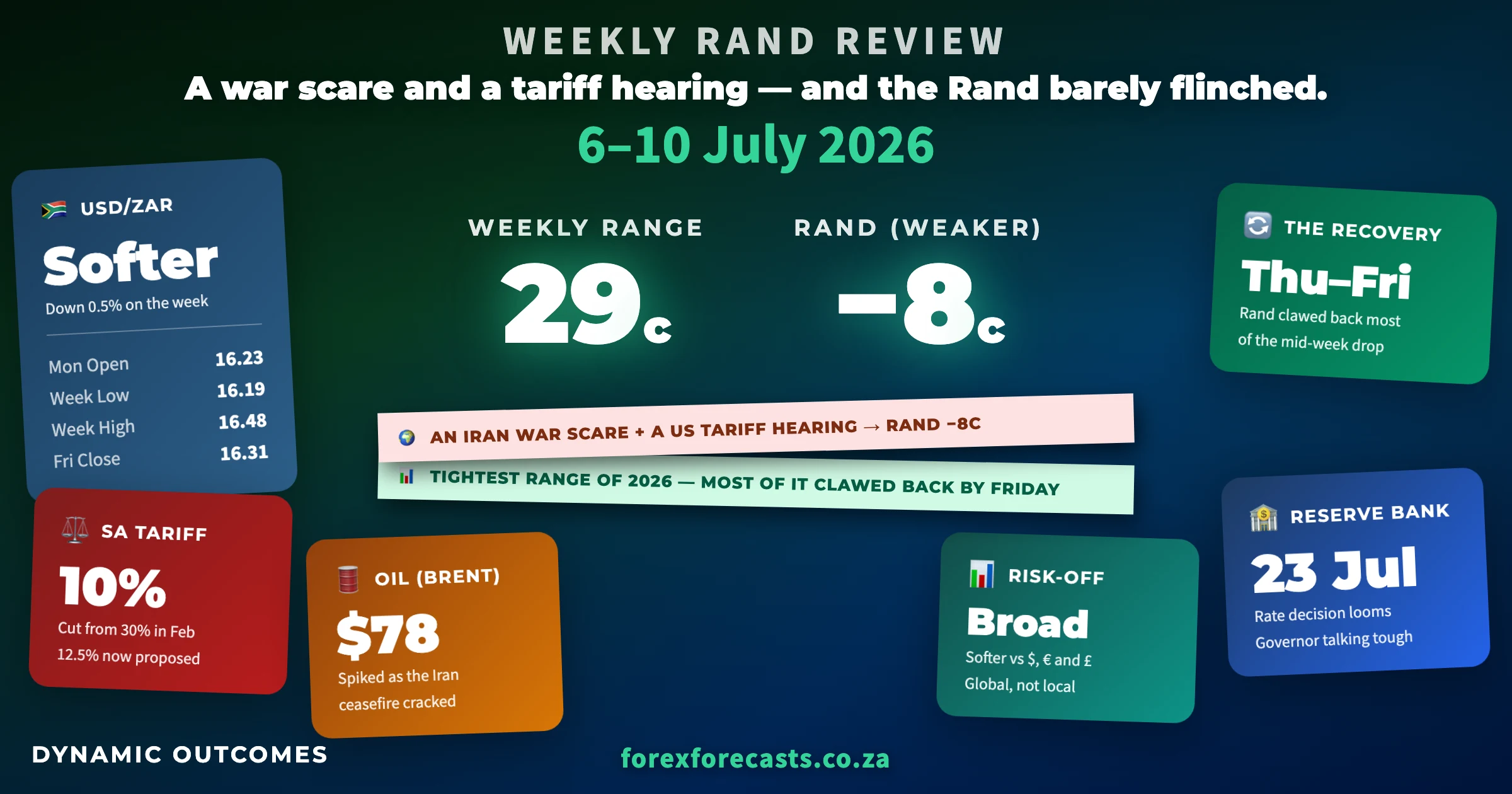
For a fortnight the Rand had quietly been winning. This week, Washington tried to take some of it back.
The blow that actually landed came from the Gulf, not the trade file: a reopened war scare mid-week sent markets running for the dollar, and the Rand slid to its weakest. A three-day US hearing on South African tariffs rumbled on in the background.
And the Rand? It gave back just eight cents, inside the tightest trading range it has traded all year.
Here's how it played out.
Key Moments (6–10 July 2026)
A few of the major headlines and events over the past five days:
🌍 A War Scare Reopened in the Gulf. Fresh US strikes on Iran and an "it's over" from the President at the NATO summit sent markets running for cover.
⚖️ A US Panel Weighed Tariffs on SA. Three days of hearings ran in Washington on a proposed forced-labour tariff – a trade file that quietly improved this year.
💰 The Dollar Found a Bid. After last week's slide, the greenback steadied and started pushing back.
📊 The Tightest Range of the Year. The Rand travelled less this week than in any other of 2026, a round trip that says plenty.
🏦 The Reserve Bank in the Wings. A rate decision falls on 23 July, and the Governor is still talking tough.
Monday: A Quiet, Firm Open 📉
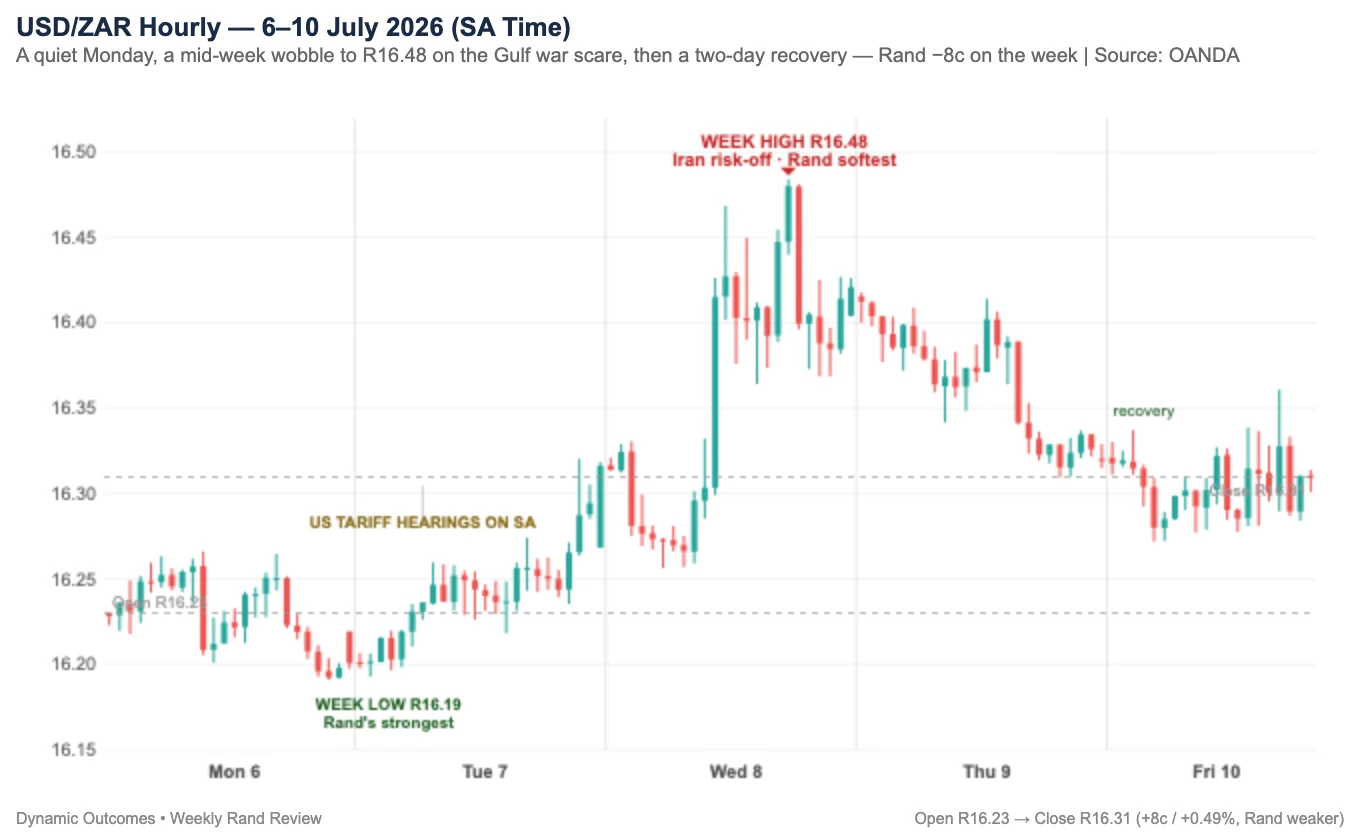
The Rand opened the week at R16.23/$ and eased to R16.19 through the morning, the strongest level it would touch for the next five days.
There was nothing at home to trade. The local calendar was empty, and the dollar, fresh off last week's stumble below 101, was still finding its feet.
So the Rand did what a high-yield currency does when nobody is leaning on it: it drifted quietly the right way (give it an inch of breathing room and it tends to take it).
It closed at R16.20/$, a shade firmer, with the week's real business still to arrive.
Tuesday: The Dollar Starts to Press 📈
Tuesday opened at R16.20/$ and began, almost imperceptibly, to give ground.
There was no single blow behind it, just a dollar that had stopped falling. Fresh off last week's slide, the greenback steadied and started to push back, and a high-yield currency feels that shift before it can name it.
In the background, a US trade panel opened three days of hearings, weighing a fresh round of tariffs on South African goods. It was a slow-burn story rather than a market event, but it kept a familiar cloud over the Rand's export names (more on where that file actually stands below).
The Rand drifted out to close at R16.32/$, around eleven cents softer on the day – a reaction to a firmer dollar, not to any one headline.
Wednesday: The High-Water Mark 📈
Wednesday was the day the pressure peaked, and it came from the Gulf.
Overnight, the story in the Middle East had turned. The US resumed strikes on Iran, and at a NATO summit the President declared the ceasefire "over" and warned of more to come.
Risk assets recoiled. Wall Street's Dow shed 577 points, Brent crude jumped better than five percent toward $78 a barrel, and government bond yields climbed around the world as inflation fears crept back in.
For an emerging-market currency, that is the least welcome kind of morning. The Rand opened at R16.32/$ and pushed higher through the session, touching R16.48/$ just after 17:00 SAST, its weakest point of the week...
...and this had nothing to do with South Africa at all.
The tell was in the crosses. The Rand slipped against the euro and the pound just as it did against the dollar, and when a currency softens against everything at once, the story is rarely local. It is a market pulling money out of anything with a pulse and asking questions later.
(Later that evening, minutes from the Fed's June meeting revealed a committee split on where rates go next: hawkish enough to keep the dollar firm into the close, though well after the Rand's damage was done.)
It closed at R16.42/$, a little off the high, with the storm already beginning to pass.
In Other News 🌍
The Tariff Number Everyone Still Fears 🇿🇦
The trade hearings in Washington this week are worth a closer look, because the number most South Africans still attach to Trump and tariffs is a year out of date.
Cast your mind back. The headline was a 30% duty on South African goods, and it read like a catastrophe for an economy whose export book leans on cars, citrus, wine, steel and platinum-group metals. But that number did not survive.
In February, the US Supreme Court struck down the tariffs it rested on, and South Africa's rate was cut to a flat 10% – a long way down from the number that had caused all the alarm. The catastrophe headline quietly became a footnote.
What is actually live now is smaller and slower. This week's hearings concern a proposed forced-labour tariff of 12.5%, still only a proposal, and even that flat 10% rate carries an expiry date later this month unless Washington extends it. Real risks, worth watching, but a long way from the cliff-edge the old number implied.
The deeper point is an uncomfortable one. South Africa keeps finding itself in Washington's cross-hairs, and years of tilting foreign policy toward Beijing, Moscow and Tehran did nothing to help (the exposure is real; so is the question of who created it).
For now, though, the market delivered the calm verdict. The Rand gave back eight cents on the week and took most of it back by Friday. Traders are not pricing a catastrophe, because on the current facts there isn't one.
Oil's Mid-Week Jolt 🛢
The Iran flare-up left its clearest mark on the oil price.
Brent began the week near $72 a barrel and spiked to $78 as the ceasefire unravelled, before easing back toward $76 by Friday.
For a fuel-importing economy that just enjoyed a July petrol cut, a sustained move higher would be unwelcome. It is exactly the imported-inflation pressure the Reserve Bank is watching as it weighs its next move. For now, the spike looks more like a scare than a shift (one nervous week does not reset a trend, but it is worth keeping an eye on the pump).
To get back to the Rand...
...because for all the noise out of Washington, the more telling half of the week was the recovery that followed.
Thursday: The Rand Claws Back 📉
Thursday was the session that reframed the week.
With the Iran headlines cooling and no fresh shock to digest, the risk-off mood began to drain away. The Rand opened at R16.42/$ and firmed steadily through the day, retracing most of Wednesday's move to close back at R16.32/$, around nine cents stronger.
And the Rand? It did what it has done all year when a global scare passes: it went looking for its footing and found it faster than the headlines said it should.
A soft patch of US data helped, too...
...with weekly jobless claims and consumer borrowing both pointing to an economy quietly losing steam, which kept the dollar from pressing its advantage.
By the close, most of the week's damage had already been undone.
Friday: Holding the Line 📉
Friday's only job was to keep what Thursday had rebuilt.
The Rand opened at R16.32/$ and traded a narrow, uneventful band through a quiet session, settling the SA day around R16.31/$, barely changed and comfortably clear of Wednesday's lows (a dull Friday is precisely what a recovering currency orders).
There was no local data and no fresh catalyst, just a market content to let a turbulent week settle. It left the Rand eight cents softer than where Monday began, a modest loss on paper, and a far smaller one than the week's headlines had threatened.
Volatility and Risk Analysis
Eight cents. That was the Rand's net move across five days that held a war scare and a trade fight, and it barely registered.
Open to Close Move: the week opened Monday at R16.23/$ and closed Friday near R16.31/$ – about 8 cents of Rand weakness (0.49%).
Risk per $1 Million Exposure: R80,000
Average Daily Range: just under 13 cents – a third straight week of unusually subdued daily movement.
Risk per $1 Million Exposure: R126,000
Maximum Single-Day Move: Wednesday's near-23-cent swing, almost all of it in the hours around the Iran headlines.
Risk per $1 Million Exposure: R228,000
Weekly Range: just over 29 cents (R16.19 low to R16.48 high) – a 1.8% swing top to bottom. That range was the narrowest of any week in 2026.
Risk per $1 Million Exposure: R293,000
A note on the crosses, because it frames what happened. This week the Rand softened against the dollar, the euro and the pound alike, weakest against sterling and gentlest against the euro. When a currency slips against everything at once, the driver is global risk, not a single counterpart. Last week's move was a dollar story; this week's was a nerves story, and nerves fade faster than trends.
To put the timing in practical terms: an importer who waited and bought dollars into Friday's R16.31 rather than Monday's R16.23 paid roughly R8,000 more per $100,000 – while an exporter who held out and sold late pocketed about the same. In a softly weakening week, patience quietly rewarded the seller.
The Week Ahead
The quiet stretch gives way to a busier diary, and the balance of risk sits squarely on two dates.
SA: All eyes on the SARB – rate decision 23 July · the Governor's tone the key tell
US: June inflation reading – 14 July · the first clean read since the Fed split
Global: The tariff-hearing outcome · the 10% rate's July expiry · oil and the Iran situation
What to Watch
As for the Rand itself, our latest call still points lower. This week's wobble to R16.48 came and went without ever threatening the line that would call time on it. The direction of travel hasn't changed, and the levels that matter are waiting in the portal.
This was a week that made a quiet point: the headlines that frighten South Africans are not always the ones that move the Rand. A reopened war and a tariff hearing would, on paper, rattle a small open currency. This one gave back eight cents and spent two days taking them back. The noise came from Washington; the composure, this time, was home-grown.
"A war scare and a tariff hearing... ...and the Rand gave back just eight cents. The headlines frightened everyone. ...the market read the detail."
Until next week – to your success~
James Paynter
The real lesson of the week was in what did not happen. A war scare and a trade fight landed in the same five days, and the Rand's total damage was eight cents – most of it recovered inside forty-eight hours. Currency moves are rarely about the headline; they are about how much of it the market actually believes. Reading that gap – between what looks alarming and what actually shifts the price – is what 21 years and over 8,750 scored Rand forecasts at 72.3% average accuracy are built on.
See the latest USD/ZAR forecasts at Strategic Rand.
Want the full Rand cycle picture?
Register Free for Rand ForecastsHow much extra have you been paying in fees and spreads? FX savings calculator