📈 The Dollar Handed the Rand a Gift Midweek – and by Friday It Was Gone
Published 20 July 2026
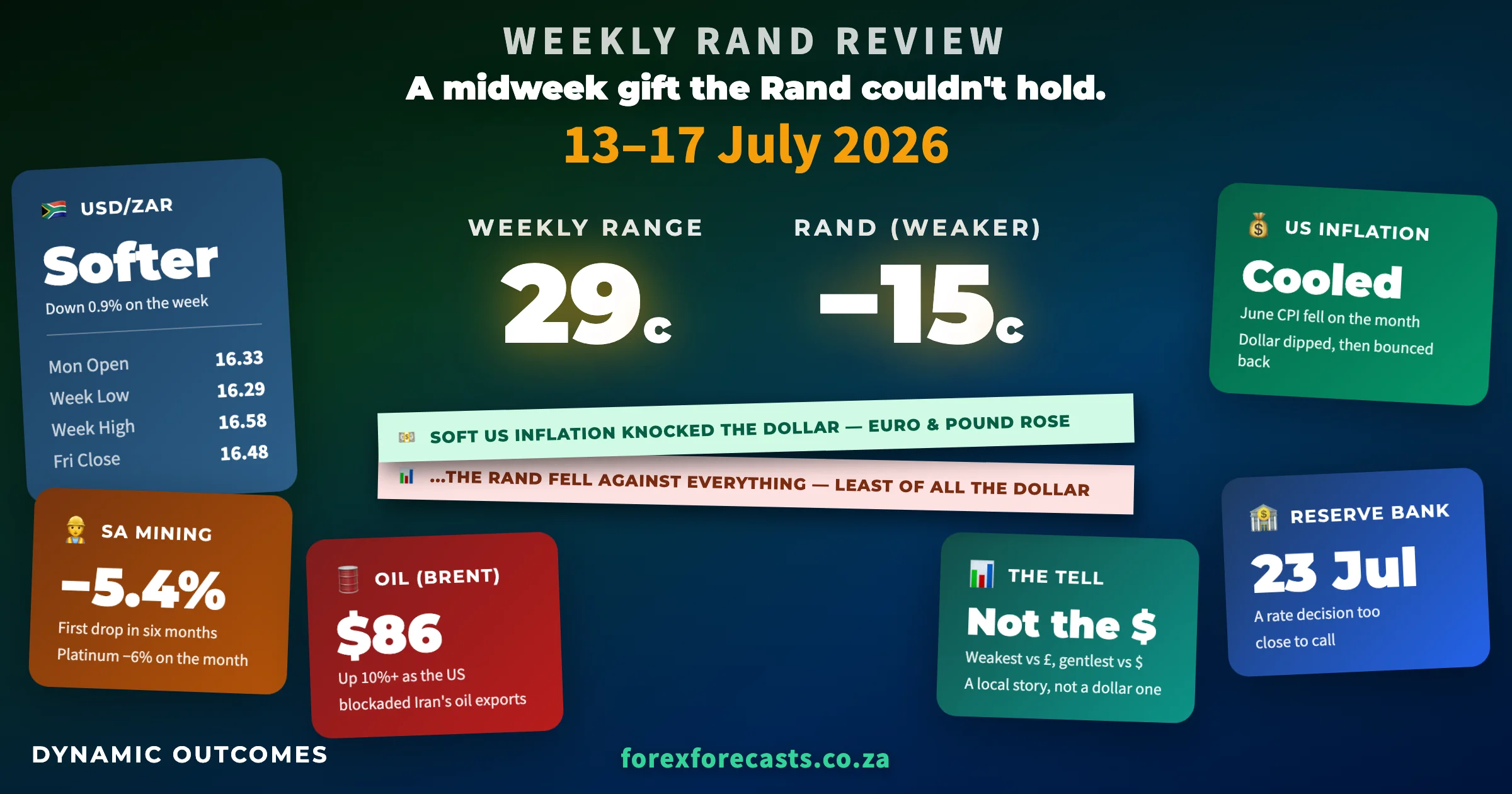
Here is a puzzle. Midweek, the dollar was on the floor, felled by a cold US inflation number. The euro and pound climbed on it, and for two sessions the Rand climbed too.
Then it gave the lot back.
By Friday the dollar had found its feet, oil was drawing money in, and the Rand closed weaker against every major currency.
When a currency can't hold a falling-dollar gift, the problem is closer to home.
And the Rand? It gave back about fifteen cents, its weakest in a month.
Here's how it played out.
Key Moments (13–17 July 2026)
A few of the major headlines and events over the past five days:
🛢 The Gulf Went From Scare to Blockade. Last week's jitters hardened into the real thing, and the whole market felt it.
💰 US Inflation Came In Cold. The one number the dollar had been leaning on finally broke the wrong way.
👷 South Africa's Mining Engine Stalled. The country's biggest earner picked the worst possible week to stumble.
🏦 A Knife-Edge Reserve Bank Call Loomed. Next week's decision is genuinely too close to call, and the market took notice.
🌐 Money Ran for Safety. A nervous world reached for shelter, and left the riskier corners of it exposed.
Monday: The Gulf Sets the Tone 📈
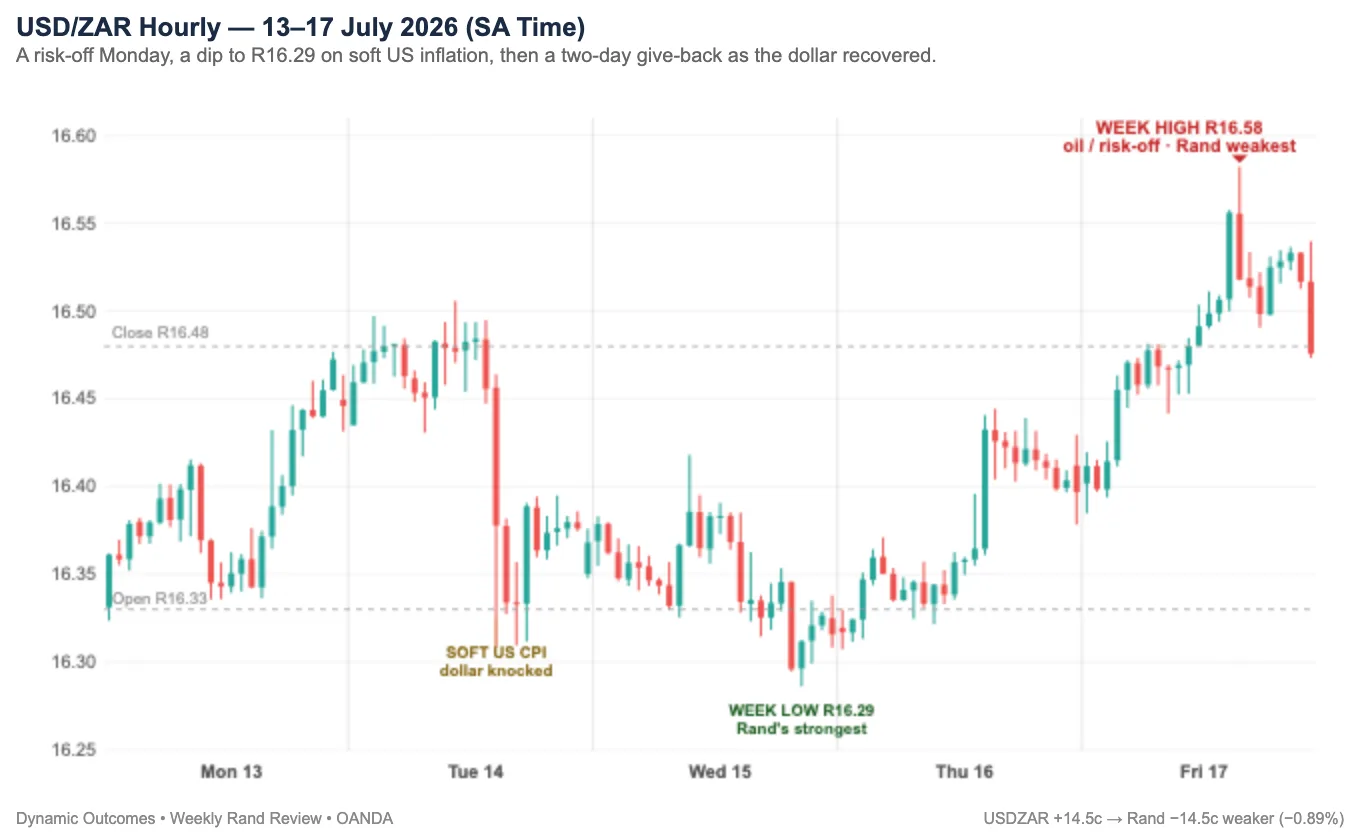
The Rand opened the week at R16.33/$ and never really looked back.
There was nothing at home to trade, so the currency took its cue from a nervous world. Over the weekend the standoff in the Gulf had turned from rhetoric to action, and Monday's markets opened in a defensive crouch – Wall Street's chip-heavy indices sliding, oil bid, and money everywhere edging toward the dollar.
For an emerging-market currency, that is a headwind you feel before you can name it. The Rand drifted softer through the session and kept drifting into the evening, touching R16.48/$ as the US risk-off mood deepened after the local close.
It settled the SA day near R16.45/$, around eleven cents weaker, a quiet start with a distinctly cautious undertone.
Tuesday: A Cold Number, A Brief Reprieve 📉
Tuesday handed the Rand its one real chance of the week, and it came from Washington.
The morning was unkind – a soft print on local mining production did the currency no favours, and the Rand slipped out to R16.51/$ by mid-morning, the weakest it would trade until Friday. Then, at half-past two SA time, the US June inflation figures landed...
...and they were cold. Prices had actually fallen on the month, the sharpest drop in years, and the case for the dollar to keep climbing came apart in an afternoon.
The greenback sank, the Rand tore back through R16.35/$, and for an hour the puzzle looked like it might resolve the ordinary way (a falling dollar is exactly the tide a high-yield currency is built to ride).
But the Fed chair was on Capitol Hill the same afternoon, reminding everyone that one soft month does not end the inflation fight – and the dollar clawed some of it back. The Rand closed at R16.37/$, near seven cents firmer, the reprieve real but already fraying.
Wednesday: The Week's Best Level 📉
Wednesday was the day the soft-dollar story had its fullest hearing, and the Rand made the most of it.
A second cool US number followed the first – wholesale prices fell too, the first drop in almost a year – and the greenback stayed on the back foot all day. With nothing at home to complicate it, the Rand firmed steadily, easing to R16.29/$ in the evening, its strongest level of the entire week.
For a few hours the puzzle had dissolved. The dollar was down, and the Rand was up, exactly as the textbook says it should be...
...and that was as good as it got.
Because underneath the currency's brief rally, the things that would drag it back down were already gathering – in the Gulf, in the metals market, and in the diary. The Rand closed at R16.32/$, holding most of its gains, at what would turn out to be a high-water mark it could not defend.
In Other News 🌍
The Gulf, From Scare to Blockade 🛢
Last week the Rand wobbled on a Middle East scare. This week the scare became the thing itself.
After Iranian attacks on shipping near the Strait of Hormuz, Washington tore up June's fragile truce. It reinstated its naval blockade of Iran's ports, choking the country's oil exports, and revoked the waivers that had let Iranian crude flow freely since the ceasefire.
And note where the blockade actually sits. Not across the strait, which Washington wants open and says so, but off Iran's own harbours, its oil bottled at source.
Take a major producer's barrels off the market by force, add a war-risk premium, and crude does one thing. Brent climbed better than ten percent across the week, from around $78 to nearly $86 a barrel.
For global markets, an oil shock of that size is a risk-off trigger...
...and money did what it always does. By Thursday it was running for the dollar, out of anything with a pulse in the emerging world, and the Rand – a liquid proxy for that whole basket – took the brunt.
For South Africa specifically, there is a second sting. This is a fuel-importing economy that only just enjoyed a July cut at the pump, and a sustained oil spike is precisely the imported-inflation pressure the Reserve Bank least wants to see a week before it has to decide on rates (one bad week at the pump does not reset a trend, but the timing could hardly be worse).
The Commodity Currency's Bad Week 👷
If the Gulf supplied the shove, home supplied the stumble.
South Africa's mining output fell 5.4% in the year to May, the figures showed on Tuesday – the first decline in six months, with iron ore down sharply and the platinum-group metals sliding too. It landed on a currency already reading a weakening tape, and it did not help.
Worse, the metals themselves were on the back foot. Platinum shed close to three percent to sit near $1,598, down more than six percent on the month, and gold slipped back below $4,000 after a brief run higher. For a currency that earns much of its keep digging things up and selling them, a simultaneous fade in how much is mined and what it fetches is a direct hit to the country's terms of trade.
It is the quiet, structural side of a currency's fortunes, less dramatic than an oil headline, but it is the ballast under the Rand, and this week the ballast was lighter (the mines matter far more to the Rand than most of the noise that gets the airtime).
When Washington Named China 🇨🇳
One piece of this week's noise had nothing to do with the Rand, and everything to do with a name South Africans should be watching: China.
On Thursday night, in a primetime address, President Trump pointed to a trove of newly declassified files, now published on the White House's own election-integrity page, and made two claims at once: that a foreign power reached into the American vote, and that parts of America's own establishment worked to bury it.
The foreign half names Beijing. The files allege China illicitly acquired some 220 million American voter records, starting around the 2020 cycle, in what they call the largest compromise of election data in history. Alongside sit files on voting-system vulnerabilities, a Michigan registration-fraud investigation, and a claim of some 278,000 non-citizens on federal voter rolls.
The domestic half is the sharper one. Trump said the documents show intelligence officials moved to suppress the China findings, with one internal email, he claimed, admitting the presidential daily brief had been "deliberately massaged" to keep them quiet, and an FBI official describing herself, in her own words, as running "a shadow government" to stop the meddling from coming to light.
Then the reception gave the story a second act. Two of the big broadcast networks kept the address off their main channels entirely, running it only on their streaming feeds while others carried it live, a decision Trump called part of a plot. Make of the timing, and the coverage it got, what you will.
For a South African reader, the relevance isn't the American politics, it's the counterparty. This is the same China that Pretoria keeps drawing closer to, through BRICS and a widening web of trade and lending.
Whatever one makes of the specific claims, a US administration publicly naming Beijing as an election adversary, and accusing its own agencies of burying the evidence, is a geopolitical fault line running straight through the bloc South Africa has chosen to stand in. And fault lines, sooner or later, show up in the currency.
To get back to the Rand...
...because the second half of the week is where the puzzle answered itself – the dollar found its feet, and the Rand had nothing left to lean on.
Thursday: The Dollar Turns 📈
Thursday was the day the reprieve ran out.
The Rand opened at R16.32/$, close to its best, and for a while held its ground. But two things turned against it at once. The Gulf would not stay quiet, with fresh reports of strikes keeping oil bid, and the dollar, after three days on the floor, began to climb off it.
As the afternoon wore on, the Rand gave way, weakening past R16.40/$ and closing there, around eight cents softer on the day.
A soft patch of US data did nothing to change it. Retail sales were tepid and jobless claims stayed low, but with an oil shock steering safe-haven money toward the dollar, the greenback firmed anyway. The Rand had lost its one tailwind just as a fresh headwind arrived.
By the close, the week's brief moment of clarity had gone, and the Rand was back on the defensive.
Friday: The Weakest Point, a Late Reprieve 📈
Friday brought the week's weakest moment, and then a small mercy.
The Rand opened at R16.40/$ and weakened through a jittery session as the week's pressures converged. Oil sat near its highs, a deepening technology selloff soured the global mood, and news that China's economy had slowed more than expected piled on a growth scare.
With a firmer dollar on top of all that, the Rand slid to R16.58/$ in the afternoon, its weakest point of the week.
Underneath it sat the Reserve Bank. With a rate decision days away and impossible to call, and inflation expectations above the Bank's 3% target, no one wanted to be caught long of the Rand into the weekend.
Then the late New York session offered a small reprieve, easing the pair back to close the week at R16.48/$. That left the Rand about fifteen cents softer than where Monday began, a week that started cautious, briefly found its feet, and ended defensive.
Volatility and Risk Analysis
Fifteen cents. That was the Rand's net loss on a week that briefly handed it the opposite, and that gap is the whole story.
Open to Close Move: the week opened Monday at R16.33/$ and closed Friday at R16.48/$ – about 14.5 cents of Rand weakness (0.89%).
Risk per $1 Million Exposure: R145,000
Average Daily Range: just over 16 cents, livelier by the day than the past fortnight, even as the week's total travel stayed tight.
Risk per $1 Million Exposure: R163,000
Maximum Single-Day Move: Tuesday's near-20-cent swing – the whipsaw around the cold US inflation number, up then part-way back.
Risk per $1 Million Exposure: R198,000
Weekly Range: just under 30 cents (R16.29 low to R16.58 high) – a 1.8% swing top to bottom. It was the second-narrowest range of any week in 2026, behind only last week – two tight weeks in a row.
Risk per $1 Million Exposure: R296,000
A note on the crosses, because it changes the story. Over the week the Rand still weakened least against the dollar, more against the euro, and most against the pound.
But that flatters the greenback. The dollar spent the first half of the week falling and only clawed it back late, so the euro and pound simply banked more of that mid-week slide and gave less of it back.
Strip the dollar's round trip out, and what is left is a Rand that couldn't hold its one good stretch, then wilted the moment the dollar came back. The problem this week was at least as much at home – oil, mining, a rate call no one can price – as it was in Washington.
To put the timing in practical terms: an importer who waited and bought dollars into Friday's R16.48 rather than Monday's R16.33 paid roughly R14,500 more per $100,000, while an exporter who held out and sold late pocketed about the same. In a week that closed weaker than it opened, the seller's patience quietly paid.
The Week Ahead
The quiet gives way to a loaded week, and almost all of it points at one room in Pretoria.
SA: CPI (June) – Wednesday 22 July · SARB rate decision – Thursday 23 July (a genuine coin-toss)
US: a quieter data slate after the cold inflation prints · any Fed push-back to watch
Global: the Gulf / oil the wildcard · ECB (23 July) and Bank of England both leaning tighter
What to Watch
As for the Rand itself, our latest call has not changed its mind. It still points to the currency firming from here, and this week's slide never once threatened the line that would call time on that view. The direction of travel holds; the levels that matter are waiting in the portal.
This was a week that quietly rewrote the usual script. For months the Rand's fate has been decided in Washington. This week Washington handed it a gift – a falling dollar – and the Rand couldn't take it.
The reason sat closer to home, in an oil price it imports, in mines that produced a little less, and in a rate call no one can confidently make.
The question now is which way that call breaks.
"Midweek, the dollar was on the floor... ...and still the Rand couldn't hold its ground. When a currency can't ride a falling dollar, ...the problem is closer to home."
Until next week – to your success~
James Paynter
The lesson of the week was hiding in the crosses. Midweek the dollar was on the floor and the Rand still couldn't make it count; by Friday, when the dollar turned back up, it had no answer at all. Over the week the Rand lost least against the dollar and most against the pound – the tell that its real problem sat closer to home than Washington. Reading which currency is actually moving yours, and why, is the difference between reacting to a headline and reading a market. That is what 21 years and over 8,750 scored Rand forecasts at 72.3% average accuracy are built on.
See the latest USD/ZAR forecasts at Strategic Rand.
Want the full Rand cycle picture?
Register Free for Rand Forecasts