📉 Everything Went Wrong Last Week – Except the Rand
Published 7 September 2026
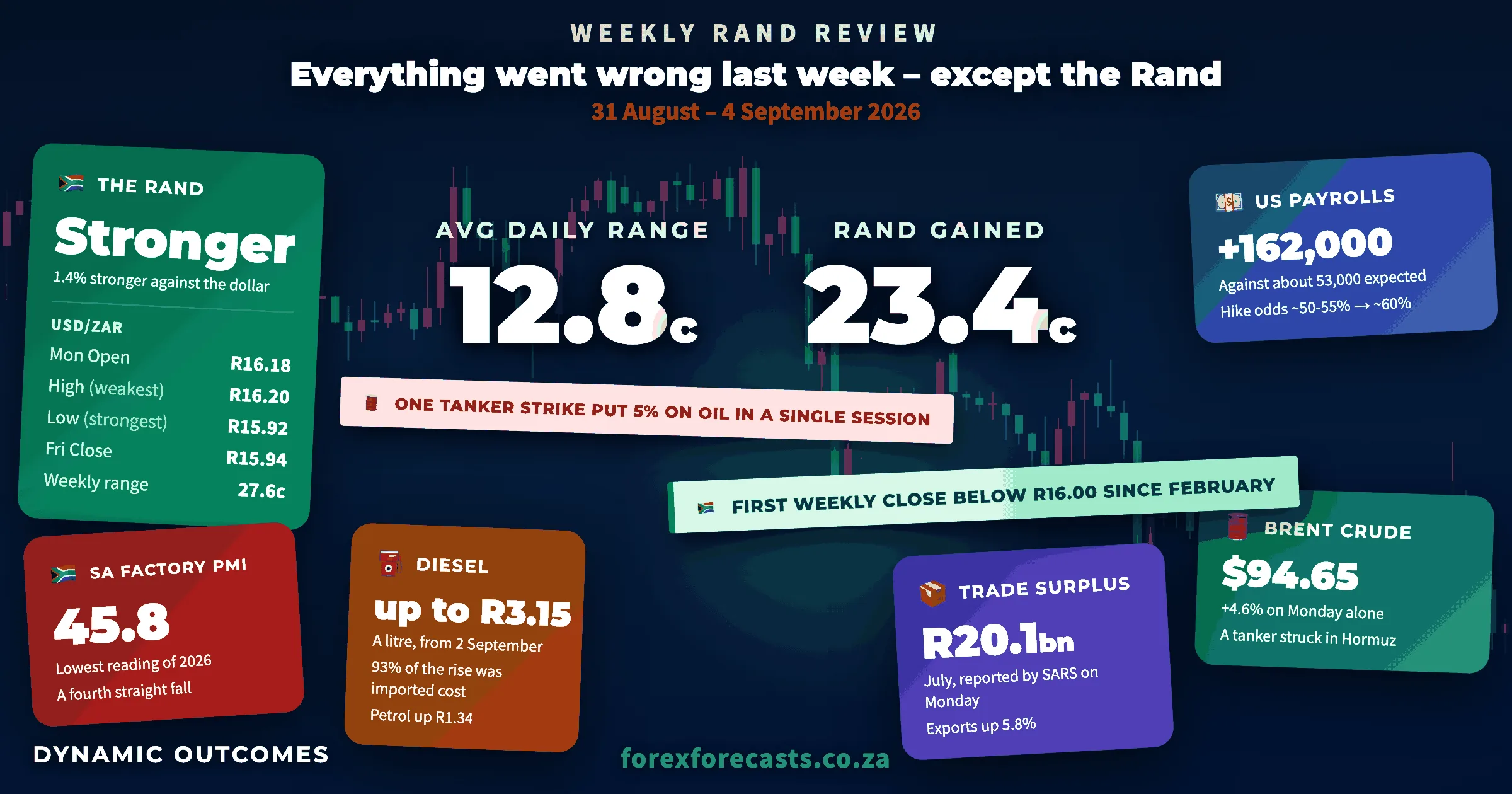
Well, that was a week that had no business ending the way it did...
...and yet the Rand walked out of it at its strongest close since February.
An oil shock on Monday, a fuel hike on Wednesday, the worst factory data we have had all year (and no, that is not a typo) – and then, on Friday, a US jobs number roughly three times what anyone had forecast.
And the Rand? It gained 23 cents through the lot of it.
Here's how it played out...
Key Moments (31 August – 4 September 2026)
Some of the more pertinent headlines and events over the past week:
🛢 A Tanker, And A 5% Barrel – One vessel struck in Hormuz on Monday, and oil did the whole week's work in a session.
⛽ Diesel Up Over R3 A Litre – Wednesday's adjustment put over R3 on the cleaner grade, and almost none of it was our doing.
🇿🇦 Our Factories Had Their Worst Month Of 2026 – The Absa PMI fell for a fourth straight month, and business activity fell off a cliff.
🇺🇸 Two Jobs Reports, Opposite Answers – ADP had the US labour market stalling on Wednesday, and then payrolls said the exact opposite on Friday.
📊 The Fed Argument Is About A Hike Now – Three of them already dissented for one back in July, and Friday did nothing to talk them out of it.
🌍 AGOA Signed Through To 2028 – Trump signed it on Wednesday inside a stopgap funding bill, and we had asked for fifteen years.
Monday opened at R16.18/$ with a Middle East story that had stopped being rhetorical over the weekend.
A tanker took three projectiles in the Strait of Hormuz and two seafarers were killed. WTI put on 5.2% to $90.22 and Brent 4.6% to $94.65.
Now, an oil shock is supposed to be bad news for a country that imports most of what it burns...
...but the Rand promptly gained 7 cents.
Most, not all, mind. Sasol still makes close to a third of our fuel out of coal at Secunda, and Mossel Bay would be making a good deal more of it if the gas had not run dry back in 2020.
What was interesting is that the sentiment bias was suggesting this, despite the news, as our Friday update showed – before a cent of this had happened.
In essence, while we stayed below R16.28, the bias was lower.
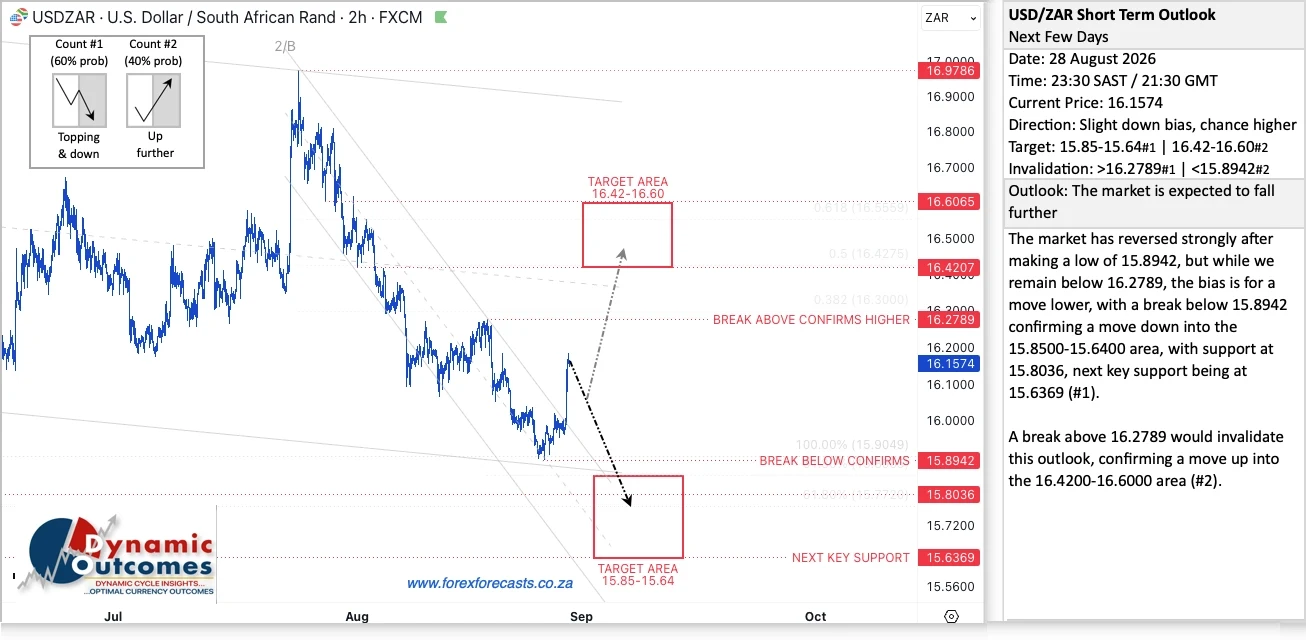
USD/ZAR Short Term Outlook, 28 August 2026
A R20.1 billion trade surplus from SARS that afternoon did help a bit to boost the Rand, even as the US dollar was having trouble of its own.
Tuesday was the only session that went against us, and the day the local news was at its worst.
The Absa manufacturing PMI came in at 45.8 from 46.8 – a fourth straight decline and the lowest of 2026. The business activity index inside it collapsed from 48.8 to 40.2, which is a stall, not a slowdown. Tellingly, the weakness was almost entirely domestic, while export sales improved.
The Rand gave back 4 cents, but that was all the punishment it was going to get.
The White House, meanwhile, was busy extending AGOA to 2028 – of which more below.
Wednesday was the day the Rand did its real work (and the fuel price its real damage).
The gazetted adjustment took effect: R1.34 on a litre of petrol and R2.94 to R3.15 on diesel. Roughly 80% of the petrol increase and 93% of the diesel increase came from international refined product prices...
...which is to say, from a barrel priced in US dollars none of us has any say over.
Then, mid-afternoon our time, ADP reported US private payrolls up just 38,000 in August, the weakest since January and short of the 47,000 expected.
Of interest, the selling in the greenback had begun a good hour before the number was out. By the close the Rand had taken 11.3 cents – the biggest single-day gain of the week, and R16.00 was suddenly in view.
And in other news...
🛢 One Tanker, And A Gold Price Going The Wrong Way. Monday's attack on the MT Sidr came at the end of a weekend that had already seen US strikes on IRGC launchers at Larak Island, in a conflict now in its seventh month. Hormuz is running about 4.9 million barrels a day against 21.6 million before the war.
And here is the odd part. By Friday, with the barrel up near $95, gold was down 1.3% on the day at about $4,420.
A war in the Gulf, and the safe haven falls anyway...
It would seem that the market was discounting the legacy media narrative...and realizing that Iran was being squeezed into a corner, with not many cards left to play.
🇿🇦 AGOA To 2028, With The Trapdoor Open. Trump signed the extension on Wednesday, tucked inside a stopgap funding bill rather than passed as a law of its own. SA had asked for fifteen years and got two.
SA vehicles are already carrying 25% under section 232 and another 12.5% under section 301 since July, which takes most of the shine off duty-free access. The 2027 eligibility review opened in June, and the President decides that one annually...
...so it is an extension and not a settlement, whatever the headlines say.
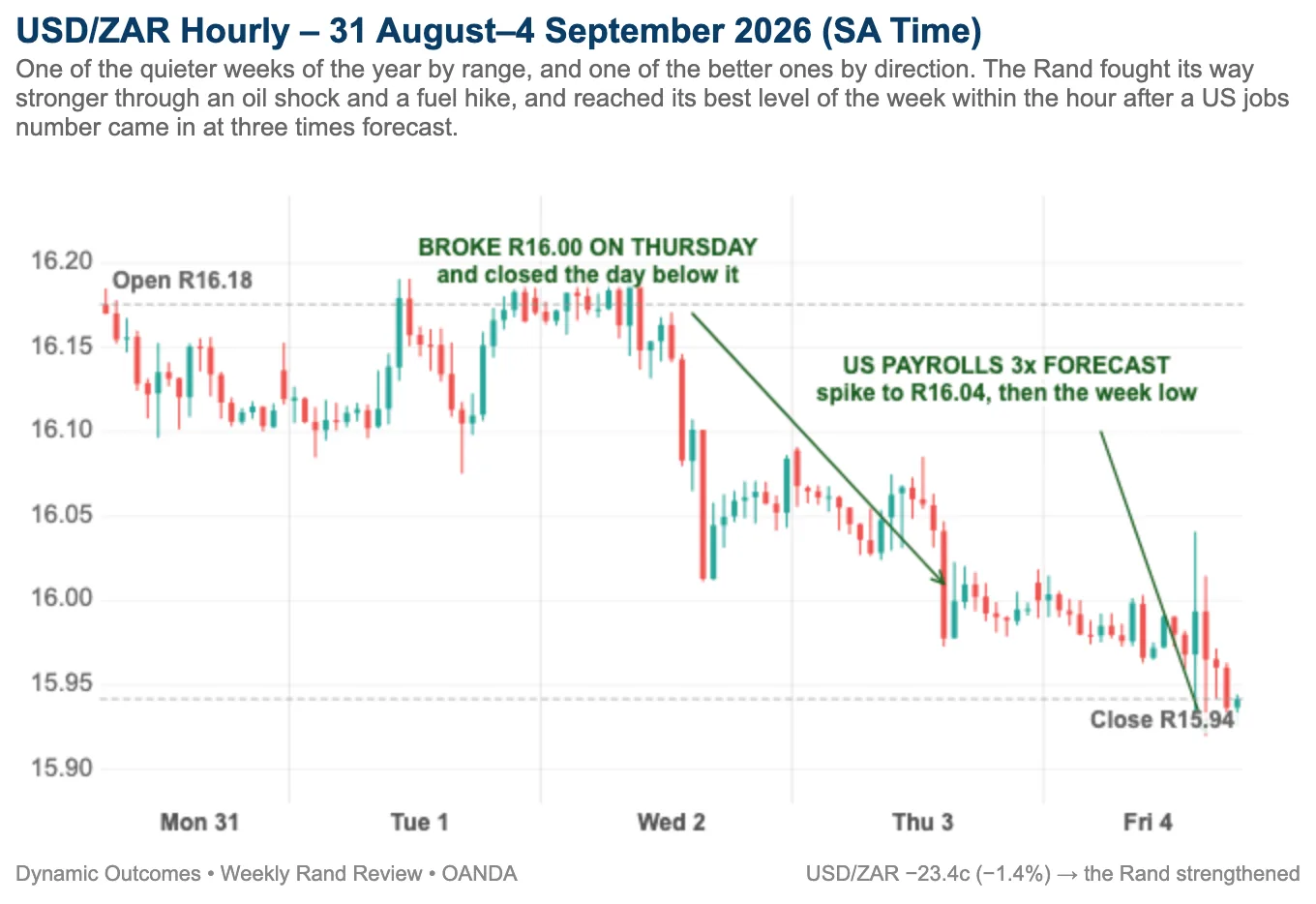
USD/ZAR hourly, 31 August – 4 September 2026 (SA time) · OANDA
To get back to the Rand – Thursday was the day the level finally gave.
Early in the afternoon the Rand pushed back below R16.00, and this time it closed the day there. All on a day the US turned in a trade deficit of $88.6 billion, $17.4 billion worse in a single month.
A Fed governor spent the afternoon leaning towards a hold, yields eased back across the curve and the yen put on more than 2% in a day.
We closed at R15.99, having given the level a proper test rather than a touch.
Friday brought the number the whole week had been waiting for, and it was not even close to expectations.
US non-farm payrolls came in at +162,000 against a consensus of about 53,000 – three times what the street had braced for. June and July were revised up too, and July flipped from a reported loss of 23,000 jobs to a gain of 21,000...
...which quietly deleted the entire "the US labour market is rolling over" narrative that had been doing the rounds.
And in the old playbook, that is a number which buries every emerging-market currency on the board. Odds of a Fed hike on 16 September went from around 50-55% to roughly 60%.
And the Rand's answer to it all? It sold off to R16.04 in the hour after the release, but then reversed sharply to register its low for the entire week – R15.92 – inside the next hour...
...while the US dollar could not hold a cent of its spike.
Volatility and Risk Analysis
What that means at the desk, for the Saffers actually paying these invoices: an importer settling a US$1 million bill on Monday morning was looking at R16.18 million. By Friday's close the same invoice cost R15.94 million – a saving of about R234,000 on identical dollars, for waiting just four days.
Of course, for exporters, the opposite was true, and taking action early in the week would have saved them considerably versus waiting.
Open to Close Move: The week opened at R16.18/$ on Monday morning and closed Friday afternoon at R15.94/$ – a 23.4c (1.4%) strengthening
Risk per $1 Million Exposure: R233,740
Average Daily Range: 12.8c (0.8%)
Risk per $1 Million Exposure: R127,800
Maximum Single-Day Move: 18.5c (1.1%) on Wednesday, high to low
Risk per $1 Million Exposure: R184,900
Weekly Range: 27.6c between the week's high and low – a 1.7% swing
Risk per $1 Million Exposure: R276,350
What is interesting is that this was not a wild week by any measure – in fact, that 27.6-cent range makes it one of the quieter of the year. There was no real drama in it...
...but the Rand simply kept grinding away at it, which is often the kind of move that tends to stick.
The Week Ahead (7–11 September 2026)
SA: Q2 GDP on Tuesday 8 September – and after a first quarter that scraped 0.5%, hopes are not high.
US: CPI on Friday 11 September – one Fed governor has said publicly that it decides his vote before the FOMC meets on the 15th and 16th.
Global: The ECB on Thursday 10 September, where the market has a 25 basis point hike to 2.5% as good as done. Canada starts hitting back at the US tariffs on Tuesday, and the Gulf went off again over the weekend (which we will be dealing with next week).
What to watch. Our GDP will set the domestic mood, but the Rand's direction is being decided several thousand miles away, and Friday's US inflation number is where that happens. Coming on top of the payrolls number, and I do not see how they get out of hiking.
What really made it for us this week was that there was some possibility of the market moving higher. We had definite levels in place that provided our clients with an invalidation of the overall down bias should this level be taken out.
It never was – and as a result, both exporters and importers had the right information available to them – to make the right decision and take action at the right time...
...and make a substantial improvement on their bottom line.
And this, despite the news providing every reason for the Rand to have had a poor week...
...once again, highlighting the fact that the news provides triggers but is never a direction-giver – sentiment is.
Until next week – stay sharp, stay skeptical, and don't let the headlines do your thinking for you.
Please do hit reply if you have any questions or comments – I read every one that comes back.
To your success~
James Paynter
Want the call before the move? See the Strategic Rand forecasts.
Want the full Rand cycle picture?
Register Free for Rand Forecasts