🇺🇸 The Fed Hiked...The Rand Shrugged It Off by Thursday
Published 21 September 2026
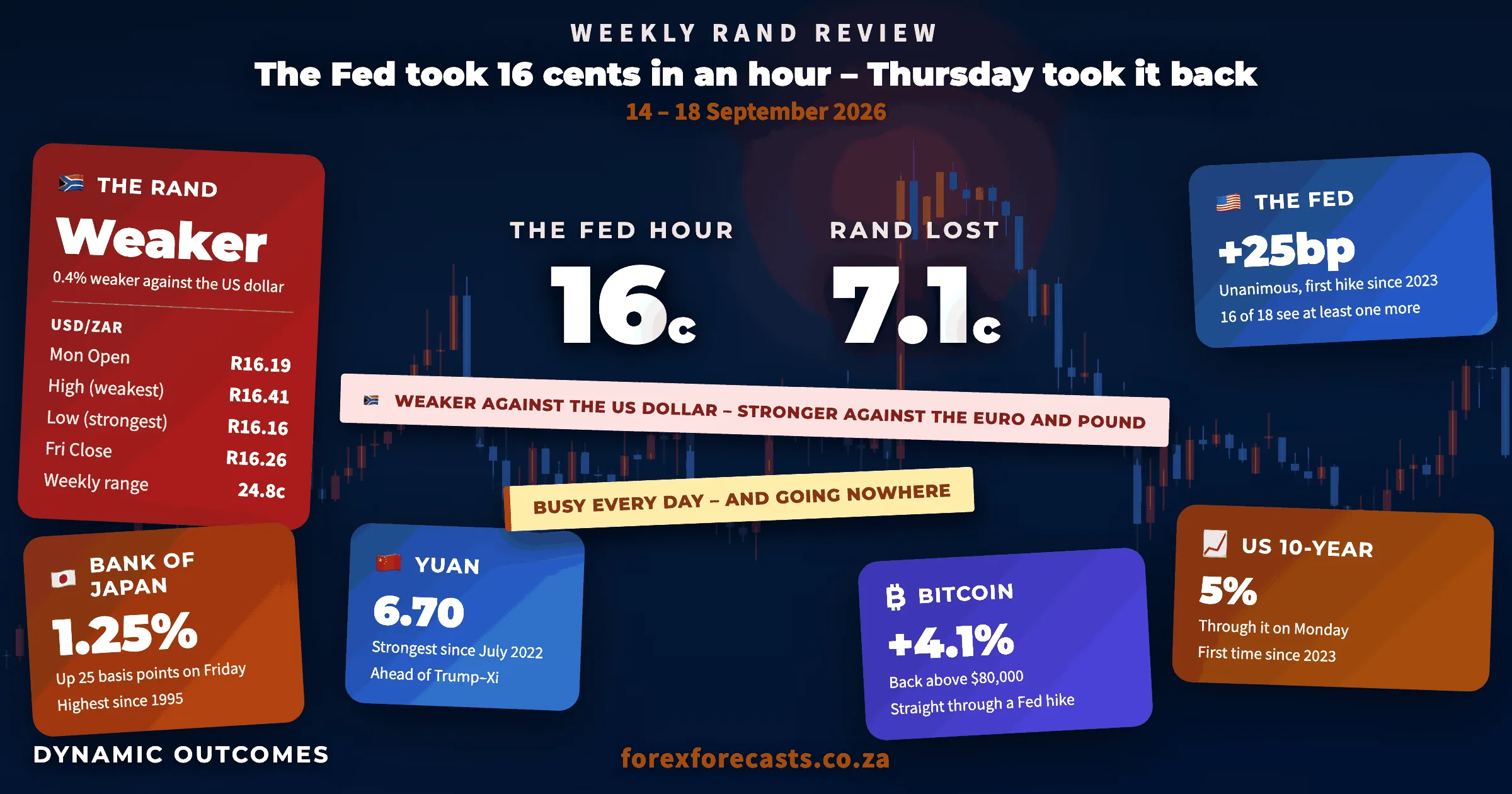
Well, the Fed finally did what the market had spent the past week talking itself into...
...and the Rand paid for it with 16 cents in a single hour on Wednesday evening.
Then, by Thursday afternoon, it had quietly taken the whole lot back.
It opened the week at R16.19 and closed it at R16.26 – just 7 cents weaker, but stronger against both the euro and the pound. Not bad for a week the US dollar was supposed to own!
Let's dig into it...
But first – the call we had out before any of this began.
The cycles had the US dollar topping out against the Rand and falling further from there, with a level at R16.28 that would delay the move and a close above R16.42 that would prove us wrong.
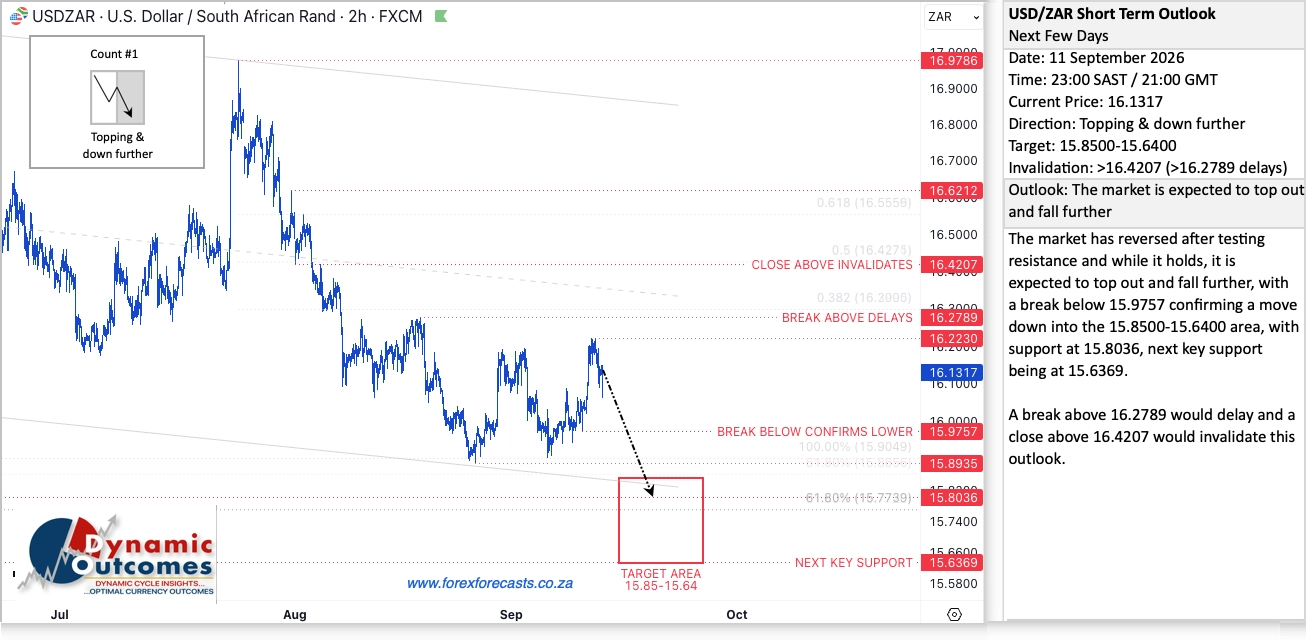
USD/ZAR Short Term Outlook, issued Friday 11 September 2026 – before the week opened.
Key Moments (14–18 September 2026)
Some of the more pertinent headlines and events over the past week:
🇺🇸 The Fed Hikes – The first rise since 2023, and not a single hand went up against it.
💵 Dollar Index Back Over 100 – With the euro sliding from 1.16 to 1.15 against it.
🏦 Other Rate Decisions Followed – Japan hiked to its highest rate since 1995, while London held with three votes for a hike.
🇺🇸 Washington Restricted Visas for Some South Africans – It arrived here overnight on Tuesday, aimed at officials, with the US ambassador calling it the first of several measures.
🇿🇦 SA Bonds and the JSE Firmed – Our 10-year yield eased to around 8.8% on Thursday and the All Share added half a percent, even as the Fed tightened.
🇿🇦 Electoral Court Dismissed the ANC's Candidate Challenge – 181 of its candidates stay off the ballot in six municipalities, seven weeks out from the local elections.
⛽ October Fuel Price Hikes – The petrol warning is now over R2 a litre. Where does it end?
Monday opened at R16.19 with an early warning in it. The US 10-year yield went through 5% for the first time since 2023, and the Rand had a 9-cent hour straight after lunch our time, up to R16.35 by mid-afternoon.
The local unit clawed some of that back before our market closed at R16.22 – 3.3 cents weaker on the day, and already through the first of our lines.
Tuesday was the same shape, just smaller – pushed out to R16.35 again by mid-morning, then working its way back to close a couple of cents better at R16.25.
Wednesday was the day everyone had circled, but for most of it absolutely nothing happened.
Saffers woke up to some surprise news out of Washington, as the State Department published an announcement on Tuesday evening in Washington, aimed at South Africans it holds responsible for race-based discriminatory legislation, land expropriation without compensation, and the incitement of racial violence.
No list will be published, so those affected will find out when they next apply to travel (which is its own kind of message).
Pretoria called the move unilateral, which is the reply you would expect. What matters more is the sentence that came after it: the US ambassador called this the first step in a series of escalatory measures...
...and the next steps in a series like that one tend to cost rather more than a visa. To my mind, years of Pretoria cosying up to Beijing, Moscow and Tehran were never going to be free, so the bill is now being presented in instalments.
The Rand, for its part, barely flinched. The news arrived here at 2am on Wednesday, and by the time our market opened it was a shade firmer than when Washington pressed publish.
The next potential trigger was US retail sales, coming in at 1.2% against 0.8% expected – the best month since March...
...which, if you believe the textbooks, should have sent the greenback flying the moment it came out.
So did it?
Nope. It barely twitched (so much for the textbooks), closing the SA session at R16.27, 3.5 cents weaker, and waited for the Fed.
Just after 8pm our time the Fed hiked by 25 basis points, unanimously...
...and for the hawks, all but two of the eighteen officials pencilled in at least one more before the year is out.
And the Rand?
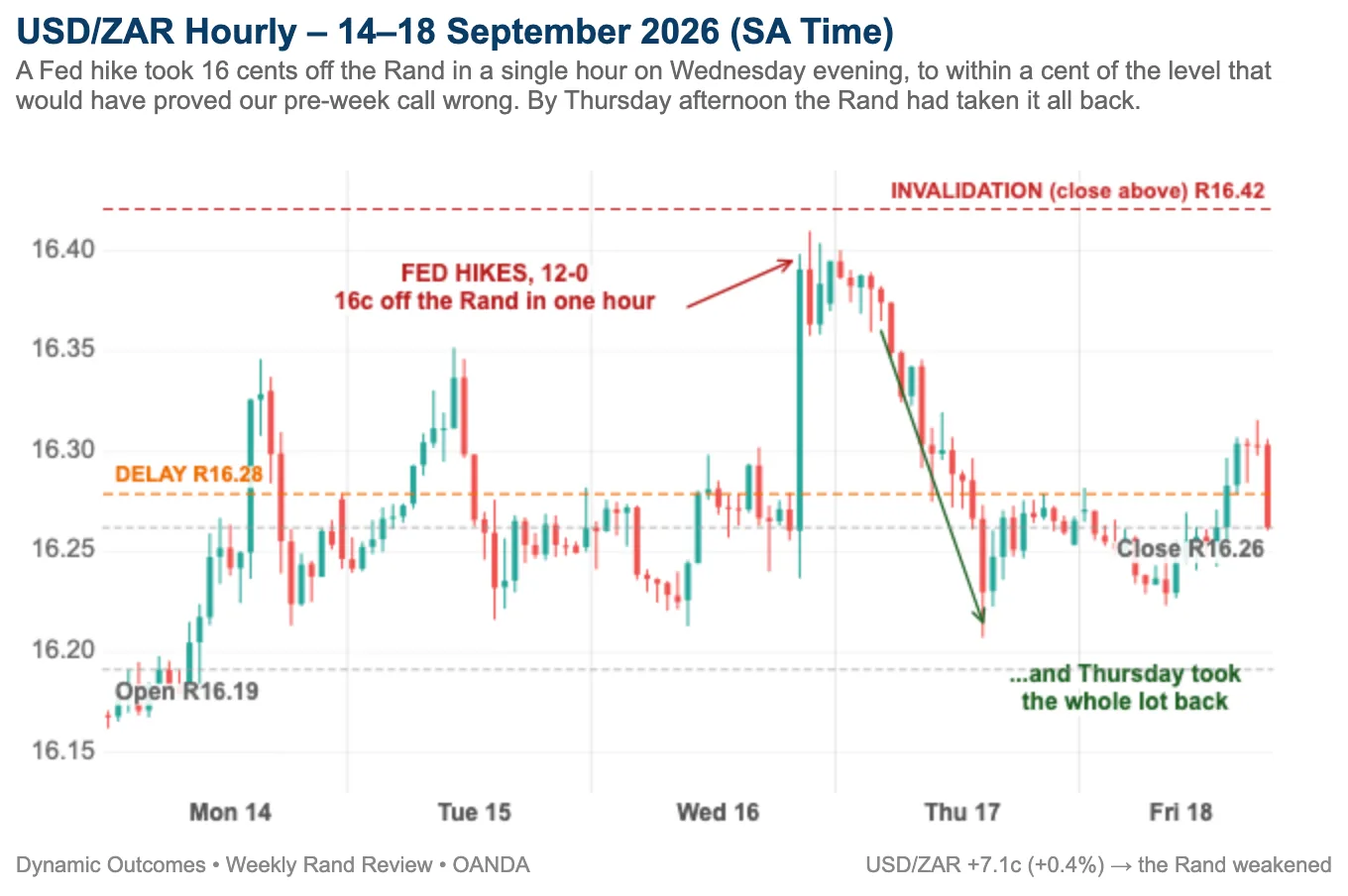
It went from R16.24 to R16.40 inside the hour, and on to R16.41 shortly afterwards – its weakest level since the first week of August!
New Fed chair Kevin Warsh then gave the shortest press conference since they began doing them in 2011, about 30 minutes (short and to the point, for once), the gist of which was that inflation is too high and has been for too long...
...which is not exactly news to anyone who has filled up a car this year!
In Other News
And in other news...
The yuan reaches its strongest level in four years. The offshore yuan went to 6.6957 to the US dollar on Friday, its best since July 2022. Beijing had set a firmer daily fixing for eight sessions running, in the very week the greenback was strong against almost everyone else!
Trump and Xi meet on the 24th, and a firmer yuan going into that room is about as clear a gift as Beijing knows how to give...
...so watch that meeting, because if it goes well, currencies like ours tend to get dragged along with it.
Three other central banks make their vote. Brazil cut on the Wednesday, the Bank of England held with three of its nine wanting a hike, and the Bank of Japan went up a quarter point on Friday – its highest rate since 1995.
Four central banks, three very different answers, but the only one that moved the Rand was 8,000 miles away.
SA bonds rally the morning after the Fed. Our bond market had already shut for the day, three hours before Washington said a word, so Thursday was the first session in which it could answer at all. Our 10-year yield eased about 11 basis points to around 8.8% (it had been above 9% earlier in the month), while the All Share added half a percent to 114,157 and gold sat 1.2% firmer at $4,315.
A US rate rise is supposed to pull money out of places like ours...
...and instead, on the first morning our market could answer the Fed, our bonds were being bought. Firmer commodity prices are the explanation being offered. However, I would keep an eye on what our own inflation figure and the SARB do to that on Wednesday.
Bitcoin closes above $80,000. Up about 4.1% on the week, from $77,664 to $80,861...
...and on a week of a Fed hike that was supposed to be bad for exactly this sort of asset!
October's petrol increase is now put above R2 a litre. The latest projections have petrol up R2.17–R2.29 and diesel up R1.87–R2.22 from the 7th, which would put the pump price into record territory – for Saffers paying for a Gulf war we have nothing to do with.
To get back to the Rand then...
Thursday is where it got interesting.
The Rand opened our morning at R16.35.
And surely it would carry on where Wednesday night left off?
Not a bit of it!
By early afternoon it was all the way back at R16.21.
Then US jobless claims came in at a very low 196,000 (should be bullish for the greenback)...
...and yet the local unit still did not care, closing the day a whisker better than Wednesday at R16.27.
Now just think about that for a moment...
...the Rand's close on Thursday was a fraction of a cent better than its close on Wednesday, before the Fed had said a word.
A full-blown rate hike, a Fed promising more to come and a strong jobs number – but by the next afternoon, the net cost to the Rand was nothing at all!
To my mind that tells you where Wednesday's move really came from – not the decision itself, but a crowd that had been buying US dollars for days in anticipation...
...and by Thursday morning there were simply no more persons to push the greenback any higher!
Friday was quiet by comparison, a 9-cent range from start to finish. The Bank of Japan hiked overnight, the 10-year went back above 5%, and the Rand drifted to close the week at R16.26.
So what does that leave of the call we started with?
The market went through the first level on Monday afternoon. It never managed the second – Wednesday's high stopped a single cent short of it.
We continued to call lower with our update on Wednesday – and the week closed back underneath both.
Such is the value of understanding where sentiment actually stands in a big week like this!
Volatility and Risk Analysis
For those of you carrying US dollar exposures, here's what the week meant in Rand terms:
Open to Close Move: 7.07 cents
Risk per $1 Million Exposure: R70,700
Average Daily Range: 16.03 cents
Risk per $1 Million Exposure: R160,300
Maximum Single-Day Move: 19.70 cents, Wednesday's range
Risk per $1 Million Exposure: R197,000
Weekly Range: 24.78 cents, R16.16 low to R16.41 high
Risk per $1 Million Exposure: R247,800
But here's the really interesting part: by weekly range this was the fourth narrowest week of the year's 38, and yet the average day swung more than any week since late July.
Busy every day, and going nowhere...
...which is exactly the kind of week that punishes whoever feels they have to act.
An importer who bought at Thursday's open instead of early that afternoon paid 14.2 cents more on every US dollar – about R142,000 per $1 million – between breakfast and early afternoon...
...and if they had just waited until the close, 8 of those 14 cents would have come back to them in the forex profit account!
The Week Ahead (21–25 September 2026)
SA: It is our turn. August inflation and the SARB's rate decision both land on Wednesday the 23rd, and Heritage Day closes SA markets on Thursday the 24th.
US: Government funding runs out on the 30th, and a shutdown from 1 October would put the next payrolls figure at risk.
Global: Trump and Xi meet on the 24th, and the yuan has already told you which way Beijing is leaning.
What to watch. R16.42. A Fed hike could not get the Rand through it, and I will be watching very closely to see whether our own inflation figure and the SARB can manage what the Fed could not.
For all the noise, the Fed's hour cost the Rand nothing that Thursday did not hand straight back.
Which is worth remembering on Wednesday, when it is our turn.
I would love to know your thoughts on any of this issue – just hit reply, I read them all.
To your success~
James Paynter
P.S. Every week we publish the level that would prove us wrong, before the week even starts, at a price and in writing. This week a Fed rate hike took the Rand to within a cent of it... and then turned straight back. That is what 21 years and 8,756 scored Rand forecasts at 72.3% average accuracy gives you – a map, and a line that tells you when to stop. See the Strategic Rand forecasts
Want the full Rand cycle picture?
Register Free for Rand Forecasts