📈 Four Quiet Days of Rand Gains...Then Friday Happened
Published 31 August 2026
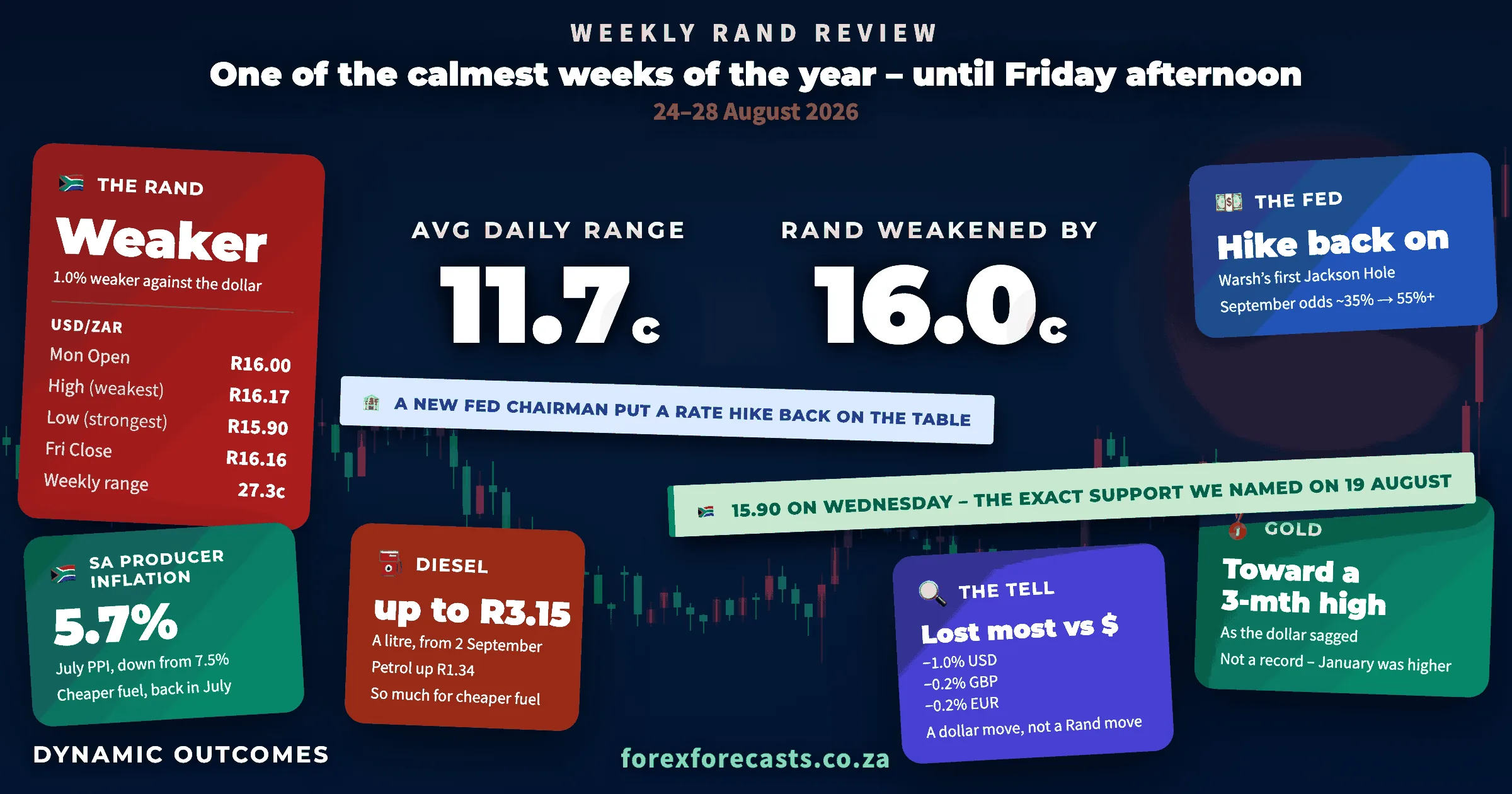
Well, that was a week of two completely different halves...
...and the second half only lasted one afternoon.
For four days the Rand went quietly about its business, picking up ground against a US dollar that had very little to say for itself. By midweek we were trading at our best level since February (and nobody said a word about it).
Then a new Fed chairman stood up in Wyoming!
Here's how it played out...
Key Moments (24–28 August 2026)
Some of the more pertinent headlines and events over the past week:
🇿🇦 SA Factory-Gate Inflation Cooled Sharply – Producer inflation down to 5.7% from 7.5%... good news, for about a week.
⛽ And Then, The Fuel Price – The 2 September adjustment undoes rather a lot of it.
🇺🇸 A New Fed Chairman's First Jackson Hole – Kevin Warsh takes the biggest platform in central banking, but declines to use it.
🔥 US Inflation Refused To Cool – Core PCE held exactly where it was, two days before the Chairman got to his feet. Timing, as ever.
🌍 Is Hormuz Open Or Shut? – Washington and Tehran cannot agree, and Brent fell anyway. Work that one out.
Monday opened with the Rand at R16.00/$ and a local calendar containing precisely nothing (no data, no SARB, not so much as a speech worth the name).
Which is not the disadvantage it sounds like...
...because when there is nothing at home to fret about, we simply take our lead from the US dollar.
The US dollar, however, was flat on its back, the index having slipped to its weakest since mid-May.
We drifted a shade weaker through the session, dipping to R15.97 early in the morning before handing it back and a bit more, closing us out at R16.02/$... a 2c day that nobody noticed.
But our updated analysis from the Wednesday before had already told us and our subscribers where this was headed, as the chart we published shows.
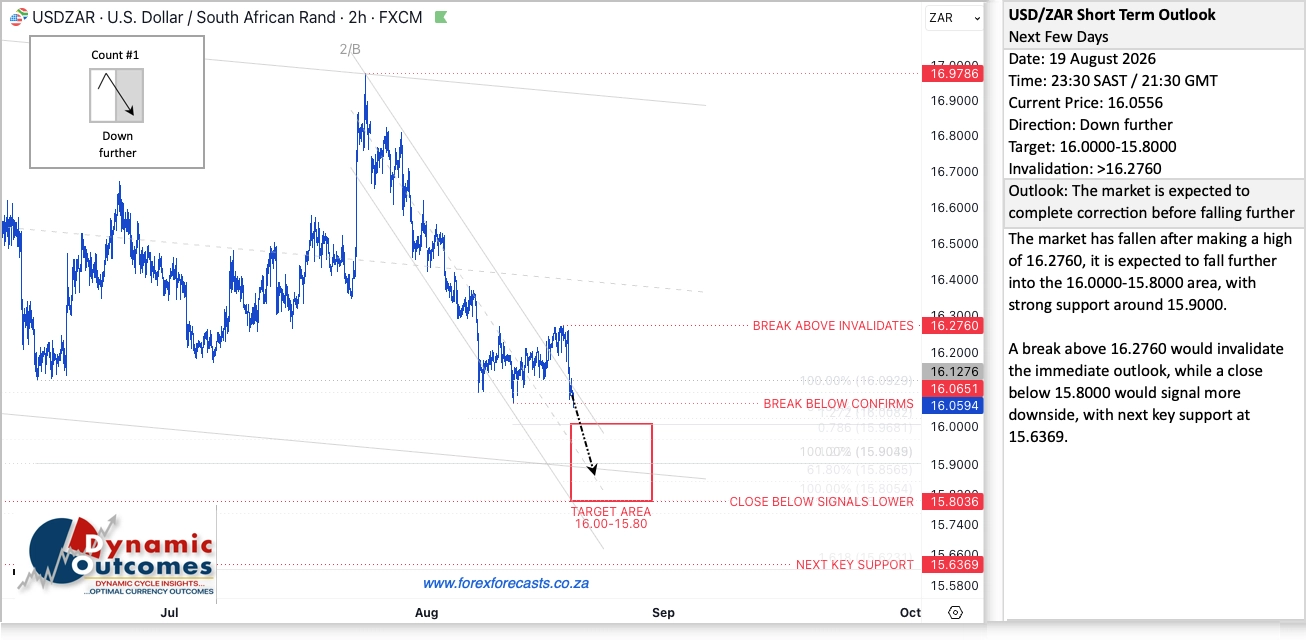
USD/ZAR Short Term Outlook, 19 August 2026
The outlook was clear enough – a continued move lower into the R16.00 to R15.80 area, with support expected around R15.90 on the way down. A break back above R16.28 would have killed it outright.
Quite something to put in writing, considering we had not traded down there since February...
...but that is what the analysis was telling us, whatever the news chose to throw at it.
It was going to be an interesting week.
Tuesday was when we started to move. And we moved the way we usually do when nobody is watching – slowly, quietly, no fuss about it.
There was still nothing local to react to. Even so, the US dollar stayed heavy, gold pushed on toward a three-month high, and foreigners kept buying South African bonds. We took full advantage, working our way down through R16.00 and closing the SA session at R15.95/$...
...which was 7.5c of gain, in a week that was supposedly going nowhere.
And then came Wednesday. By early afternoon we had reached R15.90/$ – our strongest level since the last week of February, with six months of lost ground clawed back.
And that, indeed, is precisely where it stopped.
At 2:30pm our time the US released their July PCE inflation figures, the ones the Fed watches above all others. Core inflation held at 3.3%, exactly where it was expected to, with the headline number running hotter still at 3.7%.
So it held, when the whole market needed it to fall...
Every position out there was betting the Fed would be cutting by September. But what is the reality? Inflation had not moved an inch.
We turned in the very hour we made the low, and by the close had given back 8.8c to finish at R15.99/$...
As you would have seen, our 19 August forecast had named R15.90 as strong support, a week before any of this. And that is exactly where the market went – and then stopped!
And that is the thing we keep coming back to – **the cycle patterns tell us how market sentiment is placed**, while the news just decides which day the market gets around to respecting this.
In Other News
The Strait That Is Open. Or Closed. – Depends entirely who you ask. Washington says the blockade holds and the strait is "open and operating", mines cleared. Tehran says it is shut until America changes its behaviour, and that it opens and closes on Iran's command alone.
The shipping data (for what it is worth!) appears to flatter neither of them. Traffic has been moving again since the memorandum lapsed, but it is running at a small fraction of the 85 or so transits a day that used to be normal.
So why is the closed version the one that keeps getting the airtime? Is it a desperate regime leaning on an anti-Trump legacy media to sway opinion? We can certainly ask the question...
...because a blockade that is quietly failing is not much of a bargaining chip. One the world still believes in is worth a great deal – especially with US mid-term (and Israeli) elections on the horizon.
And Brent eased to $88.22 regardless.
Lake America – The master troller is at it again. In what was surely the week's most consequential development, the President signed an executive order on Thursday renaming Lake Ontario "Lake America", in the middle of his trade fight with Canada. "This is official, effective immediately."
And it is not just talk. The US Geographic Names Information System has made the change official, and Google Maps now shows Lake America to anyone looking from inside the United States, Lake Ontario to anyone looking from Canada, and both names to everybody else. MapQuest is holding out.
The backdrop is a trade fight Canada has rather more to lose from. Talks collapsed the Friday before, and by the next morning the tariffs Canada had been negotiating to avoid were 50% – on $20 billion of its goods. Dairy, drink, cement, hockey equipment.
Washington says Canada walked. Ottawa says the US moved the terms, but this comes from a country that has kept American dairy out for decades behind quotas that let a set amount in free and then charge 245% on cheese and 298% on butter above it.
More than 70% of the goods Canada sells abroad are bought by a single customer. Canada needs the US a good deal more than the US needs Canada, and Ottawa knows it.
Cheaper Factory Gates, Dearer Forecourts – Thursday brought the only local data of the week, and it was good news: producer inflation slowed to 5.7% in July from 7.5%, largely on cheaper fuel.
Enjoy it while it lasts...
...because Wednesday's fuel adjustment adds R1.34 to a litre of petrol and up to R3.15 to a litre of diesel.
So the very thing that pulled producer inflation down in July pushes it straight back up in September. Only a pricing formula could manage timing like that!
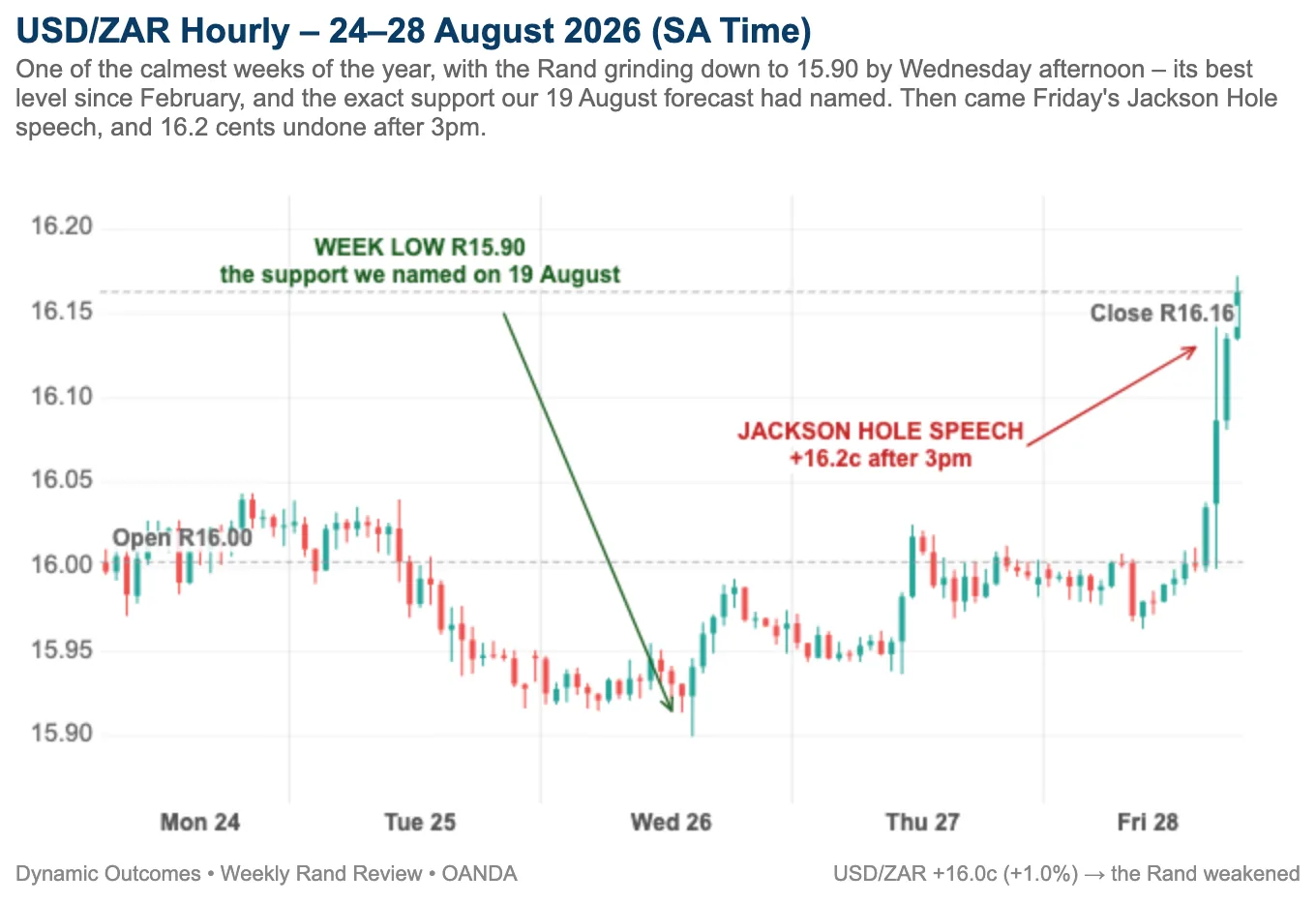
USD/ZAR hourly, 24–28 August 2026.
To get back to the Rand – and Thursday was the day nobody wanted to commit to anything.
US jobless claims came in at 203,000 against the 208,000 expected – reassuring for anyone worried about the US labour market, and mildly unhelpful for anyone hoping the Fed might be forced into cutting.
Even so, we gave back 4.2c across the day to close at R15.99/$ again, within a whisker of where we had ended Wednesday. Our own producer inflation figures, meanwhile, came and went without troubling anybody at all.
Everything was waiting for Wyoming.
Friday opened as quietly as the rest of the week had gone.
And the Rand? It spent the entire morning doing nothing much at all, sitting between R15.96 and R16.01 through eight full hours of trading.
Then, at 4pm our time, Kevin Warsh began his first Jackson Hole address as Chairman of the Federal Reserve.
He called inflation "concerning", he said the Fed had work to do... but then, handed the biggest platform in central banking, he said nothing at all about what he actually intends to do next – remarking that investors should not be looking primarily to the Fed for their next trade.
Markets took it as hawkish, which for a room full of persons positioned for cuts amounts to much the same thing. The odds of a September rate increase went from about 35% to more than 55% in the space of one speech, and the US dollar index recovered everything it had given away all week...
...while we gave up everything we had gained all week, and a good deal more besides, before Johannesburg had even closed.
Through R16.09, then R16.14, finishing at R16.16/$ – a single cent off the week's high, with the candle still pointing upward as the lights went off.
And to put this in a nutshell: Two full years of the market asking the Fed when it would finally start cutting...
...and the new man's opening move is to put a hike back on the table!
Mind you, no doubt the economists will explain it all to us next week.
Volatility and Risk Analysis
Open to Close Move: R16.00/$ to R16.16/$ – a 16.0c (1.0%) weakening
Risk per $1 Million Exposure: R159,940
Average Daily Range: 11.7c (0.7%) – the second-narrowest of the 34 weeks so far this year
Risk per $1 Million Exposure: R117,478
Maximum Single-Day Move: 17.4c (1.1%) on Friday
Risk per $1 Million Exposure: R174,220
Weekly Range: 27.3c (R15.90 low to R16.17 high) – a 1.7% swing
Risk per $1 Million Exposure: R272,870
What that means at the desk: an importer settling a US$1 million invoice on Friday morning was looking at just under R15.99 million. By the close it was R16.16 million – **R174,000 more for the very same dollars**, on the very same day, and every cent of that arrived after lunch.
By contrast, the exporter had the mirror image of it – and a considerably better afternoon.
One thing worth holding on to before you blame the Rand for any of it. We lost 1.0% against the US dollar last week. Against the pound we lost 0.2%, and against the euro 0.2%.
That is not a currency being sold off. That is a US dollar being bought, and we happened to be standing on the other side of it.
And if you had cover on before Wyoming? Friday cost you nothing at all. If you were holding out for a better level, you are now looking at a worse one – and it took a single afternoon to get there.
The Week Ahead
SA: Absa PMI and naamsa vehicle sales (Mon), the S&P Global PMI (Thu). And the fuel price (Wed) – petrol up R1.34, diesel up to R3.15.
US: ISM surveys (Tue and Thu), and non-farm payrolls (Fri).
Europe & UK: Eurozone flash inflation and the PMIs (Tue). No Bank of England decision.
But it comes down to Friday. Consensus has US payrolls under 100,000, which would be the fourth month running.
Well that was another humdinger of a week, and in no time at all, we are two thirds the way through the year!
Once again, having an objective view helped our clients keep their emotions in check – but it would have needed a heads-up to have got the low before Warsh's statement.
We have already updated the short-term call after Friday. But I would not read too much into that closing candle from Friday – the bigger picture has not changed anywhere near as much as it looks, but we are watching key levels to confirm the current outlook.
Do let me know your thoughts on this one – simply hit reply. I read every response that comes back.
To your success~
James Paynter
Want the call before the move? See the Strategic Rand forecasts.
Want the full Rand cycle picture?
Register Free for Rand Forecasts