📈 The Quietest Week of 2026 – And the Rand Still Could Not Gain on a Falling Dollar
Published 17 August 2026
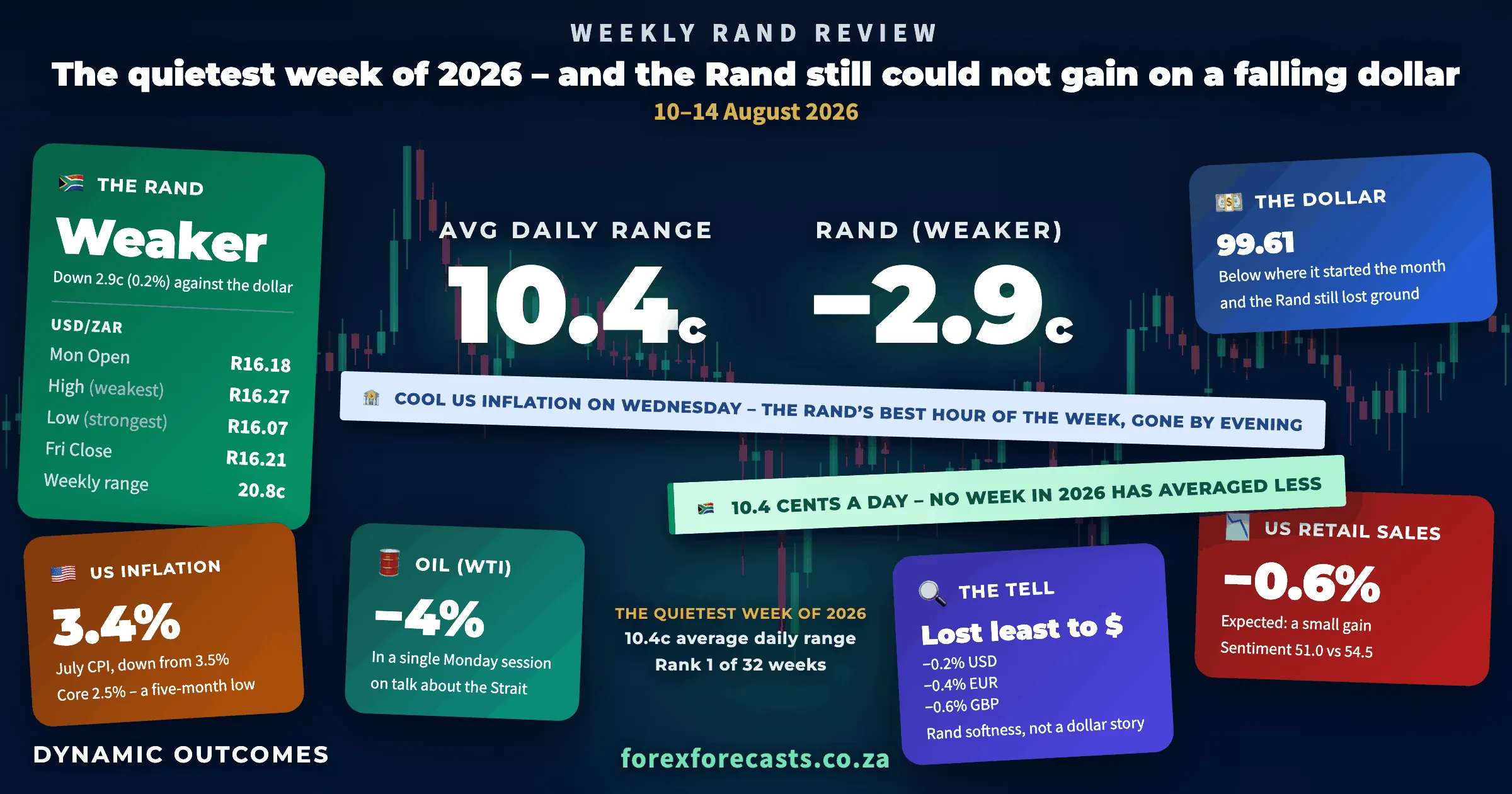
There was nothing on the South African calendar this week – the second week running.
And the Rand was handed just about everything it could have asked for...
...a dollar going backwards, a cool US inflation number on Wednesday, and metals holding firm underneath.
It went backwards anyway – 2.9 cents of it.
Here's how it played out...
Key Moments (10–14 August 2026)
These were some of the major headlines and events over the past five days:
🇺🇸 US Inflation Came In Cool. Wednesday's July figure undershot on the month, and the annual rate came down to 3.4%.
💵 The Dollar Kept Falling. The index drifted lower all week, with nothing stepping in to stop it.
⚖️ Producer Prices Landed Thursday. The headline read one way, the detail underneath read another.
💰 The American Consumer Turned Up Twice On Friday. Retail sales and sentiment, both weaker than anyone had pencilled in.
🇿🇦 Farmers Marched On The JSE. Grain producers took a pricing fight to Sandton on Thursday over what the trading platform costs them.
🛢 Hormuz Talk Moved Crude. Speculation about the Strait shifted WTI 4% inside a single Monday session.
Monday: Waiting On Washington 📈
The Rand opened the week at R16.18/$ with an empty local diary and nothing scheduled in Washington until Wednesday.
It had been firmer overnight, touching R16.15, and that was as good as Monday got. Through the morning it slipped quietly, then found its feet in the late afternoon, when 4% came off WTI inside a session on nothing more than talk about the Strait.
A cheaper American barrel is good news in principle for an economy that imports every litre it burns – though Brent, the grade our pump price actually keys off, did not follow it down.
And the Rand? Barely took a cent of it.
By the evening it had walked out to R16.21, the softest it would look until Tuesday morning, and closed the day 0.7 cents worse off than it started (half an oil crash in your favour, and a currency that shrugs at it anyway – hold that thought until Friday).
There was nothing local behind any of it...
...which was the first hint that the week's direction was going to be decided somewhere other than here.
Tuesday: The Wrong Way, Quickly 📈
Tuesday finally produced a move worth watching, and it went the wrong way.
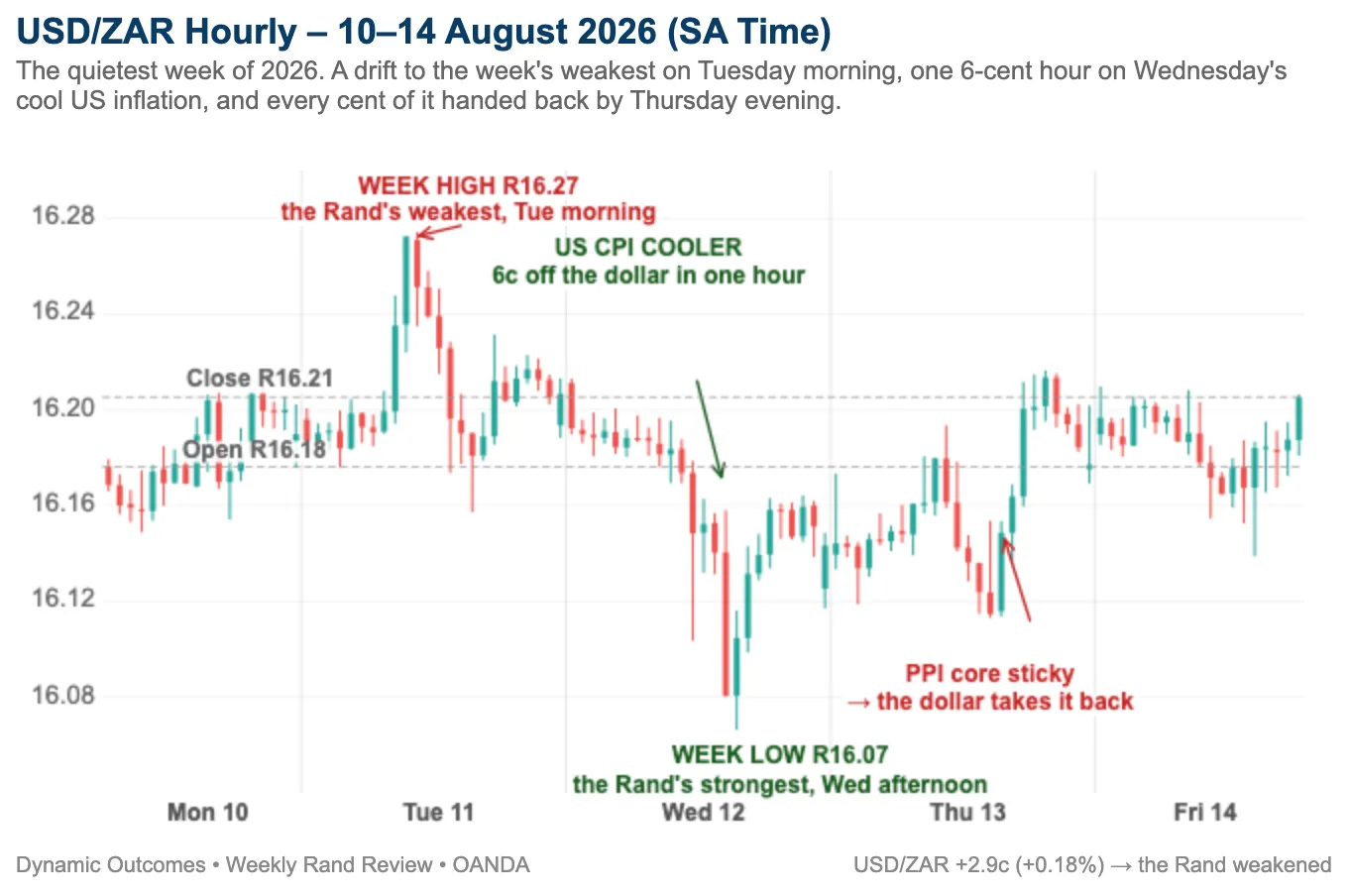
The Rand opened at R16.19 and slid hard from the open – 3.6 cents in the first hour, another 3.7 in the next – until it struck R16.27 mid-morning. That was the weakest point of the entire week, and it arrived on a day with nothing on either calendar to explain it.
Positioning ahead of Wednesday's inflation number is the honest answer...
...and it is not a satisfying one (sometimes the market moves first and explains itself later, and sometimes it never bothers).
What happened next mattered more. From that morning high the Rand fought its way back through the afternoon, reaching R16.16, and then handed most of it back again before the close at R16.20. Net for the day, 1.1 cents worse.
Nearly 12 cents from high to low and back to where it started – that is what waiting for information looks like.
Wednesday: 6 Cents, And Then Gone 📉
Mid-afternoon our time, the US reported that consumer prices rose 0.1% in July against an expected 0.2%, bringing the annual rate down to 3.4% from 3.5%. The core rate came in at 2.5%, the lowest in five months.
That is the number the Rand had been waiting two days for, and it responded immediately. 6 cents came off the dollar inside a single hour – the single biggest hour of the week by some distance – and by mid-afternoon the Rand had run all the way to R16.07 – the strongest it would stand all week.
The call we had published the previous Friday had the direction: lower, before a bottom, with a target zone at R16.02 to R15.80 and invalidation up at R16.38.
Lower it went, and it stopped 4.6 cents short of the zone without ever looking at invalidation (working, then, but not finished).
Then it gave back 9 cents inside three hours – more than the whole move the inflation number had bought it – closing at R16.16, still 3 cents to the good on the day, and the only positive session of the week.
Which should have been the start of something...
...except that by Thursday evening it had all gone.
In Other News
🛢 The Strait: Close, And Still Closed. Iran and Oman spent the week where they spent the last one, reportedly near an agreement on a jointly managed transit route through the Strait, coordinates and all. Tehran's foreign minister was careful to say this is not a reopening – that requires Washington to lift the blockade, withdraw, and pay compensation. Nothing has been signed.
On Monday WTI moved several dollars on nothing that had actually been agreed, which tells you how much of the current oil price is a risk premium waiting to be released.
🚜 Farmers At The JSE's Door. Grain producers marched on the exchange in Sandton on Thursday, arguing that the costs buried in the agricultural trading platform (transport differentials in particular) are being carried by the people who grow the crop and the people who eat it, and by nobody in between. It is a small story with a long tail. South Africa's food inflation runs through those pricing mechanisms, and the Reserve Bank's 3% target runs through food inflation.
⛪ A Licence To Preach. Thousands stood outside the Limpopo Premier's office in Polokwane on Monday, over a proposal that would make preaching a licensed activity.
Their national co-ordinator, Pastor Faith Maswinyaneng, put it plainly: "We are saying no to state interference in matters regarding the church."
Let that sink in. A licence to preach.
We covered this in January, when the chairman of the CRL's own Section 22 Committee resigned rather than front what he called a predetermined agenda of state control of religion. Seven months on...
...the mechanism has a name.
Nothing in it moves the Rand. Watch it anyway – licence first and questions later is not a religion story, it is a permissions story, and permissions regimes never stop at one sector.
One to watch very closely.
📈 Records On One Side, Nothing On The Other. The S&P 500 set another record this week. Gold held above $4,370 for a monthly gain north of 10%, and platinum sat around $1,740. Risk appetite was not the problem this week, and neither was the metal price (which narrows the list of suspects considerably).
To get back to the Rand...
Thursday: Giving It All Back 📈
Thursday was the worst day of the week for the Rand, and it started out looking like the best.
By early afternoon the Rand sat at R16.11, still holding everything Wednesday had won. Then the producer price figures arrived in the same slot, and this time the detail cut the other way.
The headline number was flat. But strip out food, energy and trade, and the core rate underneath ran 0.4% for the month, while jobless claims hit 209,000 where the market had pencilled 202,000. Sticky prices, and nobody losing their job over it.
Cool consumer prices on Wednesday, sticky producer prices on Thursday...
...and the dollar took the second one and ran.
The Rand gave up 3.3 cents in one hour and another 3.7 in the next, and by the evening it had surrendered every inch of Wednesday – back at R16.22, past where it stood before the inflation number ever arrived. It finished the day at R16.20, 5.2 cents worse off, the biggest single-session loss of the week.
Two days, two US inflation readings, and the Rand had round-tripped the whole thing.
Friday: The Pattern Completes 📈
Friday made it three.
The American consumer turned up twice, and both times looked worse than anyone had pencilled in. July retail sales came in at −0.6%, against expectations of a small gain. Sentiment followed later – a preliminary August reading of 51.0 against a forecast of 54.5.
Two bad numbers out of America. Both of them, on any conventional reading, reasons to sell the dollar (and bad news over there used to be good news here).
The Rand had worked its way down to R16.14 by early afternoon, and that was its high-water mark for the day.
By the evening the Rand had slid back to R16.22 (exactly where Thursday evening had left it) and it saw the week out at R16.21.
Three consecutive afternoons, the Rand hit its best level of the day in the hour or two after the US numbers landed. Every one of them, it gave the ground back before the close. It did not matter whether the number was good for the dollar or bad for it...
...the Rand could not hold either.
Volatility and Risk Analysis
2.9 cents. That is the week – and the arithmetic underneath it is more interesting than the number.
Open to Close Move: the week opened Monday at R16.18/$ and closed Friday at R16.21/$ – 2.9 cents of Rand weakness (0.2%).
Risk per $1 Million Exposure: R29,000
Average Daily Range: 10.4 cents (0.6%).
Risk per $1 Million Exposure: R104,000
Maximum Single-Day Move: 5.2 cents on Thursday (0.3%).
Risk per $1 Million Exposure: R52,000
Weekly Range: 20.8 cents (R16.07 low to R16.27 high) – a 1.3% swing top to bottom.
Risk per $1 Million Exposure: R208,000
10.4 cents a day. No week in 2026 has averaged less – thirty-two of them logged, and this one sat at the bottom of the list.
Now the crosses, because they say who did this.
Over the week the Rand weakened 0.2% against the dollar. Against the euro it weakened 0.4%, and against the pound 0.6% – more than three times the dollar figure.
A currency that loses least against the weakest major in the room has not been pushed by that major. The dollar index finished the week at 99.61, below where it began the month and well off its late-July high. The Rand had a falling dollar in front of it for five days and could not take a cent off it.
If you were waiting on a dollar payment this week, the timing barely mattered – and that is its own kind of information. An importer settling at Tuesday's high and one settling at Wednesday's low bought the same dollars 20.8 cents apart, R208,000 on a million. In a normal week this year that gap has been closer to R400,000. Were you positioned for a week that refused to move?
The Week Ahead
SA: South Africa's July inflation figure is the next release that matters. June came in at 5.0%, well above the Reserve Bank's 3% target, and the Committee held anyway last month on a split vote. A Bank that keeps finding reasons not to move – September will require an explanation, not just a decision. No meeting until then.
US: The Federal Reserve publishes the minutes of its last meeting on Wednesday. After a negative payrolls number, a cool consumer inflation reading and a sticky producer one inside three weeks, the internal argument in that room is worth reading.
Global: Watch whether anything is actually signed on Hormuz, and watch the 19 August deadline on the American tariff threat against Canada. A fifty percent tariff between two neighbours is not a South African story on the surface...
...but trade wars have a way of arriving here through the risk trade rather than the trade route.
Our current call has already rolled forward, and this week did nothing to change the read. But those levels belong in the forecast, not in a newsletter.
Closing
The Rand did not have a bad week. It had a week where nothing it was given worked...
...and that is the more useful thing to know.
When it cannot gain on a falling dollar, in the quietest five days of the year, it is telling you something about itself rather than about Washington.
To your success~
James Paynter
P.S. The call we published on Friday the 7th said lower before a bottom. On Wednesday the Rand went lower – 4.6 cents short of the zone we had marked, and never once near the level that would have killed the call. That call is still alive, and the update has carried the levels on from there. That is what 8,756 scored Rand forecasts and 72.3% accuracy over 21 years is actually for. See the Strategic Rand forecasts here.
Want the full Rand cycle picture?
Register Free for Rand Forecasts