📉 Rand Breaks R16/$ For The First Time Since March – And South Africa Supplied Almost None Of It
Published 24 August 2026
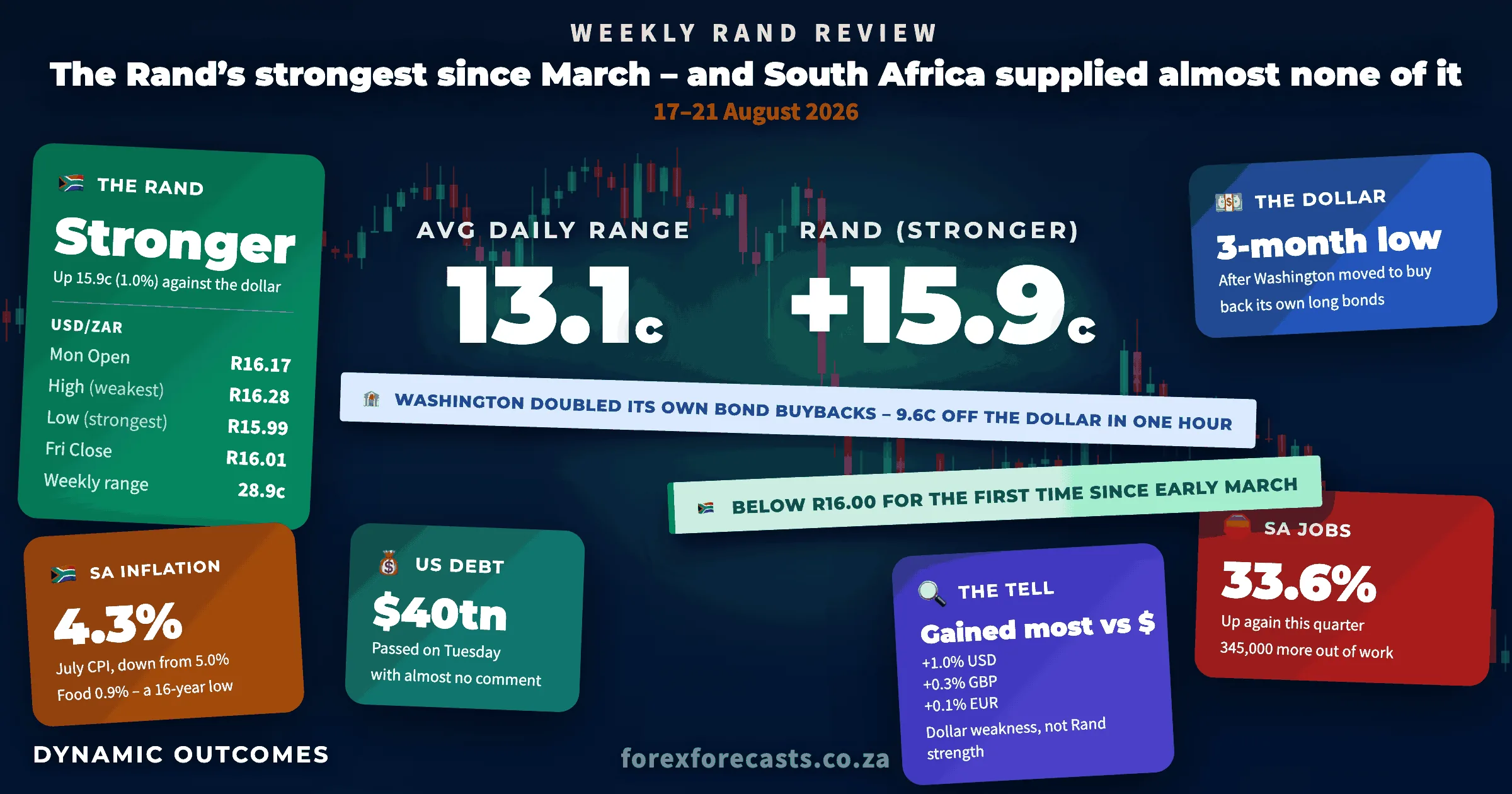
Welcome to another weekly review of how the Rand performed...
...and performed this week – with aplomb!
It was a week that had some mixed news locally (inflation down, unemployment up), while across the Atlantic, US debt hit a new milestone, and Treasury buybacks and Fed minutes sparked a sharp drop in the US dollar.
And the Rand ignored all the bad news and took full advantage of the good to hit levels last seen in March.
Let's see how this all unfolded...
Key Moments (17–21 August 2026)
Some of the major headlines and events over the past five days:
🇿🇦 Inflation Cooled – July inflation came in at 4.3% from 5.0%, food at a sixteen-year low
🏦 US Treasury Doubled Its Own Bond Buybacks – The Treasury moved to take twice as much long-dated debt off the market
💰 The US Debt Passes $40 Trillion – The debt situation hit a new major milestone.
🗣️ Fed Minute Details – 3 Members Wanted A Hike, Middle East on the committee's inflation-risk list.
📊 SA Unemployment Rises – The jobless rate rose to 33.6% – 345,000 more out of work, in the week the currency looked its best since March.
🇿🇦 SA Survives AGOA Extension – US Congress extended its African trade agreement through to 2028, and somehow SA managed to stay on the list.
Monday opened with the Rand sitting at R16.17/$, an empty domestic diary and no international data releases worth worrying about.
The market firmed initially but then gave it all back and was still drifting to close a cent weaker on a day that gave not hints on what the market had in mind for the week.
But our updated analysis and forecast from the prior Friday had give more than just a hint to us and our subscribers, as can be seen in the chart we published.
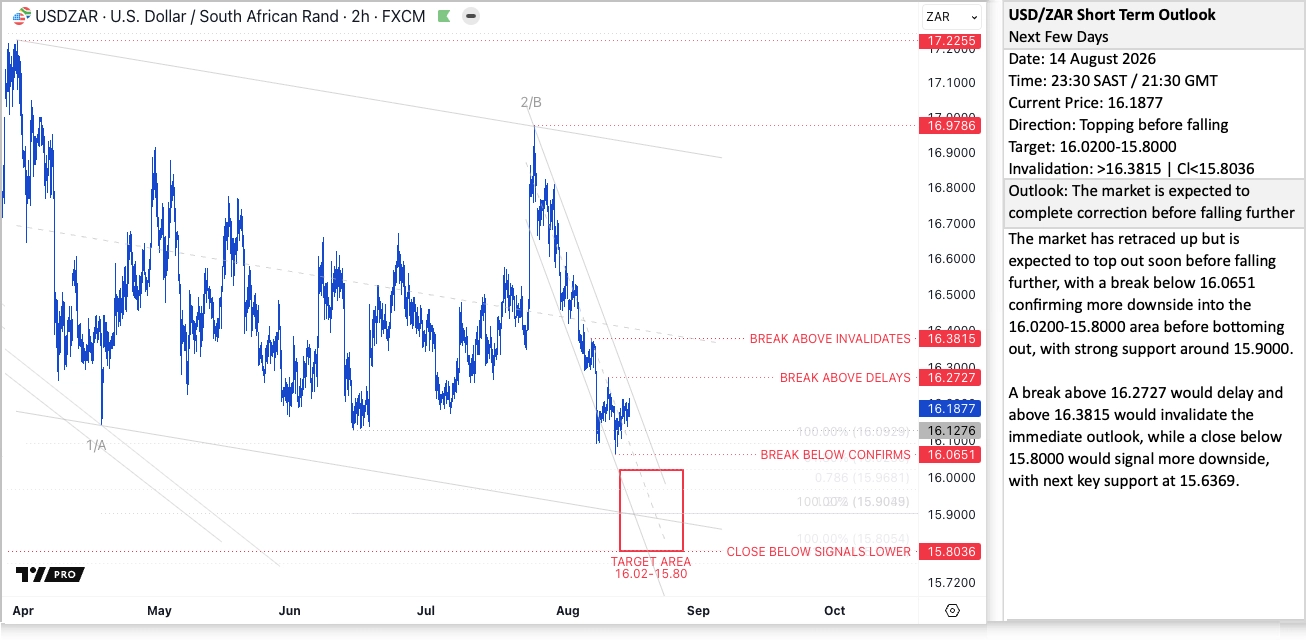
USD/ZAR Short Term Outlook, 14 August 2026 · Direction: topping before falling · confirmation below R16.07 · target R16.02–R15.80 · invalidation above R16.38
The outlook was very clear – a topping out, and then a move lower into that target area. A break above R16.27 would delay, but not invalidate, the call.
Quite a call, considering we had not seen these levels for months...
...but that is what our analysis was telling us, and this is where it was expected to go – irrespective of the news.
It was going to be another interesting week.
Tuesday dawned in what was the quietest session of the week but, in hindsight, its most important in terms of data, with the US national debt passing a mind-boggling $40 trillion!
The bond market had long before done its maths on this, with the long end of the market sitting at levels last seen in 2007, partly on the fiscal picture, but also pricing in Washington's refusal of an extension of its Iran memorandum, putting risk premium back into oil.
And then came Wednesday, and with it came some important local news – and even more important news from the US Treasury.
The first came mid-morning, when Stats SA reported July inflation had cooled to 4.3% from 5.0%, the first easing in five months. Underneath sat a remarkable figure: food inflation came in at 0.9%, the lowest in more than sixteen years.
That came as real relief for households.
Then at 2pm, came major news that the US Treasury announced it was doubling its buybacks of ten-to-thirty-year debt, from $2 billion an operation to $4 billion.
The thirty-year yield came off 9 basis points and the greenback took pain immediately, hitting a three-month low on the US Dollar Index...
...and in so doing, pin-dropped 9.6 cents against the Rand, the biggest single-hour move of the week!
The result: the local currency closed at R16.10, up 14.5 cents on the day.
And it was not only the Rand. Gold, Bitcoin and the rest of the risk complex all took off on the same announcement – anything priced against a weakening dollar had a very good afternoon.
In Other News
🇿🇦 AGOA Lives To Fight Another Two Years. US Congress voted on Tuesday to extend the African Growth and Opportunity Act to the end of 2028, and all 32 countries keep their status, South Africa included. Ratification and a signature are still outstanding, so hold the applause. And note what it does not fix: vehicle exports still carry 25% and 12.5% tariffs regardless.
🛢 The Iran Memorandum Lapsed, Oil Noticed. Washington declined to extend it on Tuesday, traffic through Hormuz is still running at roughly half its normal rate, and Brent finished around $94-95 for a second straight week of 6% gains. By Friday Tehran's president was talking about wanting the war finished – worth what such statements are usually worth...but the pressure is mounting, with Trump holding all. the cards.
🇨🇦 A 50% Tariff Between Neighbours. The three-day pause expired without a deal, Canada recalled its negotiating team, and Washington's 50% tariff came into force against the country it shares the longest undefended border with. If that can happen there, it can happen anywhere.
🏛 "No Longer A Source Of Unity". That is a senior ANC figure describing the Government of National Unity on Thursday, with the DA saying it will stop keeping quiet about the friction. Local elections are coming, and coalitions tend to get honest about each other just before they need the votes.
₿ Crypto Went Vertical On The Same Announcement. Bitcoin finished the week up 22% and through $77,000. XRP put on 56% in five days, its sharpest week since the post-settlement rally of August 2025. And the trigger was not a crypto story at all – it was Wednesday's Treasury buyback, the same announcement that took 9.6 cents off the dollar against the Rand. One debt-management decision in Washington, and everything priced off a weakening US dollar went up at once.
🥇 Metals Had A Week Too. Gold broke $4,500 for the first time since June and ran on to about $4,630, up 5%. Platinum touched a two-month high near $1,900 on our own supply disruptions – and that one matters more to us than the gold move, since we mine most of the world's platinum and the price lands in the trade account.
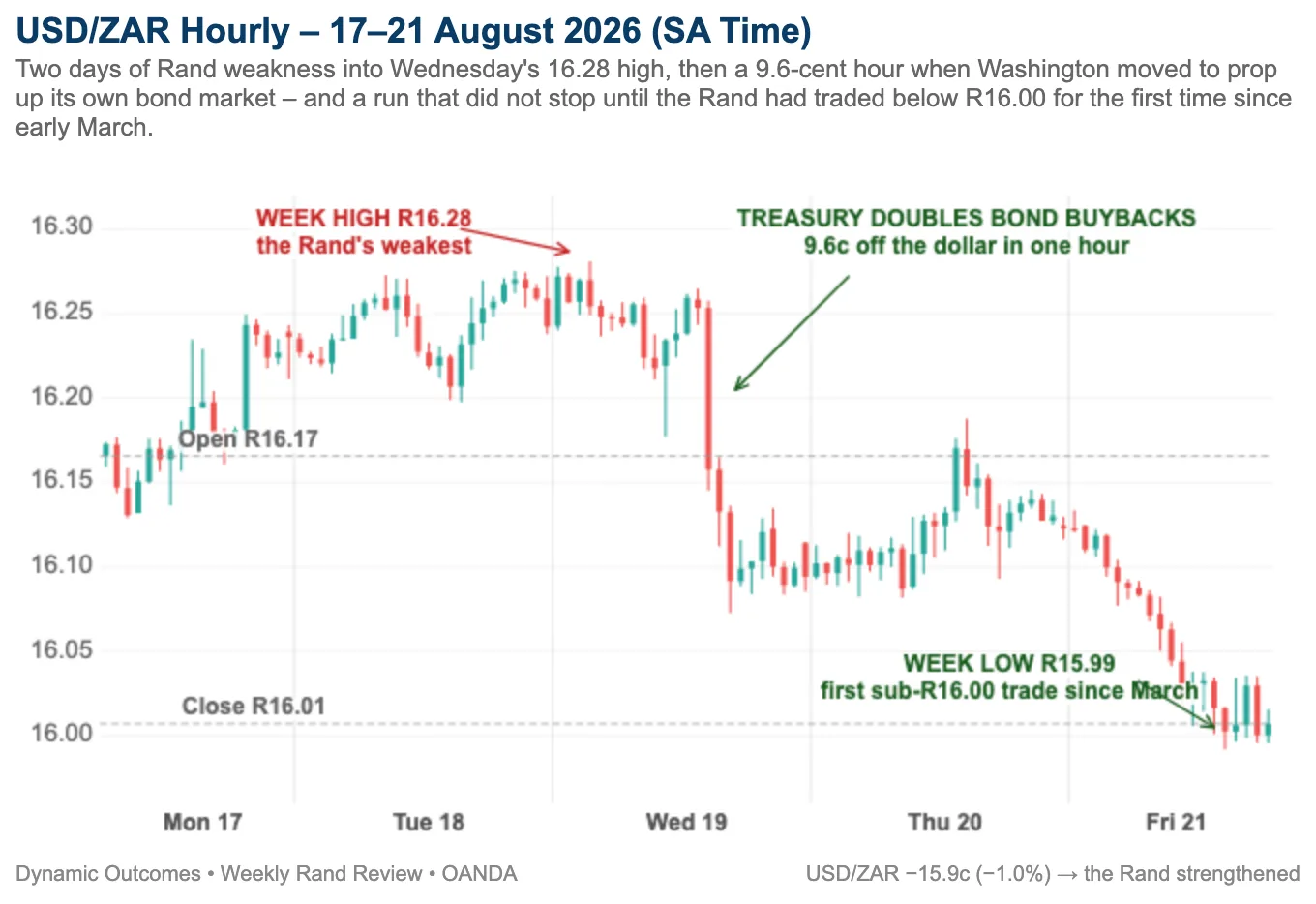
USD/ZAR hourly, 17–21 August 2026 (SA time) · OANDA
To get back to the Rand, its real test was still to come, as the market digested the previous day's announcement.
The question was whether the US Treasury intervention had actually worked?
The market remained skeptical, with ING aptly calling it a rearranging of deckchairs on the Titanic.
The Rand managed to touch R16.08 in the morning, but then gave back nearly 11 cents to hit R16.19 before clawing back some ground, closing at R16.13 as the market bounced around somewhat.
On Friday, we got the answer to Thursday's question.
By Friday the thirty-year yield was back at 5.3%, about where it sat before Wednesday's intervention. Nearly the whole move had been handed back inside two sessions, and CNBC's own headline used the word "fizzled"...
...but the US dollar kept falling anyway.
And with it doing so, the Rand ground lower all morning and touched R15.99 in the afternoon – the first time it has traded with a 15 in front of it since early March (and not one South African release put it there), ultimately closing out the week around R16.01.
So in just a couple of days the intervention failed in the market it was aimed at...
...and worked for one it was not.
My read is that this is not really a paradox at all. If the problem is confidence and not liquidity, then buying back your own long bonds mostly tells the world you are worried about them, and the currency takes the worry.
Volatility and Risk Analysis
15.9 cents, almost none earned at home. Here is what I make of the arithmetic.
Open to Close Move: The week opened at R16.17/$ and closed at R16.01/$ – a 15.9c (1.0%) strengthening.
Risk per $1 Million Exposure: R159,000
Average Daily Range: ~13.1c (0.8%)
Risk per $1 Million Exposure: R131,000
Maximum Single-Day Move: ~14.5c (0.9%) on Wednesday
Risk per $1 Million Exposure: R145,000
Weekly Range: 28.9c (R15.99 low to R16.28 high) – a 1.8% swing
Risk per $1 Million Exposure: R289,000
If you are importing, this was a good week and you should have taken some of it. If exporting, R289,000 per million dollars sat between the week's best moment and its worst.
Now the part most commentary left out.
The Rand gained 1.0% against the dollar, 0.3% against the pound and 0.1% against the euro.
Which is a very telling story:
This was not a week of major Rand strength but rather one of significant USD weakness – the Rand simply went where the dollar sent it.
And to prove it further, MSCI's emerging-market currency index closed at another record high, an eighth straight weekly gain, while the Turkish lira gained about 2% – double what the Rand did.
The Week Ahead
What to Watch
SA: Nothing that moves a currency. The Reserve Bank meets on 23 September with inflation at 4.3% and unemployment at 33.6% – the harder problem, and the one rates are worst at solving.
US: Jackson Hole runs Thursday to Saturday, with the new Fed Chair giving his first keynote on the Friday. After minutes showing three members arguing for a hike, that speech is the event.
Global: Watch whether the thirty-year yield climbs back through the level that prompted Wednesday's intervention. If Washington reaches for that tool twice in a month, the currency will draw its own conclusions – and so should you.
The Rand reached its strongest level since March, and South Africa supplied almost none of that momentum...
...which means things can swing back just as easily. How far can the current move go? We have hit our target levels but there remains some potential for further gains (as seen in our latest update).
The question of course is WHEN to act, because once again just a few days can have massive impact on your FX gain – or loss. And your emotions are wired by default to sabotage your decisions. And that is why an objective view is so important.
Another week lies ahead – with potentially the same volatility. The question is: do you have a proper forex strategy that adapts to the current cycles playing out in the market?
If not, reply to this email and tell us how you are currently managing your exposures. And if you are – how well did it help you navigate this past week?
Want the call before the move? See the Strategic Rand forecasts.
Want the full Rand cycle picture?
Register Free for Rand ForecastsHow much extra have you been paying in fees and spreads? FX savings calculator