🇿🇦 SARB Hikes...
...and the Rand Runs the Other Way
Published 28 September 2026
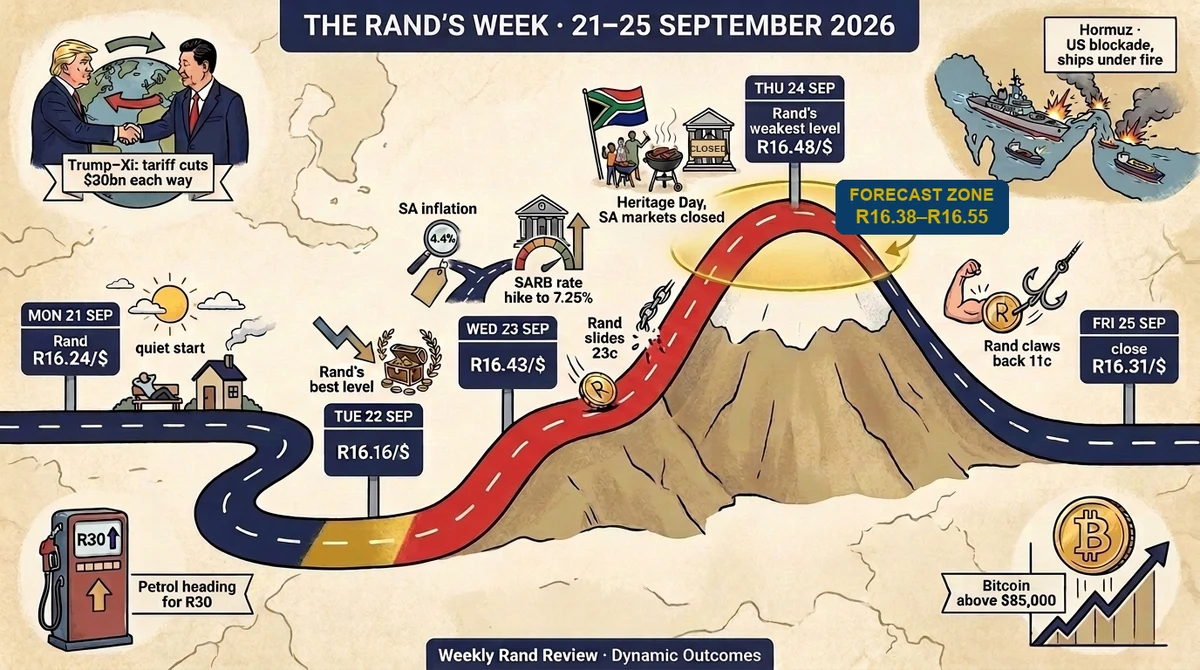
Well, last week I said Wednesday would be our turn...
...and when it came, the SARB hiked and the Rand went the other way.
It started the week at R16.24/$ and limped home at R16.31/$ – 7.6 cents weaker against the greenback, yet it still got the better of both the euro and the pound.
Let's dig into it...
But first – the call we had out on Friday 18 September, before any of this began.
The cycles had the US dollar either topped out against the Rand already, or one last thrust away from it somewhere between R16.38 and R16.55 – before turning lower. A close above R16.55 would prove us wrong.
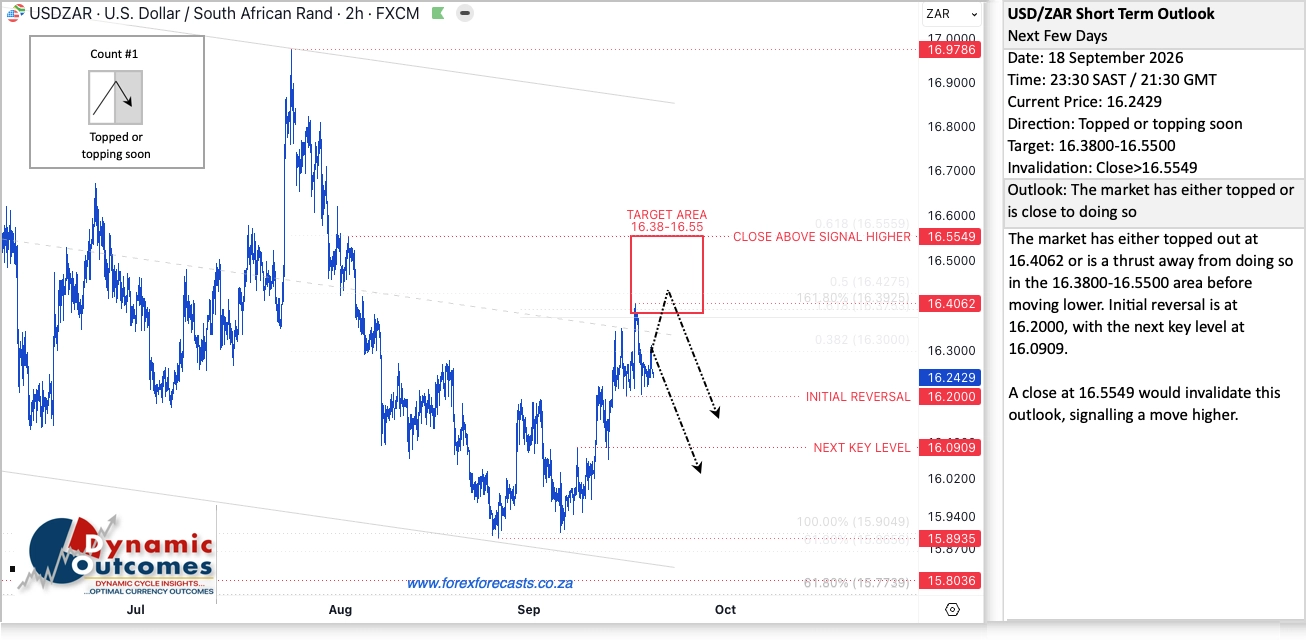
USD/ZAR Short Term Outlook, issued Friday 18 September 2026 – before the week opened.
Key Moments (21–25 September 2026)
Some of the more pertinent headlines and events over the past week:
🇿🇦 SA Inflation Comes In Under Forecast – 4.4% for August – good news...on paper.
🏦 SARB Hikes Anyway – A quarter point, and every textbook knew what the Rand should do next.
🍖 Heritage Day Activity – SA desks had the day off – the Rand didn't.
🇺🇸 Trump and Xi Summit – Two superpowers meet again in a changing world.
🛢 Hormuz Blockade Stays – Washington says no to Tehran's latest offer.
⛽ October Petrol Edges Towards R30 – The warning got bigger again this week.
₿ Bitcoin Goes Back Above $85,000 – Its best level since January.
The week opened at R16.24/$ with an empty domestic diary, and the Rand did the sensible thing with it – very little. Just 8 cents of range all day, the quietest session of the week, and a close almost exactly where it started.
Tuesday was more interesting than it looked – the Rand was on the back foot early, sagging to R16.34/$ by mid-morning...
...only to fight its way back all afternoon and evening, all the way to R16.16/$ – its best level of the week.
That was the eve of our inflation figure and the SARB, and plenty of persons, it seems, had already decided how Wednesday would go.
And then came Wednesday, with the two numbers we had been waiting for.
August inflation came in at 4.4%, a touch under the 4.5% expected, with core easing to 4.1%. In theory, that takes the heat off the Reserve Bank...
...and then the SARB went and hiked anyway – 25 basis points to 7¼%, and unanimously too, whereas July's hold had split 4–2.
Governor Kganyago's case was fuel. Oil is back up, the petrol price is lagging behind it, and he doesn't see inflation back at the 3% target until late 2027 (and a rate hike, last time I checked, doesn't put a single litre into anyone's tank!).
So inflation under forecast and a rate hike on top – which, if you believe the economists, can only mean a firmer Rand.
And the Rand?
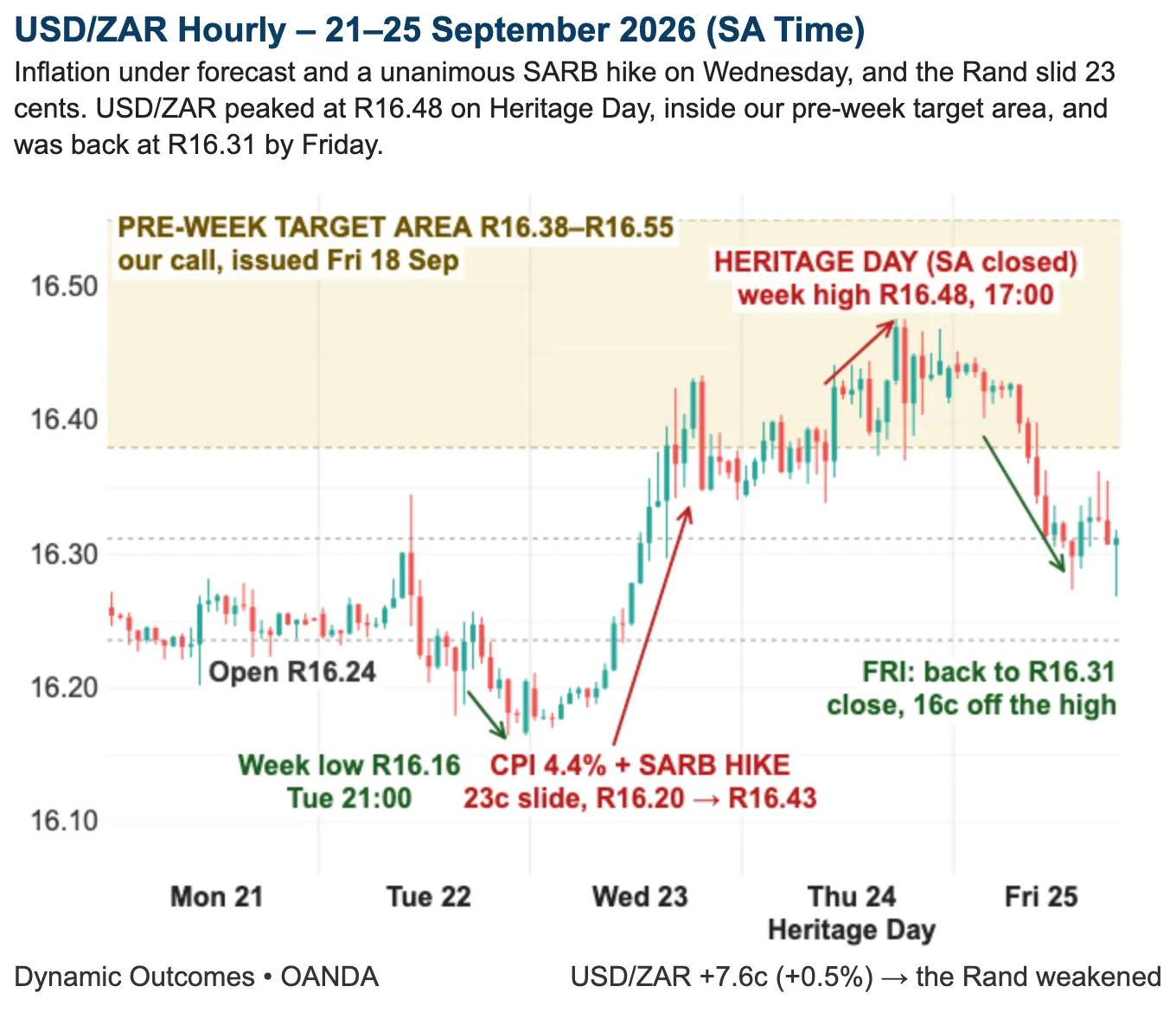
It slid from R16.20/$ in the morning to R16.43/$ by our close – 23 cents in a single session, and its worst day since 23 July!
Strong US business figures that afternoon gave the greenback a handy excuse...
...but the euro and the pound also helped themselves to more than 17 cents off the Rand that day – so this was never just a US dollar story.
Tuesday night explains Wednesday. According to Investec's Annabel Bishop, markets had priced in an 85% chance of the hike before it came. The crowd had spent Tuesday afternoon and evening buying Rand ahead of it...
...so the selling started first thing on Wednesday morning, and was well under way before Kganyago had even reached the podium.
By the time the SARB delivered exactly what they were positioned for, there was simply no-one left to buy.
Early that evening the Rand touched R16.43 and within the hour had clawed back 8 cents – the first sign the sellers were running out of puff.
In Other News
And in other news...
Trump and Xi summit. Thursday's summit in Washington stretched the US–China truce to 10 January, and by Saturday the White House was confirming lower tariffs on $30 billion of 'non-sensitive' goods each way – US farm produce and seafood into China, Chinese toys and small appliances into the US – while Taiwan, rare earths and chips were left for another day.
Last week I said a good meeting could drag currencies like ours along with it...
...and "stability, not a breakthrough", as FXStreet put it, is not the kind of news that drags anything anywhere.
But what is not published about these meetings matters more than what is made public. This meeting comes after the US pushed China's influence out of the Western Hemisphere on multiple fronts (think Panama Canal, the Strait of Magellan – where Argentina quashed a Chinese port deal – Venezuela, and then more recently, Greenland), and is now controlling the Strait of Hormuz.
And with all of this, Xi has stood down and let it happen – in the midst of what Trump called the "WORLD'S MOST POWERFUL RESET" in a post in April this year. There is more to this summit than meets the eye.
The Strait of Hormuz blockade stays. The US blockade has been in place since early July, and over the weekend the White House again rejected a peace proposal from Tehran, which came with a seven-day timetable attached to open the Strait. How many ships are actually getting through the Strait is not clear, because not many ships are going to broadcast that they are being escorted through by the US Navy.
The public ship-tracking counts and of course legacy media show barely a handful a day...
...but UKMTO (the Royal Navy's maritime trade centre) reflects a better picture, showing that US escorted ships have been increasing, though still way below pre-war levels.
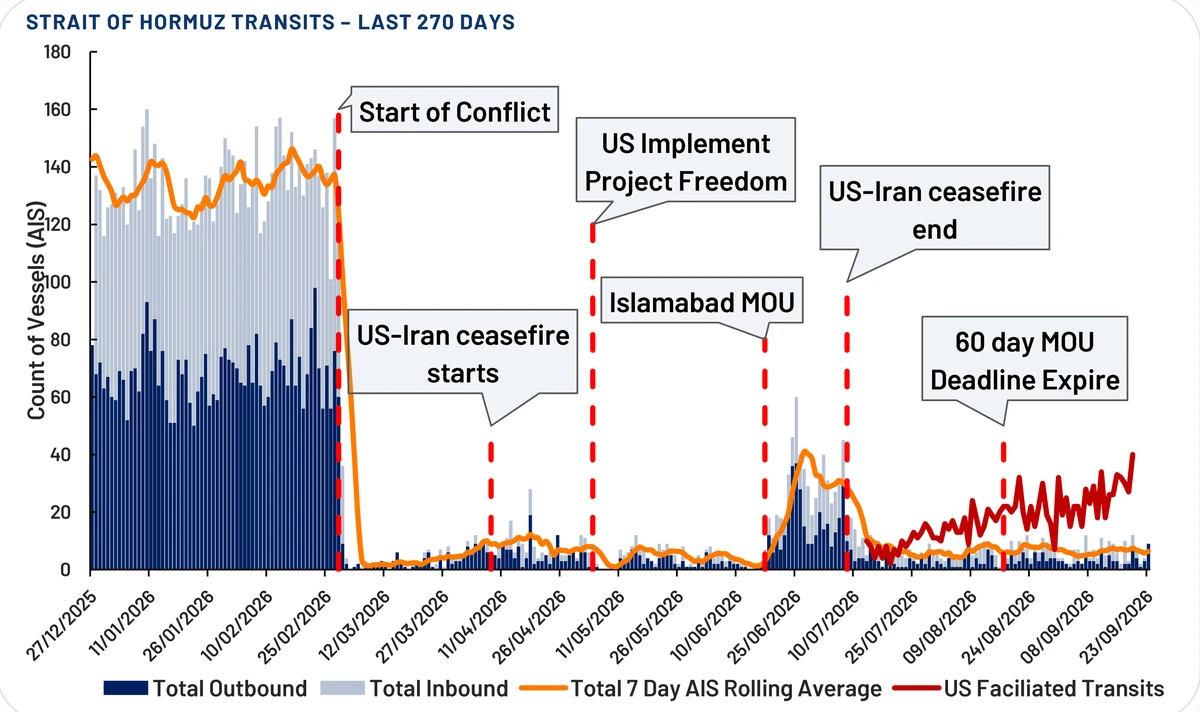
Strait of Hormuz daily transits. Source: UKMTO.
But every day the blockade remains is pushing Iran into a more desperate corner financially, and is forcing alternative oil supply routes to be built to the point where this Strait (and Iran's influence) will no longer be of any significance. Trump seems happy to wait for complete capitulation (3D chess in action, anyone?).
October petrol heads for R30 a litre. The early numbers now have petrol going up as much as R2.88 a litre in early October (last week it was 'only' R2.29), which would leave it within about 20 cents of R30 – more or less exactly what Kganyago was talking about on Wednesday.
Bitcoin goes back above $85,000. It traded at $85,818 on Monday, its highest since January, and had eased to around $84,400 by Friday...
...and it did all that in a week the US 10-year yield reached its highest since 2007!
To get back to the Rand then...
...Thursday was Heritage Day, and while most Saffers were lighting the braai, the offshore market carried on without them.
The Rand slipped all afternoon, out to R16.48 – its weakest since the first week of August...
...and that, as it turned out, was as far as the sellers could push it.
By early evening the Rand had won almost 6 cents of that back.
On Friday the Rand picked up where Thursday evening left off. From R16.45 in the early hours of Friday, it worked its way back all day and closed the week at R16.31/$ – 11 cents better on the day, and roughly half of Wednesday's damage undone.
So what of the call we started with?
Just as the call had it, the market pushed into the R16.38–R16.55 zone on Wednesday afternoon and ran out of steam at R16.48 on Heritage Day – less than 8 cents short of the line that would have proved us wrong.
R16.20/$ is the level that would confirm a reversal, and at Friday's close the Rand was just over 11 cents away from it. But so far the high has come inside the zone the cycles marked out five days before the SARB said a word!
Volatility and Risk Analysis
For those of you carrying US dollar exposures, here's what the week meant in Rand terms:
Open to Close Move: 7.62 cents
Risk per $1 Million Exposure: R76,200
Average Daily Range: 16.91 cents
Risk per $1 Million Exposure: R169,100
Maximum Single-Day Move: 26.40 cents, Wednesday's range
Risk per $1 Million Exposure: R264,000
Weekly Range: 31.19 cents, R16.16 low to R16.48 high
Risk per $1 Million Exposure: R311,900
SA markets only traded four days, and the Rand still managed its widest weekly range since the first week of August.
An importer who covered at Wednesday's close, with the headlines at their loudest, paid 11.72 cents more on every US dollar than one who waited until Friday – R117,200 per $1 million.
The Week Ahead (28 Sep–2 Oct 2026)
SA: The SARB's Quarterly Bulletin comes out on Tuesday the 29th, and the new petrol price kicks in early in the month.
US: Q2 GDP (final) and August's PCE inflation figure both come out on Wednesday the 30th, ISM manufacturing on Thursday 1 October, and the September payrolls on Friday 2 October.
Global: Hormuz, again. If the blockade lifts and oil comes down with it (not looking likely), the SARB's whole case for Wednesday starts to look rather thin.
What to watch. PCE and the payrolls will hand the market its triggers again...
...but as always, it is the underlying cycles of sentiment that will decide the direction.
Our latest call has the Rand's slide done, or very nearly – I won't give the levels away here, but I'll be keeping a close eye on whether Friday was the start of the turn.
Last week the Fed hiked and the Rand shrugged it off by Thursday. This week our own central bank hiked and the Rand took it on the chin...
...and I don't think the hike itself had much to do with it – the crowd was simply leaning the wrong way going in.
Do you have questions about what weeks like this one do to your own Rand exposures? Just hit reply – I read them all.
To your success~
James Paynter
P.S. Every Friday we put the next week's call out before a single session has traded – where the move should run out, and the price that says we got it wrong. This week the Rand slid into our zone on the day of the SARB hike, touched its weakest level of the week inside it on Heritage Day, and was already on the mend by Friday. That is 21 years and 8,756 scored Rand forecasts at 72.3% average accuracy at work. See the Strategic Rand forecasts
Want the full Rand cycle picture?
Register Free for Rand Forecasts