📈 Inflation Hit a Two-Year High. The Reserve Bank Held Anyway. The Rand Paid for It.
Published 27 July 2026
For three days, the Rand was quietly having a good week.
Then, on Thursday afternoon, in the space of a single announcement, it became the worst-performing currency in the world.
The number that did it wasn't inflation, though inflation had just hit a two-year high. It wasn't oil, though oil was pushing toward a hundred dollars. It was a decision – or rather, the decision not to decide.
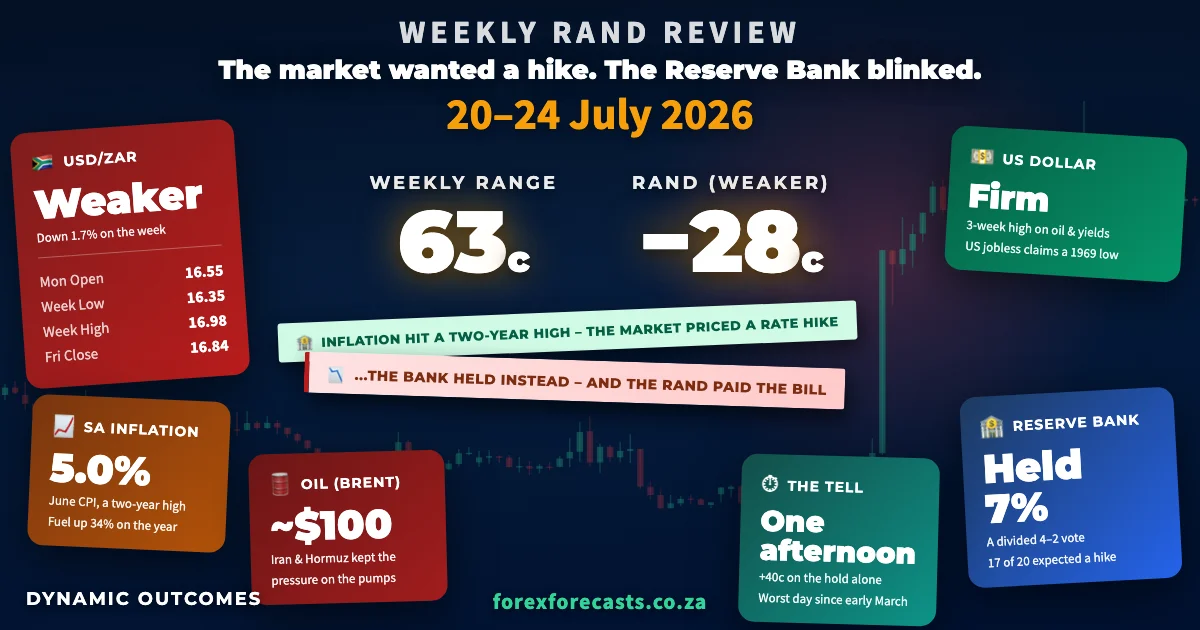
And the Rand? It shed about twenty-eight cents, its worst week since mid-June, almost all of it in one afternoon.
Here's how it played out.
Key Moments (20–24 July 2026)
A few of the major headlines and events over the past five days:
🏦 The Reserve Bank Held – and Almost Nobody Saw It Coming. The one call the market thought it had priced turned out to be the one it got wrong.
📈 Inflation Hit a Two-Year High. The number that should have forced the Bank's hand landed the day before it chose to sit still.
🛢 Oil Ran at a Hundred Dollars. The Gulf kept the pressure on, and South Africa imports every drop of it.
🌍 The Dollar Flexed Everywhere. US jobless claims hit a level not seen since 1969, and money lined up behind the greenback.
🇿🇦 Washington Rebuilt Its Tariff Wall. A new set of duties on South African goods took effect on Friday, quietly, in the shadow of the rate call.
Monday: A Quiet, Firmer Start 📉
The Rand opened the week at R16.55/$ and, with nothing at home to trade, spent the day drifting the right way.
There was no local data and no reason for drama. The real business of the week – an inflation reading and a rate decision – was still days off, and the currency simply firmed into the vacuum, easing back toward R16.43 by mid-afternoon.
It closed the SA day near R16.50/$, a few cents stronger, the calm before a week that had one very loud room in it (a quiet Monday is often just the market holding its breath).
Tuesday: Holding the Gains 📉
Tuesday brought more of the same, which was exactly what a firming Rand wanted.
Again there was nothing local to move it, and again the currency used the space. It ticked down to R16.41 around lunchtime, its firmest level in over a week, as traders positioned quietly ahead of the two dates that mattered.
The Rand closed near R16.46/$, holding onto Monday's gains. Underneath the calm, though, one assumption was hardening across every desk in the market: that the Reserve Bank, faced with rising inflation, would raise rates on Thursday to defend the currency.
That assumption was about to cost people money.
Wednesday: A Hot Number the Rand Shrugged Off 📉
Wednesday delivered the week's first big data point, and the Rand's reaction told you everything about how the market was leaning.
At ten in the morning, the June inflation figures landed – and they were hot. Consumer prices had climbed to 5.0% over the year, up from 4.5%, a two-year high, driven almost entirely by fuel as the oil price fed through to the pumps – and the Rand firmed anyway.
That is the tell. A currency that firms on a hot inflation reading is a currency whose traders have already decided what comes next. The hot number wasn't a threat; it was confirmation – confirmation that the Reserve Bank now had no choice but to hike. The Rand eased to R16.39/$ in the evening, its strongest level of the entire week, positioned almost perfectly for a rate rise it was sure was coming.
It closed at R16.42/$. Twenty-four hours from its best moment, and its worst.
In Other News 🌍
The Gulf Keeps Its Foot on the Oil Price 🛢
The backdrop to South Africa's inflation problem was sitting, as it has all month, in the Strait of Hormuz.
Washington's naval blockade of Iran's ports stayed firmly in place through the week, choking the country's oil exports at source. And the Gulf refused to settle – Iranian forces struck two tankers linked to the UAE, killing two mariners, a reminder that the risk premium in the oil price is not theoretical.
So crude did what crude does when a major producer's barrels are bottled up by force. Brent pushed toward a hundred dollars a barrel mid-week, before easing about four percent on Friday as talk of possible US–Iran negotiations surfaced.
For South Africa, this is the whole chain in one line. A fuel-importing economy, an oil price near a hundred dollars, and an inflation rate that just hit a two-year high on the back of exactly that – which is what made Thursday's decision so surprising (when the imported half of your inflation is running this hot, standing still is the brave choice, not the safe one).
Washington Rebuilds the Wall 🇿🇦
While every South African eye was on Pretoria, a second story slipped through in Washington.
Earlier this year the US Supreme Court struck down the blanket tariff the Trump administration had built its trade policy on. This week, Washington simply rebuilt it – a fresh set of replacement duties, ranging from ten to twelve and a half percent, imposed on some sixty trading partners and covering very nearly all of America's imports.
South Africa's share of that took effect on Friday, a 12.5% duty tied to a forced-labour finding, layered on top of the tariffs already in place. Oranges and nuts were spared; much of the rest was not.
It is a smaller number than the headline figure that frightened everyone a year ago, and the market barely blinked at it against the noise of the rate call.
But the pattern is the uncomfortable one South Africa keeps running into. Years of tilting toward Beijing, Moscow and Tehran have bought Pretoria very little cover in Washington, and the bill for that keeps arriving in instalments (the tariff is a footnote this week; the position behind it is not).
To get back to the Rand – because everything to Wednesday was prelude. The week only really happened in one afternoon.
Thursday: The Reserve Bank Blinks 📈
Thursday was the day the market's certainty met the Reserve Bank's caution, and lost.
The Rand had opened at R16.42/$ and drifted to R16.35 through the morning – its strongest point of the week, a currency leaning confidently into a rate rise. Seventeen of the twenty economists surveyed expected exactly that: a quarter-point hike to defend against the inflation the country had just seen.
At three in the afternoon, Governor Kganyago delivered the opposite. The Bank held its rate at 7%, on a divided four-to-two vote, choosing to protect a weak economy over defending the currency – and the Rand fell out of bed.
In a single afternoon it collapsed from R16.35 to past R16.83, better than forty cents, its worst single-day performance since early March. For a few hours it was, by the market's own reckoning, the worst-performing currency on the planet. Every trader positioned for a hike now had to unwind, at once, in the same direction.
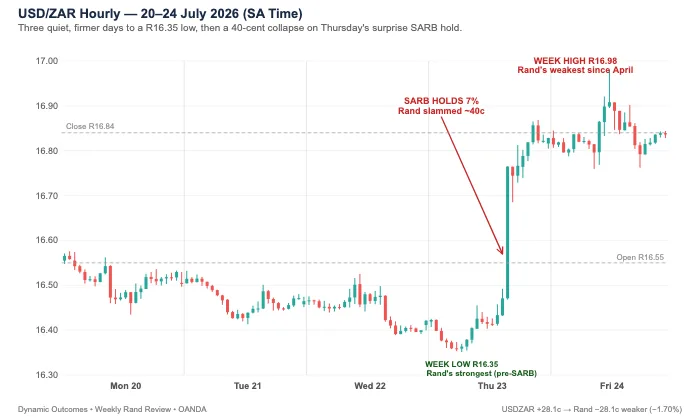
It closed the SA day near R16.83/$. The Bank had made a defensible call on growth. The currency sent the invoice within the hour.
Friday: Living With the Damage 📈
Friday's task was simply to find out how bad it was.
The Rand opened at R16.83/$ with the previous day's shock still reverberating, and early trade pushed it to R16.98 – within a whisker of the seventeen-Rand line, the weakest it had been since early April. A firm dollar, still bid on high US yields and a low read on jobless claims, gave it no help at all.
Then the day steadied. As oil eased on the Gulf negotiation reports, some of the panic drained away, and the Rand clawed back off its lows to close the week at R16.84/$.
That left it about twenty-eight cents weaker than where Monday began – a week that spent three days quietly building a case for Rand strength, and one afternoon demolishing it (the market can price a decision for weeks; it can only react to the one that actually lands).
Volatility and Risk Analysis
Forty cents in an afternoon. That was the single move that defined the week, and everything else was scenery.
Open to Close Move: the week opened Monday at R16.55/$ and closed Friday at R16.84/$ – about 28 cents of Rand weakness (1.70%).
Risk per $1 Million Exposure: R281,000
Average Daily Range: just under 23 cents, dragged up almost single-handedly by that one Thursday.
Risk per $1 Million Exposure: R227,000
Maximum Single-Day Move: Thursday's near-52-cent swing – almost all of it in the hours after the rate call.
Risk per $1 Million Exposure: R517,000
Weekly Range: just under 63 cents (R16.35 low to R16.98 high) – a 3.8% swing top to bottom. It was the second-widest range of any week in 2026, behind only early April's Gulf-ceasefire week.
Risk per $1 Million Exposure: R629,000
A note on the crosses, because it locates the blame. Over the week the Rand weakened most against the dollar, less against the euro, and least against the pound.
Part of that is simply a strong dollar – the greenback firmed all week on a hundred-dollar oil price and the lowest US jobless claims since 1969, so any currency would have struggled against it. But the sharpest damage, on Thursday, was against everything at once. When a currency falls against the euro and the pound in the same hour it falls against the dollar, the driver is at home – and on Thursday afternoon, home was a room in Pretoria.
To put the timing in practical terms: an importer who waited and bought dollars into Friday's R16.84 rather than Monday's R16.55 paid roughly R28,000 more per $100,000, while an exporter who held out and sold late pocketed about the same. In a week the Rand lost this heavily, the exporter's patience was quietly, handsomely rewarded.
The Week Ahead
After a week decided at home, the next one hands the microphone back to Washington.
SA: The dust settles on the rate call · no major local data due
US: Federal Reserve decision – 29 July · Q2 GDP (advance) – 30 July
Global: Bank of Japan – 31 July · the oil price / Gulf de-escalation
What to Watch
Two to watch: the Federal Reserve on Wednesday for the dollar's next cue, and the oil price for any sign the Gulf is calming. As for the Rand itself, this week's shock was exactly the kind of event a short-term view cannot price – a central bank doing the opposite of what the whole market expected.
This was the week the Rand learned an old lesson the hard way: the most expensive surprises are the ones the market was sure could never happen.
For three days it built a confident case for its own strength, leaning into a rate rise that seemed a certainty. The Reserve Bank had other priorities, and the currency paid for the gap between what was expected and what arrived.
The question now is whether R16.84 was the shock finding its level, or just the first move of a longer one – and that is exactly the kind of call our latest USD/ZAR forecast is built to make. See the Strategic Rand forecasts.
Want the full Rand cycle picture?
Register Free for Rand Forecasts