📉 The Rand Had Its Third-Best Week of the Year – Against a Dollar That Never Moved
Published 10 August 2026
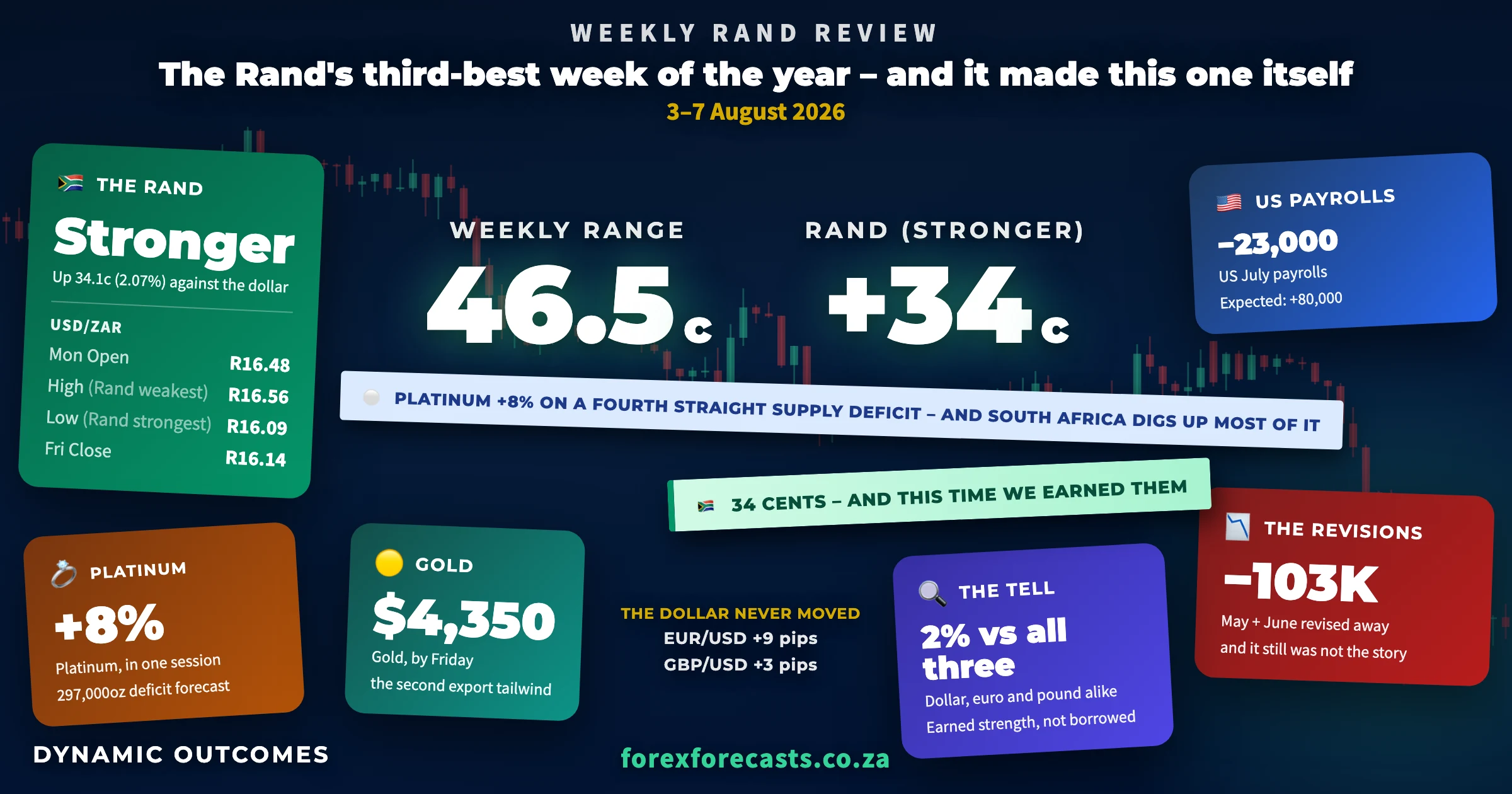
Its strongest level since early March – and the payrolls number everyone blamed it on only came out on the last day.
There was no South African news this week. No inflation figure, no rate decision, nothing at all.
And the Rand had its third-best week of the year...
...against a dollar that never actually moved.
Here's how it played out...
Key Moments (3–7 August 2026)
These were some of the major headlines and events over the past five days:
⚪ Platinum Jumped 8% in a Session. A supply shortage the market had stopped pricing came back into focus on Tuesday – and it matters more to South Africa than to almost anyone else.
🇺🇸 The US Jobs Report Went Negative. The consensus was a gain near eighty thousand, and not one forecaster had it coming in below zero.
🛢 The Gulf Moved Closer to Reopening. Talks over the Strait of Hormuz reached their final stages, with a familiar ultimatum attached.
🏦 A Fed Governor Talked Openly About Hiking. Wednesday delivered the clearest hawkish signal in weeks – and Wednesday still did not go the way it should have.
⛽ August's Pump Went Both Ways. One fuel got cheaper on Wednesday, and the one that moves everything else did not.
📊 South Africa Released Nothing At All. Five days, no data, no policy, no press conference – and it turned out not to need any.
Before we got into the week, our subscribers had the below insight from the prior Wednesday, showing that the market was expected to head lower to test R16.50...
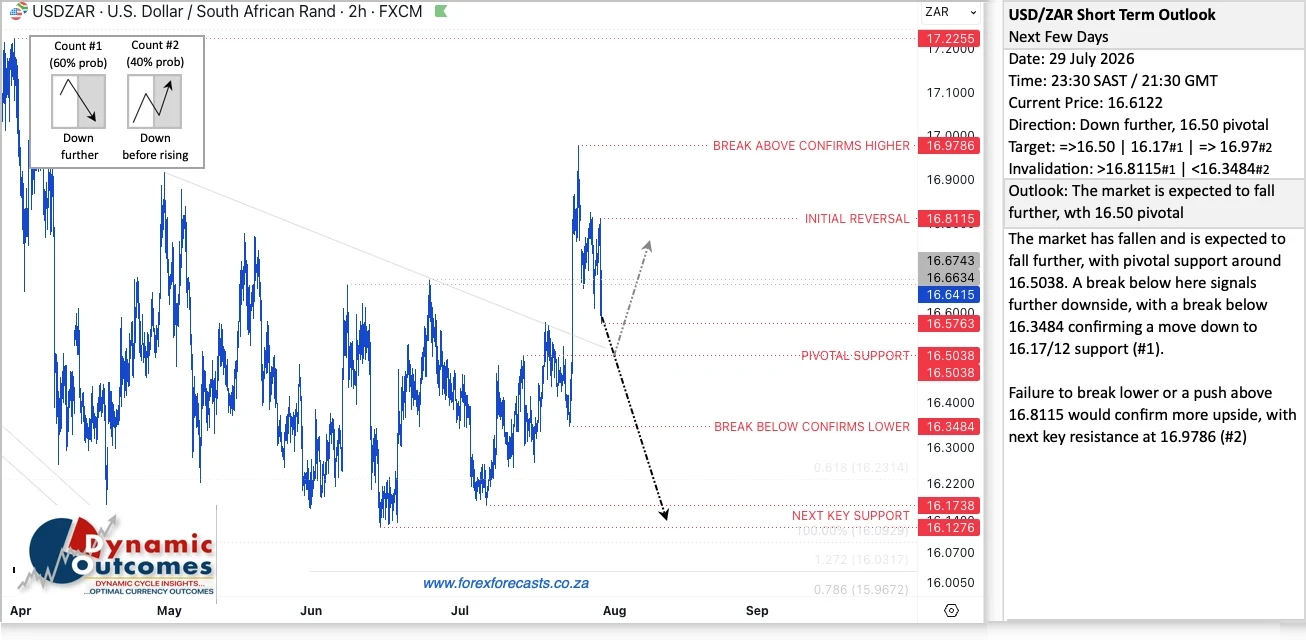
USD/ZAR Short Term Outlook, issued 29 July 2026 at R16.61 · direction down, R16.50 pivotal, R16.17 marked as the preferred target
...with the bias being for a break lower – next key target support being at R16.17/12.
By Friday, we had seen the test of R16.50 support, which seemed to indicate the week was going to belong to the Rand, whatever happened.
Monday: The Dollar's Good Day 📈
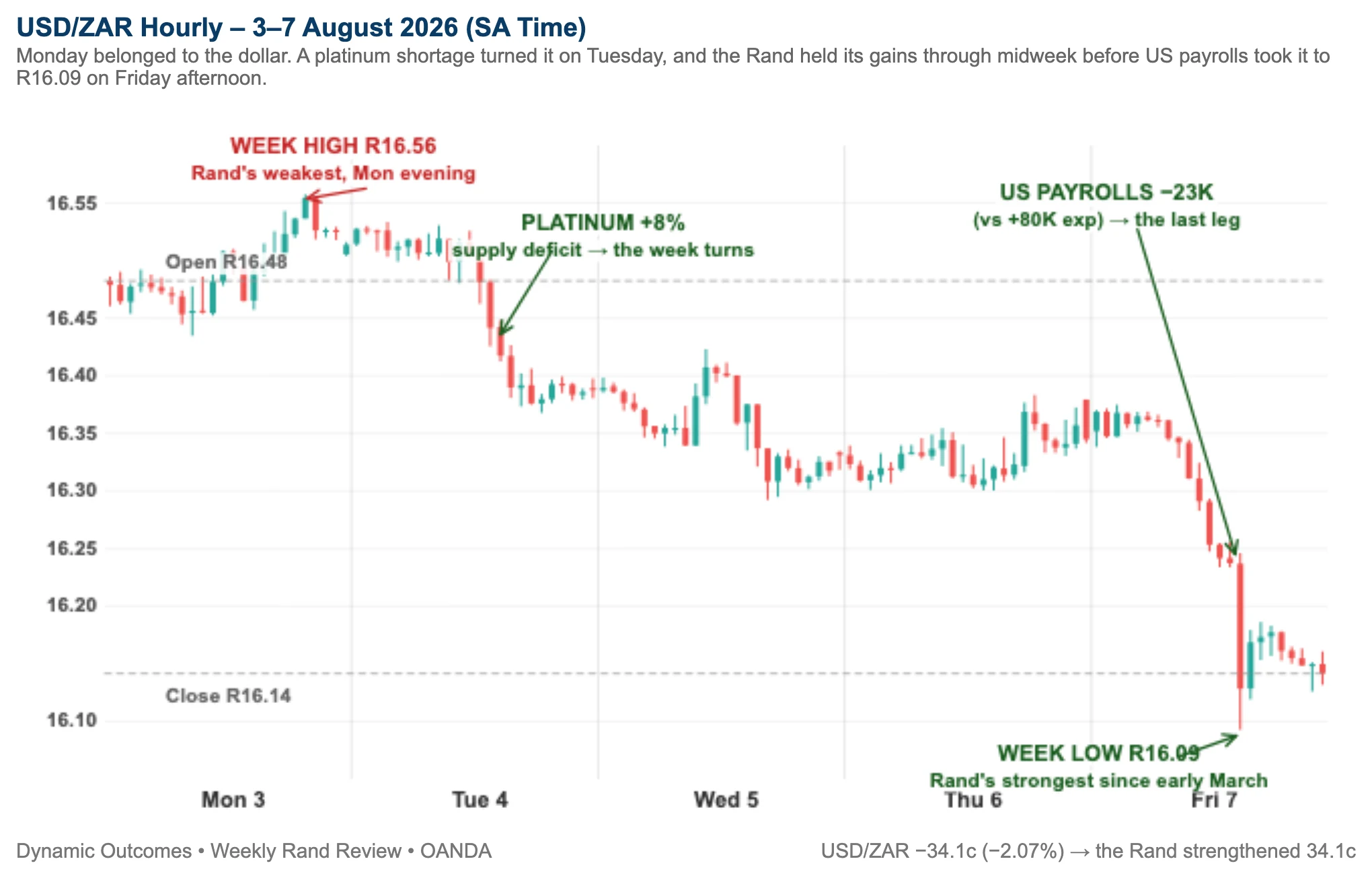
The Rand opened the week at R16.48/$ with an empty local diary...
...and one number worth watching in Washington.
It firmed early to R16.43 by eight in the morning, then spent the rest of the day drifting the other way.
US manufacturing activity came in at 55.6 in the afternoon – the strongest reading since May 2022, and a seventh straight month of expansion.
A genuinely strong number, and the US dollar liked it, as it pushed the Rand all the way back up to R16.56 – 3 cents softer than it started, and Monday belonged to the dollar.
Tuesday: A Shortage Nobody Reported 📉
Tuesday's trigger came from commodity spikes, not economic news.
Platinum jumped 8% in a single session to around $1,756 an ounce, as the market re-priced a 297,000-ounce supply shortfall forecast for 2026 – the fourth consecutive year the world will consume more platinum than it produces.
Of importance to the Rand, South Africa mines most of it – which nobody outside a mining desk mentioned all week...
...but the market certainly noticed.
The Rand had been sitting at R16.53 in the small hours. By evening, it had regained over 12 cents – on a day the local calendar was completely empty.
The Rand was starting to move as forecast, even as we still had 3 days before the US Non-Farm Payrolls jobs report.
Wednesday: The Hawk That Couldn't Fly 📉
Wednesday should have been a US dollar day.
A serving Federal Reserve Governor used a speech to say she was prepared to act on inflation – by raising rates. That is about as direct a signal as a sitting Governor gives, and it came alongside a services reading that missed by only a fraction...
...and the greenback hardly fluttered an eyelid.
Meanwhile, the Rand ground down to R16.29 by the close and gave back barely any of it after hours – on a day the dollar had every excuse to win (a rate-hike speech, and not a buyer in sight.)
Closer to home, the new fuel prices took effect – petrol down 52 cents a litre, diesel up between R1.23 and R1.38. Good news for cars, bad news on every truck moving goods to a port.
And in other news...
🛢 The Strait, Slowly Opening.
Iran and Oman spent the week in what both sides described as the final stages of an agreement to reopen the Strait of Hormuz, with Washington adding that it would happen soon or Iran would be hit very hard. Nothing is signed. But a shipping lane that has been a standing risk premium on every barrel South Africa imports moved measurably closer to normal, and emerging-market assets noticed before the currency market did. The Iran regime has been this close to a deal before, but seem to like playing cat and mouse at the negotiation table. The fact is, they can make demands, but when you don't hold many cards, let alone aces, you are between a rock and a hard place.
The longer this continues, the less Iran as a major oil player will be a factor. The US, together with other Arab nations and global players, continue to redefine energy flows, as highlighted the last week by US Treasury Secretary Scott Bessent, stating that the Straits could be potentially irrelevant within two years, as plans are afoot to bypass the Hormuz with pipelines instead.
📈 Wall Street Set Records While We Were Not Looking.The S&P 500 closed at a record 7,737 on Tuesday – its first record in two months – and the Dow cleared 54,000 for the first time ever. Strong earnings and a tech rebound did most of it, with the same Hormuz optimism that lifted the metals doing the rest. It matters here for one reason only: risk-on weeks are when emerging-market currencies get bought, and this was the week the Rand was named among the best of them.
To get back to the Rand...
Thursday: Catching Its Breath 📈
Thursday did very little, and it was instructive.
US jobless claims held at 199,000 – a third straight week below two hundred thousand, the longest such run since 1969.
On any ordinary reading, that is a labour market in rude health, and it arrived less than twenty-four hours before the number that said the opposite.
The Rand poked at R16.30 just after lunch, then lost interest and handed it back – 1.4 cents worse off, and going nowhere until Friday. Gold sat above $4,270 and did not much matter yet...
...though it would by Friday afternoon.
Four days in, the Rand was up nearly 14 cents on a week in which South Africa had published precisely nothing.
Friday: The Number Everybody Blamed 📉
Friday dawned, and the Rand immediately seemed to take courage as it pushed lower throughout the day to test R16.20/$ ahead of the payrolls release.
Then the payrolls hit, and everything you will read this weekend will tell you they caused the week.
The US reported that employment had fallen by 23,000 in July, against expectations of a gain near eighty thousand. May and June were revised down by a further 103,000 between them, and wage growth slowed to a tenth of a percent, while the unemployment rate fell to 4.1%.
So yes, it was a big Friday...
...but it was the fourth day of a move that started on Tuesday.
Volatility and Risk Analysis
A significant week of movement – let's see how it affected those exposed
Open to Close Move: the week opened Monday at R16.48/$ and closed Friday at R16.14/$ – 34.1 cents of Rand strength (2.1%).
Risk per $1 Million Exposure: R341,000
Average Daily Range: just under 16 cents (1.0%).
Risk per $1 Million Exposure: R157,000
Maximum Single-Day Move: 21.0 cents on Friday (1.3%).
Risk per $1 Million Exposure: R210,000
Weekly Range: 46.5 cents (R16.09 low to R16.56 high) – a 2.8% swing top to bottom.
Risk per $1 Million Exposure: R465,000
Twelfth-widest of the weeks we have logged this year. An ordinary week for movement... that happened to travel a very long way in one direction.
Now the crosses, because they say who did this – and this time it was not Washington.
Over the week the Rand gained 2.1% against the dollar. Against the euro and pound it gained 2.0%. Three major currencies, the same two percent, in the same five days.
And the dollar itself finished flat – less than 0.1% on the index, the euro up 9 pips and the pound up 3. If you were waiting on a dollar payment this week, Pretoria paid you, not Washington. An importer settling Monday evening at the week's high and one settling Friday afternoon at its low bought the same dollars 46.5 cents apart – R465,000 on a million. Exporters had the mirror image, and a worse week for it.
The question is: Were you positioned for any of it? Would you have been better off if you had had our forecast from the week prior?
The Week Ahead
SA: South Africa is quiet again, with one release that matters: the second-quarter labour force survey. The first quarter came in at 32.7%, and if the second is worse, nobody gets to look away from it this time. If you have a rand payment landing the week after, that is the reading to diarise. No SARB meeting; the next Monetary Policy Committee is in September.
US: July inflation comes out on Wednesday 12 August, and it matters far more than it did a week ago. Their jobs number has just gone negative, and their inflation is not coming down. Good luck sitting in that room.
Global: Watch whether the Hormuz agreement is actually signed, but don't hold yu breath with a regime that is notoriously untrustworthy.
Last week's reveiew was another example of simply understanding where sentiment cycles were placed and where these were likely to head, irrespective of the news.
This is the first step towards managing your currency exposures. It's never the news that moves markets. It's persons reacting to that news – and being swayed by their own emotions as to what actions to take,
If you last week threw you, maybe it's time to stop flying blind – and start using something that has proved to work over more than two decades.
Until next week...
To your success~
James Paynter
Want the full Rand cycle picture?
Register Free for Rand Forecasts