🇿🇦 Two Elections in Two Days...
...and the Rand Comes Out Ahead
Published 9 November 2026
The US dollar topped out on Monday morning, inside the area our cycles had flagged.
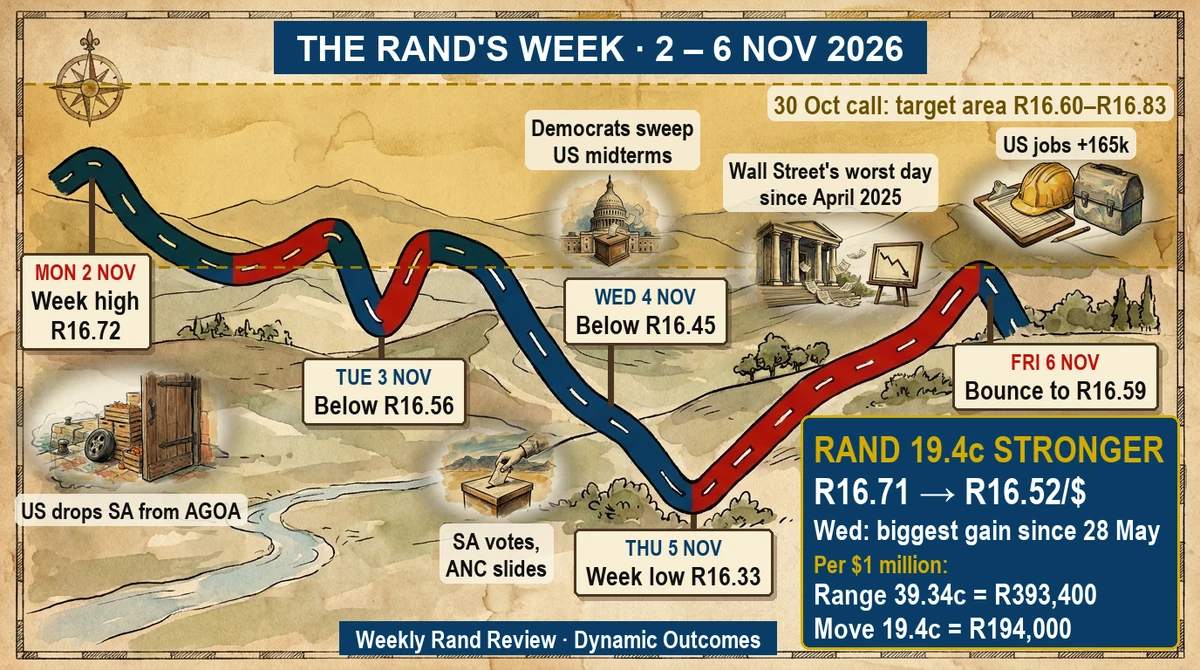
What moved the Rand last week: the Rand against the US dollar, 2 to 6 November 2026.
What moved the Rand last week?
The US election was the trigger last week. Overnight into Wednesday, a public holiday in SA, the Democrats took both houses of Congress, and the Rand gained 22.3 cents to R16.40, its biggest one-day gain since 28 May. It finished the week of 2 to 6 November 2026 at R16.52/$, 19.4 cents stronger against the US dollar.
Well, what a week for counting votes!
The US went to the polls on Tuesday and Saffers on Wednesday, with Washington showing SA the door on trade before either count had even started.
Then Wall Street crashed on Thursday, just to round it all off!
And the Rand? It had its best SA session in more than five months on Wednesday, and signed off the week 19.4 cents stronger at R16.52/$.
Before we dig into how it all played out, here was the call we put out on Friday 30 October, before the week had even started.
Our cycles had the US dollar pushing a little higher against the Rand, into an R16.60–R16.83 area that would be make-or-break. A break below R16.56 would be the first sign of a turn, and a break below R16.45 would confirm it.
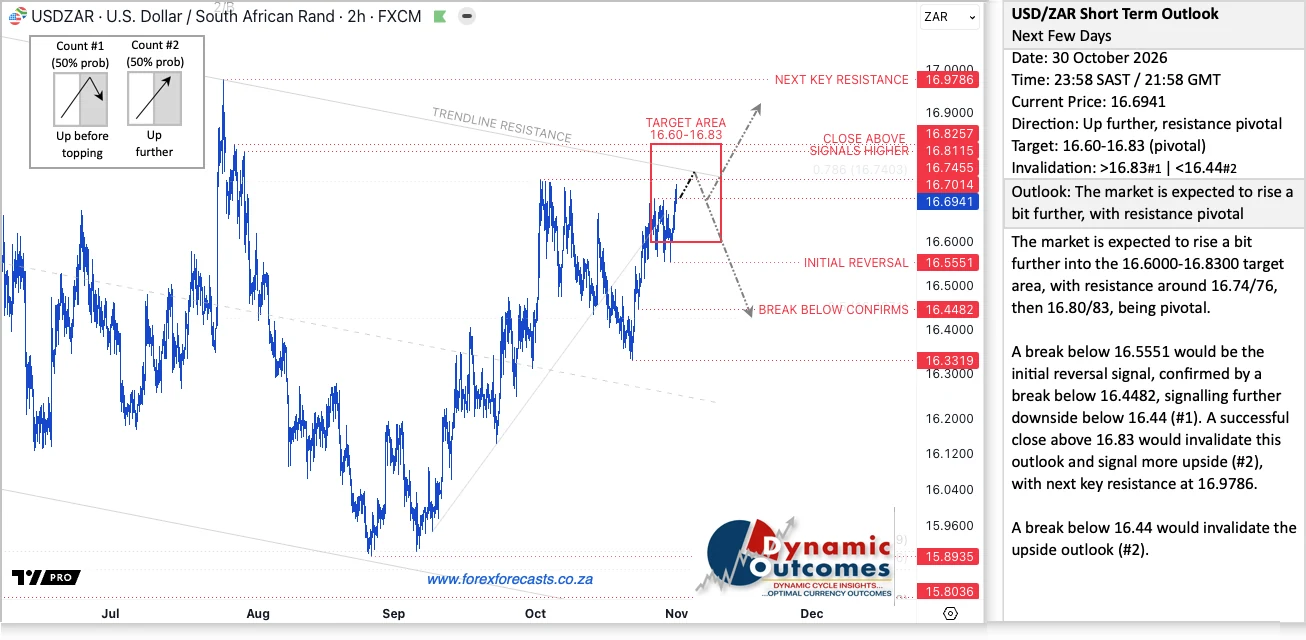
USD/ZAR Short Term Outlook, issued Friday 30 October 2026.
So, we knew what to look out for before any of the following hit the headlines.
Key Moments (2–6 November 2026)
Some of the more pertinent headlines and events over the past week:
🇺🇸 Washington Shows SA the AGOA Door – What did it cite, and when does it bite?
🇿🇦 The ANC Slides at the Polls – How far, and who is picking up the big metros?
🇺🇸 Democrats Take Both Houses of Congress – So how did Wall Street react?
🛢 Brent Drops Below $100 a Barrel – How far did it fall in three days?
⛽ SA's Fuel Levy Cut Kicks In – So how much cheaper is a tank of petrol?
📊 US Jobs Blow Past Forecasts – By how much, and how did the Rand handle it?
The Rand opened Monday at R16.71/$, right where it had left off the Friday before...
...and it wasted no time getting to work, pushing the greenback down to R16.64 by mid-morning and R16.58 by late afternoon, before digging in around R16.60/$ by SA close – 10.5 cents stronger on the day, with no obvious news to speak of.
But the news did come, as that evening Washington announced it was suspending SA from AGOA (more on that below)...
...but funnily enough, the Rand hardly flinched, holding around R16.60 into the night.
Tuesday was election day in the US, and the Rand spent most of it looking over its shoulder, letting the US dollar climb back to R16.68 by mid-morning.
Then, in a single hour that afternoon, it fought its way to R16.53, again with no news trigger anyone could really point to...
...but it couldn't hold on, running out of steam and handing it all back to finish at R16.62/$, slightly weaker on the day.
Then came Wednesday, a public holiday at home as Saffers queued to vote, which should have meant a nice quiet day for the Rand...
...but not a chance!
Overnight, the Democrats had taken both the House and the Senate in the US, and the market didn't need long to make up its mind about the US dollar...
...and the Rand took full advantage, pushing the greenback from R16.62 at the start of our day down to R16.45 by lunchtime.
Oil joined in, with Brent tumbling below $100 a barrel from a high of $118 the Friday before, hitting $96 a barrel – a welcome sight for all...
...the timing of this is quite marked (we hinted some weeks back that the oil price was being kept high to hurt Trump in the mid-terms).
By SA close the Rand had romped home 22.3 cents stronger at R16.40/$, its biggest one-day gain since 28 May!
The US election was the trigger, of course...
...but the sentiment behind the move had turned well before a single vote was counted.
And in other news...
Washington boots SA out of AGOA. On Monday evening the US gave notice that SA (along with Rwanda) is out of the African Growth and Opportunity Act from 1 January 2027, so there are less than two months of duty-free access left.
For exporters, that means goods that went into the US duty-free will pay the standard US import duty from January. Not that every exporter is hit...
...as nearly 90% of what we sell the US already pays standard rates, so the pain lands on the roughly 10% that used AGOA – about US$1.7 billion last year, down from US$4 billion in 2024.
Historically, vehicles have been the biggest users of AGOA, with citrus, macadamias and wine also on the list.
Washington cited SA's trade barriers, corruption and "threats to US national security and foreign policy interests"...
...and frankly, Pretoria has no-one to blame for this but itself.
Years of cosying up to the likes of China, Russia, Iran and Cuba against Washington, plus the ICJ case against Israel that the US opposed, were always going to come with a bill – and SA's exporters are the ones left holding it.
The ANC slides to around 32%. On Friday's count, with most of Wednesday's votes in, the ANC is sitting on roughly 32% nationally, down from 45.6% in 2021 (a proper hiding), with the DA on around 25%.
The DA has more than 60% of the early vote in Cape Town and leads Joburg on about 40%, so the big metros are heading for coalition talks.
Saffers, it seems, have had enough...
...and who can blame them, with rubbish still piling up in parts of Joburg after last week's municipal strike (Pikitup warns some areas face about another week of backlogs).
Petrol is just 1c cheaper after a R1.50 levy relief. The temporary cut to the fuel levy kicked in on Wednesday, R1.50 a litre on petrol and R3.00 on diesel, running until 1 December.
So you'd think filling up would be cheaper this month...
...yet petrol fell by just 1c a litre, as higher product prices, October's weaker Rand and a 48c rise in the slate levy ate up the rest.
Mind you, diesel fared better, down by R1.10–R1.20 a litre. As for petrol, Treasury giveth, but the slate levy taketh away!
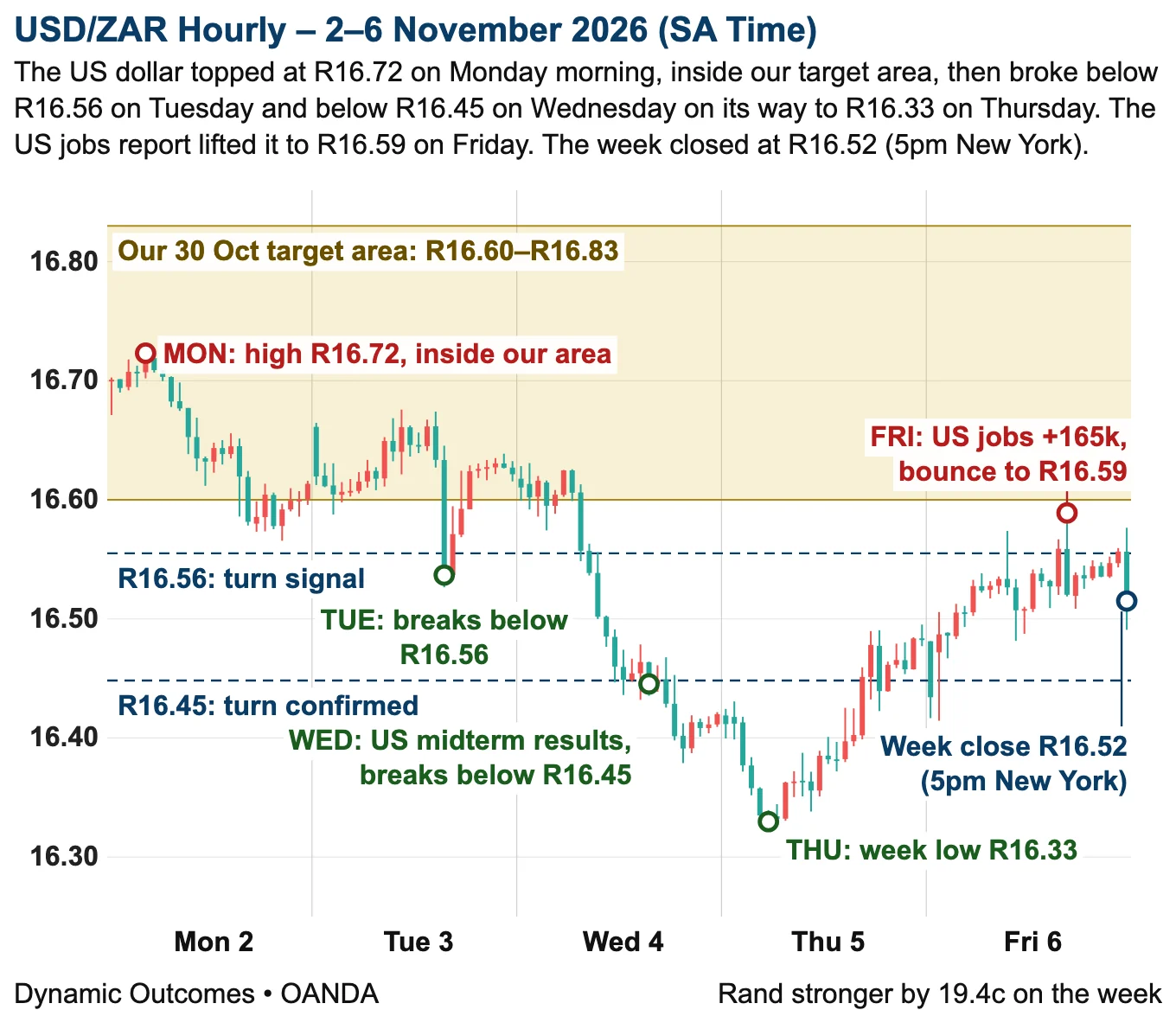
To get back to the Rand then, Thursday started where Wednesday left off, with the Rand pushing on overnight to R16.33, its strongest level since 30 September.
The Bank of England hiked its rate to 4% at lunchtime, but the real drama was still to come...
...when Wall Street opened mixed and then fell off a cliff within the hour, with the S&P 500 down 4.4% and the Nasdaq 5.5% by the close, the worst day for both since April 2025.
Traders blamed weak chip earnings and fears that a Democrat Congress will clamp down on AI data centres (the very thing that's been carrying the tech giants).
Risk appetite went over the cliff with it, and the Rand let the greenback push back up to R16.49 by late afternoon, before it caught its breath at R16.44/$ by SA close.
Friday began on the back foot, with the Rand opening at R16.53/$ after more ground lost overnight.
Then, at 3:30pm our time, the US jobs report blew the forecasts away, with 165,000 jobs added in October (more than double what was expected) and unemployment down to 4.1%...
...and the US dollar jumped to R16.59 within the next hour or so.
But the Rand managed to fight back to R16.53/$ by SA close, and signed off at R16.52/$ in US trade, 19.4 cents stronger than it started the week.
Not bad for a week with two elections, an AGOA eviction and a Wall Street crash in it!
And what of our call?
The US dollar topped out at R16.72 early on Monday morning, inside our R16.60–R16.83 area. It then broke below R16.56 on Tuesday afternoon for the first sign of the turn, and below R16.45 on Wednesday to confirm it, before sliding all the way to R16.33 on Thursday...
...just as per our forecast!
For our latest update, subscribe here.
Volatility and Risk Analysis
For those of you with US dollar exposures, here's the week in Rand terms:
Open to Close Move: The week opened at R16.71/$ on Monday morning and closed at R16.52/$ on Friday – a 19.4c (1.2%) strengthening.
Risk per $1 Million Exposure: R194,000
Average Daily Range: 17.98 cents
Risk per $1 Million Exposure: R179,800
Maximum Single-Day Move: 25.20 cents, Wednesday's range
Risk per $1 Million Exposure: R252,000
Weekly Range: 39.34 cents, R16.33 low to R16.72 high
Risk per $1 Million Exposure: R393,400
The biggest day of the week came on a public holiday, while SA was queueing to vote.
If you bought US dollars at Monday's open, you paid R307,500 more on every $1 million than if you'd waited until Wednesday's close!
The Week Ahead (9–13 November 2026)
SA: With the IEC wrapping up the final election results, coalition haggling will be under way. Then it's back to the numbers, with SA's third-quarter jobless figures and September manufacturing on Tuesday 10 November, and mining on Thursday 12 November.
US: October inflation (CPI) is due on Tuesday 10 November, with producer prices on Friday 13 November.
Global: Keep an eye on oil after its slide below $100, and on anything out of the Middle East that could send it back up.
What to watch. Mark Tuesday in your diary, with US inflation and SA's jobless numbers on the same day, and the SARB's rate decision on Thursday 19 November not far behind.
As for the Rand, our latest update, issued on Friday night, has the greenback heading higher again after Friday's bounce (if you have US dollars to buy or sell this week, you'll want the levels in front of you).
There were triggers aplenty this past week, and there'll be more in the days ahead...
...but as always, it's the underlying cycles of sentiment that decide which way the Rand goes, and how far.
Has this week changed your plans for your US dollar exposures? Hit reply and let us know.
To your success~
James Paynter
P.S. This week's call went out on Friday night, 30 October, two days before Monday's open, with the area we expected the US dollar to reach and the levels that would signal the turn – and we've been doing it for 20+ years, across 8,672 scored Rand forecasts. See the Strategic Rand forecasts
P.P.S. If you have significant Rand forex exposures...do you know how much extra you have been paying in forex spreads and fees – and what you could be saving, starting next week? Find out with our new FX savings calculator →
Get the next Weekly Rand Review free in your inbox on Monday morning.
Subscribe to the Weekly Rand ReviewHow much extra have you been paying in fees and spreads? FX savings calculator